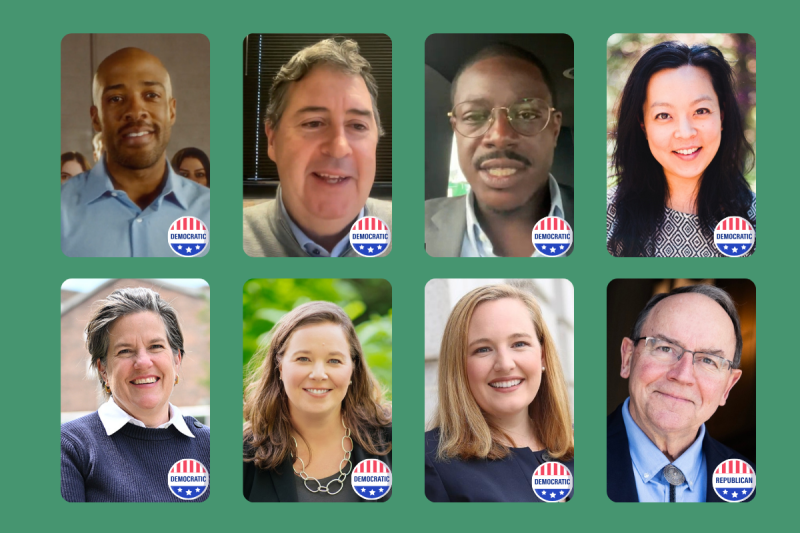
Rep. Francesca Hong, one of seven major Democratic candidates for governor, wants Wisconsin to join other states in a new tactic aimed at reducing the billions of dollars in corporate cash gushing into political campaigns: Change the definition of a corporation.
Hong’s “What Democracy Looks Like” plan, released Friday, is the latest in a series of pledges and promises by candidates who say they want to restore the power of voters and candidates who are now lavishly outspent by outside groups, many funded with corporation donations.
The US Supreme Court ruled in the 2010 Citizens United case, with all Republican-appointed justices ruling in favor and all Democratic-appopinted justices dissenting, that governments could not ban corporate and union election spending as long as they don’t donate directly to any campaigns, fueling super PACs. As a result, more than $4 billion in outside political spending took place in federal elections in 2024, nearly 12 times the amount spent in 2008, according to the campaign finance watchdog group OpenSecrets.
Since corporations can only operate in states where they are legally chartered, Hawaii and Montana are trying to enact a new approach that redefines corporations as “artificial persons” that are prohibited from spending money on political candidates or ballot issues.
“Billionaires and huge corporations hate the idea that every person gets one vote,” said Hong in announcing her reform plan, “and they’ve spent decades hunting for ways to use their wealth to buy elections and silence the rest of us. If a small group of powerful people are going to attack democracy, we need to counterattack with everything we’ve got. That’s what democracy looks like.”
Suppression vs. reform
Republicans frequently claim Americans are losing confidence in election integrity because of “improprieties” that are frequently hinted at but have never been demonstrated in court. Republican candidate for governor, US Rep. Tom Tiffany, repeated his assertion of suspected improprieties recently when he refused to answer the question of who won Wisconsin in the 2020 presidential election. The winner was President Joe Biden, with recounts, audits, and court challenges affirming it each time.
Democrats counter that any loss of confidence by voters is coming from a feeling of helplessness as their votes and their voices are drowned out by outside cash, misinformation, and attacks on voting rights. They also point to Republicans lawmakers’ refusal to allow even modest reforms such as speeding up the processing of absentee ballots without attaching major strings to those changes that would surely be vetoed by the governor.
“The modern Republican Party is based on voter suppression,” said gubernatorial candidate and state Sen. Kelda Roys in a video posted to social media after the US Supreme Court’s most recent weakening of the Voting Rights Act. “A political party tries to earn your vote. An authoritarian regime tries to control the outcome of an election, tries to put hurdles up and barriers in place.”
Lt. Gov. Sara Rodriguez, who is also running for governor, noted the irony of President Trump’s views on voting rights after a recent Florida election in an April post on X. “Trump signed an executive order restricting mail-in voting. The same Trump who voted by mail in Florida last month. The rules don’t apply to him — they never do. As governor, I’ll defend Wisconsin’s elections and protect every eligible voter’s right to cast a ballot.”
Milwaukee County Executive and candidate David Crowley pledges as governor to “protect voting rights, push for nonpartisan redistricting at every level, and strengthen the systems that ensure every voice is heard—because democracy only works when it works for all of us.”
Hong’s plan also includes a 30-day absentee voting window—something Republicans shrunk in the last decade to 13 days—as well as automatic voter registration at the Department of Motor Vehicles, and permanent absentee voting rights that would enable Wisconsin voters to be sent an absentee ballot or an application for an absentee ballot for every election unless they opt out.
Candidate Missy Hughes, a dairy industry leader, would also “deploy legal experts across targeted voting precincts to ensure that no voter is intimidated or turned away.”
Mandela Barnes, former lieutenant governor, has called in the past for a constitutional amendment to overturn Citizens United and making Election Day a national holiday, among other measures. More recently, he vowed to “use every option available” to redraw Wisconsin’s congressional boundaries — currently gerrymandered to give Republicans 80% of the state’s US House seats despite a more closely divided population.
Joel Brennan, president of the Greater Milwaukee Committee, promised a willingness to deploy state law enforcement resources—“and, if necessary, the Wisconsin National Guard—to safeguard election workers, polling places, and election infrastructure.”