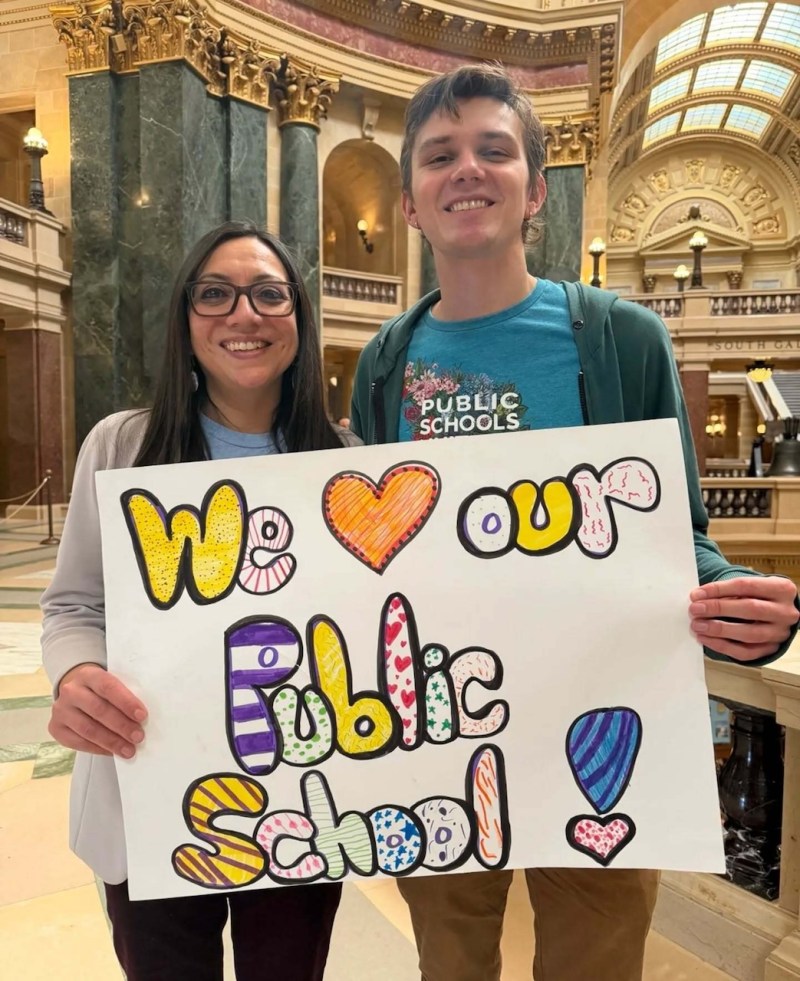
“Wisconsin residents and public schools are struggling, and they need meaningful, lasting relief,” Democratic Rep. Chrisitian Phelps of Eau Claire said.
Once a special education paraprofessional in Wisconsin public schools, Phelps believes the state deserves “pro-public leadership.”
Strengthening public schools, health, and land, plus building up the “public ability to participate in democracy” is what compelled him to run for Assembly in 2024.
To that end—for public schools— since taking office in January 2025, Phelps has introduced the Private Voucher Spending Safeguard Act, which was to “protect Wisconsin taxpayers from unlimited spending on unaccountable private voucher schools.” That bill did not pass the Republican-controlled legislature.
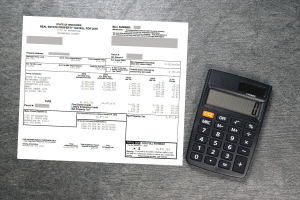
Most recently in March 2026, Phelps and Rep. Angelina Cruz (D-Racine) introduced a proposal (Assembly Bill 1176) that would direct $1.3 billion of the state’s budget surplus specifically toward public school funding and property tax relief, rather than increasing funding for private school vouchers. Voucher programs are commonly expanded alongside, or instead of, public school funding increases.
Phelps told UpNorthNews the proposal is an opportunity to save money, “compared to what we’ve been doing under Republican control for 15 years.”
“We need to stop increasing reckless public payments to private and privately operated schools—our proposal would have ensured that we remain responsible by not increasing those payments,” Phelps said.
Wisconsin taxpayers are spending more than $700 million on private school vouchers for about 60,000 students this school year. According to the Wisconsin Department of Public Instruction (DPI) the state’s four voucher programs provide payments directly to private schools—with 96% going to religious schools—amounting to $10,877 per K-8 student and $13,371 for each high school student.
Phelps said increasing funding for private school vouchers “diverts resources away from public districts.”
The Cruz-Phelps proposal was rejected by Republican leadership and Assembly Speaker Robin Vos (R-Rochester) dismissed the bill as “not serious.”
“Robin Vos has run the legislature in a very heavy-handed way as Assembly Speaker—he is all about austerity,” Phelps said. “He has been very clear that he doesn’t really believe in public investments in these public services and institutions, and he does not leave much room for leeway on his opinions—even within his own caucus.”
Republican leadership and Evers strike a school funding deal that flopped
Related: Evers-Vos surplus deal defeated as Democrats and Republicans split their votes
This week, a $1.8 billion bipartisan spending package negotiated by Democratic Gov. Tony Evers, Vos, and Senate Majority Leader Devin LeMahieu (R-Oostburg) to increase school funding and provide tax relief failed to pass the Wisconsin Senate.
“The rejected bill prioritized expensive political maneuvers that could have left Wisconsin in a $2.9 billion deficit by 2029,” said Phelps. “That is why it failed.”
“Speaker Vos, Leader LeMahieu, and Gov. Evers tried to sell a ‘property tax relief plan’ that did not go far enough in supporting working class people, would have created structural inequities in public school funding, and would have put Wisconsin in a very difficult financial position to fix our deeper economic challenges.”
The bill was defeated by a rare coalition of 15 Democrats and 3 Republicans. Phelps said it fell short on what kids need.
“It would have only invested about $600 million, which is less than half of what Assembly Democrats proposed for general and special education. This proposal also increased spending on privately operated schools, and left so little in the state’s reserves that all public services—including public education—would still be on the chopping block in the near future.”
Phelps said Wisconsinites have been clear that they want more support for their kids’ public schools and that’s why in March, Assembly Democrats, educators, and constituents were behind the Cruz-Phelps proposal “to fix the mistakes made in Republican budgets, reduce property taxes, and pick up the tab without making a massive public expenditure in an uncertain economic climate under the Trump Administration.”
Phelps said his bill continues to “sit on a shelf” even though it’s the only proposal providing structural property tax relief and sustainable public school funding.
“AB 1176 would result in much more public school funding than the deal we voted on this week, and it is $500 million cheaper,” he said. “Most importantly, it would address structural underfunding instead of relying on one-time expenditures.”
The bill’s co-author, Cruz, acknowledged public schools would likely have been grateful for a limited infusion of cash proposed by the governor and Republicans—but it was “funding that was tied to a boost in revenue for charter schools and already better-funded voucher schools.”
“Our public schools are on the precipice of collapse, so much so that they’ll be happy about crumbs,” Cruz said. “This funding may have helped districts save jobs for this coming school year, and I’m all for that—but we’re not addressing the persistent structural problem Assembly Democrats proposed to address with AB 1176 back in March.”
Phelps said he understands why so many struggling Wisconsinites and education professionals want immediate economic support. That’s why, he said, the path forward is clear. “Fund public schools, lower local property taxes, invest the surplus in a way that actually lasts—no gimmicks.”