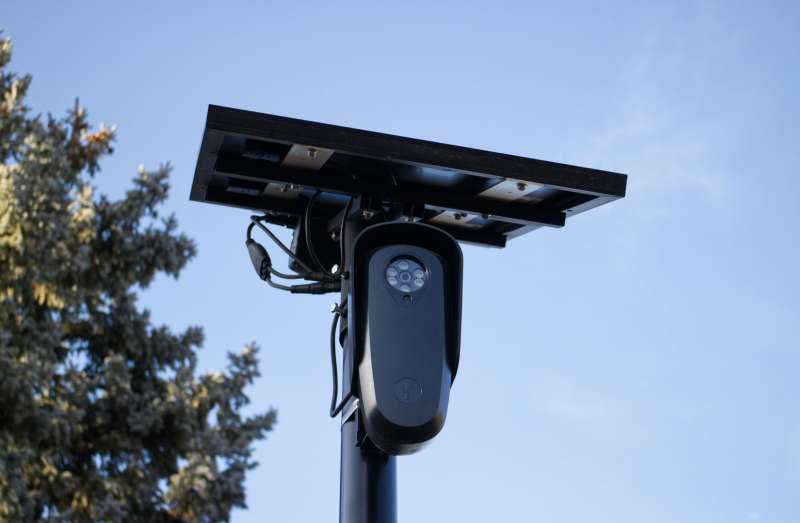
As residents across Wisconsin call on local elected leaders to cancel local contracts with the surveillance company Flock—citing concerns that police officers may misuse the data collected by the company’s AI-enhanced automatic license plate readers (LPRs)—law enforcement agencies are defending their use of the cameras.
In a Facebook post in early May, the Holmen Police Department shared details of several instances in which they claim the cameras aided their investigations. The department also said that the cameras have been a “game changer for public safety” since they were installed throughout the city in 2024, and denied claims that the technology is being used for anything else
“Flock LPRs are built to capture vehicle details. They do not collect personal information,” the Holmen Police Department wrote on Facebook, joining the increasing number of police departments across Wisconsin who say they want to keep Flock cameras in their communities.
Jon McCray Jones, a policy analyst for the ACLU of Wisconsin who has been studying the impact of Flock surveillance cameras on local communities in the Badger State, said that the Holmen Police post ignores the multiple reports of state and federal law enforcement agencies misusing the technology—from instances of Wisconsin police officers using Flock cameras to stalk romantic partners to reports of federal agencies like ICE using Flock’s searchable database to monitor immigrants, protestors, and even those in abortion-ban states who travel to seek medical care.
“These systems aren’t designed to target suspects. They’re designed to surveil and track the movement of everyone. If you can log my movement patterns and what I like to frequent on a day-to-day basis over the course of a month, you have more data about my life than if you came in with a warrant to search my home,” Jones said.
That’s why many Wisconsinites like Jones are advocating for community control over police surveillance laws that give them the power to decide if and how surveillance technologies are used in their communities. The laws are designed to open dialogue between community members and elected leaders about whether and how surveillance technology like Flock cameras is used where they live.
If elected officials and residents agree to bring surveillance technology to their communities, law enforcement would be required to regularly report on the information acquired from the surveillance software, including how it was used, its impacts on public safety, and who has access to it and for how long.
To date, at least two dozen jurisdictions around the US have passed community control over police surveillance laws, including the city of Madison. As residents continue to share their concerns, Jones said he hopes that it will create a ripple effect that helps others realize what’s at stake when surveillance systems show up in their communities.
“I think that people need to understand that our laws have constantly fallen on the wrong side of morality across multiple different issues, and surveillance technologies enforce those laws, whether they’re morally good or not.”