Lt. Gov. Sara Rodriguez’s roots are in the emergency room.
“I’ve watched patients put off care until something treatable turned into a crisis,” Rodriguez recalled. “I’ve held the hands of parents who weren’t sure if they were going to be able to afford their child’s insulin. I’ve sat with families who lost everything with just one trip to the hospital.”
Wisconsin’s 46th lieutenant governor began her healthcare career working the night shift as a registered nurse before she became a healthcare executive, a state legislator, and then the state’s second-in-command. She also served as an Epidemic Intelligence Service Officer with the Centers for Disease Control and Prevention (CDC).
Rodriguez believes healthcare is a human necessity and that no one should have to choose between medical care and basic needs. She’s worried about the ramifications of sweeping federal healthcare cuts on Wisconsin and the 1.2 million residents who depend on BadgerCare, the state’s Medicaid program.
“I’ve been to all 72 counties in the state as lieutenant governor, and the number one thing I hear in every county, red, blue, urban, suburban, rural, is they cannot afford the healthcare and they can’t get it when they need it,” Rodriguez said. “This Republican bill just made every bit of that worse.”
3 Lambeaus: The cost of federal healthcare cuts
The Republican bill she’s referencing is the Trump administration’s “One Big Beautiful Bill Act” that was passed last summer. An estimated 276,000 Wisconsinites could lose their Medicaid coverage over the next decade because of it.
Rodriguez—who’s also a Wisconsin Democratic candidate for governor—said that many people would fill Lambeau Field three times over. “Picture telling every single one of them that they’re on their own,” she said.
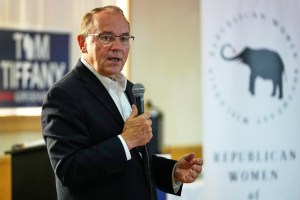
US Republican Rep. Tom Tiffany—who’s also running for Wisconsin’s top job—voted for the budget resolution that gutted Medicaid, and later voted against extending the enhanced Affordable Care Act (ACA) tax credits.
Data from the Kaiser Family Foundation shows more than 22,000 Wisconsinites who got their health insurance through the ACA marketplace have canceled their coverage since 2025. The data attributes the drop in enrollment to people being unable to pay higher premiums.
After more than 15 years of Republicans trying to gut the healthcare program that nearly 300,000 Wisconsinites rely on, Tiffany has acknowledged his party does not have an alternative plan to the Affordable Care Act.
“Tom Tiffany voted to make healthcare premiums unaffordable for working people,” said Democratic Party of Wisconsin spokesperson Emily Stuckey. “Tiffany has worked over his nearly 20-year political career to gut healthcare for working people and admitted that he has no alternative to the Affordable Care Act—if elected governor, Tiffany would continue to advance the MAGA agenda and make healthcare completely out of reach for working Wisconsinites.”
“Tom Tiffany is continuing his long history of betraying his constituents to advance his own right-wing political agenda,” said A Better Wisconsin Together Communications Director Lucy Ripp. “At a time when Wisconsin families are already facing rising costs and unaffordable healthcare options, Tiffany is voting for delayed care and higher costs.”
Protect Our Care President Brad Woodhouse said across the country, people are living with reduced access to care.
“After cutting over $1 trillion from Medicaid and the ACA to fund tax breaks for billionaires and big corporations, Trump and his allies in Congress are doubling down on their cuts to healthcare in order to fund his gold-plated ballroom, needless wars, and even more billionaire tax breaks,” Woodhouse said. “Poll after poll shows that the American people know who exactly is responsible for their skimpier coverage and sky-high premiums.”
Symptom of a failing system
Retired central Wisconsin radiologist Gillian Battino said she knows who is responsible. “This is near and dear to me, not only because of my practice and my experience serving patients, but also because my younger brother is a special needs person.”
Battino, a Democratic candidate for state Senate in central Wisconsin’s 29th District, has practiced in Wausau, Marshfield, and Madison. Her brother is a Medicaid and Medicare recipient. “To me, how we treat our most vulnerable people is a reflection of the health of our society,” Battino told UpNorthNews. “When we start to dehumanize and disrespect the most vulnerable people in our society, I think that that is a reflection of a failing system.”
“Honestly, this is the formula for healthcare system failure in rural Wisconsin.”
Several Wisconsin hospitals face a high risk of closure, service cuts, or layoffs due to Medicaid underfunding and federal budget cuts. Rodriguez said the closures matter because they threaten rural access to emergency and maternity care, increasing ambulance drive times, and local financial strain.
“Nine-hundred hospitals, nursing homes, and clinics nationwide are already closing or at risk of closing or cutting essential services because of these cuts,” Rodriguez said. “When the only hospital for 40 miles closes its doors, a heart attack becomes a death sentence.”
“A complicated birth becomes a tragedy, and that’s what’s coming, and Republicans knew that when they voted ‘yes.’”
Escalating crisis for rural hospitals
Rural and low-income communities have a higher dependence on Medicare and Medicaid than urban or wealthy areas. Because these government programs pay hospitals and doctors significantly less than private insurance, these facilities operate on thin, or non-existent, profit margins.
Lower-income populations frequently face challenges with uninsurance or underinsurance. When patients cannot pay out-of-pocket for their care, providers must write off the costs as uncompensated care, adding to local facility healthcare debts and financial shortfalls.
One of these at-risk facilities is in Tiffany’s 7th Congressional District. Advocacy group Public Citizen first listed Aspirus Stanley Hospital as having a higher risk of reductions or closure. A closure would force people to travel 30 miles to facilities in Eau Claire or Medford. However with recent hospital closures in the Chippewa Valley, the remaining centers can’t absorb the unmanageable surge of emergency and primary care patients.
“It’s ridiculous—it’s an absolute tragedy—completely irresponsible, and tone deaf to the situation,” said Battino.
“Republicans found the money for billionaires’ tax breaks,” Rodriguez said. “They couldn’t find it for a kid’s inhaler, and Wisconsinites are about to feel it the most.”
“A lot of them live in Tom Tiffany’s district in Wisconsin. He voted for it. He owns it, and from what I can tell, he does not care.”