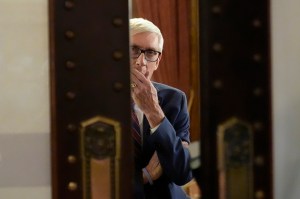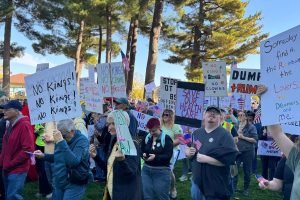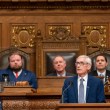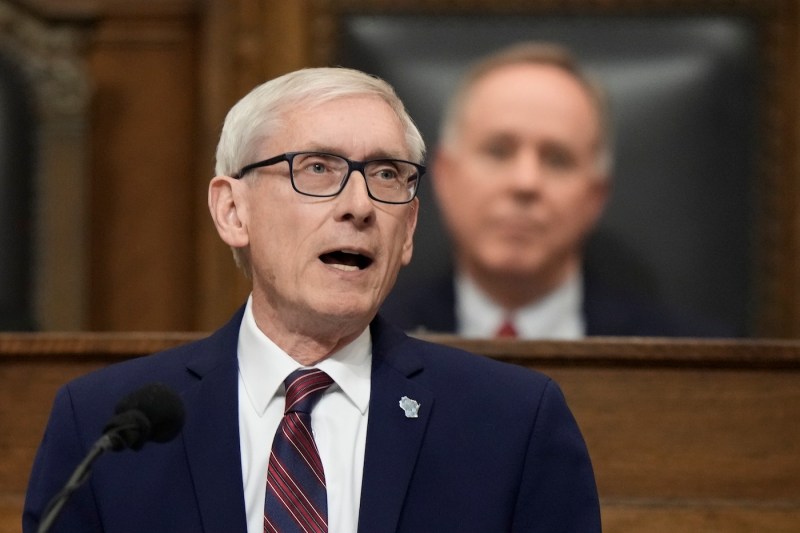
In one of the most weirdly bipartisan scenes since the smoking ban debate of 2007, party labels went out the Capitol windows as legislators ultimately rejected a deal between Wisconsin’s Democratic Gov. Tony Evers and Republican Assembly and Senate leaders that would have allocated much of a projected budget surplus for direct checks, special education, and some tax relief measures.
Democratic critics blasted the bill as short-sighted and fiscally reckless and said it would have hampered their ability to make lasting reforms to how state taxpayers fund public education. Evers and the Democrats and Republicans who supported the package blasted the critics, saying they were missing an opportunity for immediate bipartisan actions that would help struggling families and fiscally-strapped school districts.
Announced on Monday, the deal lasted little more than 48 hours—passing the Joint Finance Committee with 12 Republicans voting yes and all four Democrats voting no, passing the Assembly Wednesday night 61-23 with 10 Democrats joining all Republicans in voting yes, and then failing in the Senate 18-15 after three Republicans joined all Democrats in opposition.
“Wisconsin’s kids and schools aren’t going to get the investments they desperately need this year,” said Evers in a statement after the Senate vote, “because Tom Tiffany and a few Republican and Democratic lawmakers chose to blow up a bipartisan plan to invest in our K-12 schools, lower property taxes, and help working families afford rising costs, all because they’d rather do what’s best for the next election than what’s right for the people of our state.”
But Evers negotiated the deal without including the Democratic leaders of the Assembly and Senate.
“This reckless proposal was not something we could support,” said Sen. Dianne Hesselbein (D-Middleton), the Minority Leader. “When Democrats are in the majority, we will steer a course to a Wisconsin in which our economy works for all, where schools are sufficiently funded, and healthcare is affordable and accessible.”
“The spending proposal in front of the legislature could put the state in a very difficult financial position in future years,” said Rep. Greta Neubauer (D-Racine), Assembly Minority Leader, referencing an estimate from the Legislative Fiscal Bureau that said the state could face a structural budget deficit of $2.9 billion to start the 2027-28 budget cycle if the package had passed.
Immediate relief vs. ‘smoke and mirrors’
The plan drawn up by Evers, Assembly Speaker Robin Vos, and Senate Majority Leader Devin LeMahieu—three leaders who are all retiring after this year—would have spent $1.8 billion of a projected $2.5 billion surplus that has ballooned because more revenue is coming into state coffers compared to what was expected last year when the state budget was written.
The plan included spending $850 million on direct checks to about 3 million Wisconsin taxpayers; $300 million on one-time increased funding for special education; $328 million to permanently eliminate state income taxes on overtime; and $102 million to permanently eliminate state income taxes on tips.
The bill also called for $300 million for K-12 schools and $50 million for Wisconsin Technical College Districts, but as noted by the Fiscal Bureau, the funds “would provide property tax relief but not additional resources for school districts,” due to state-imposed revenue limits. Educators had expressed exasperation that money was being called “school aid” when it was actually property tax relief with no new dollars for cash-strapped districts due to state aid not keeping up with inflation for 16 years.
The special education funds came under fire because a $16 million portion would have been allocated for voucher and charter schools’ special needs scholarships. Voucher schools already get 90% of their special education costs reimbursed by the state.
Even the election year rebate checks were criticized by Democrats as being inadequate.
Rep. Christine Sinicki (D-Madison) called it a “smoke and mirrors” deal: “What they aren’t telling you is that 20% of Wisconsinites will not be eligible to claim this rebate, as they need to have had a tax liability in 2024. This means those who need the money the most, people on a fixed income, for example, will not receive a check, but millionaires will receive the full $300.”
Other Democrats, including many of the candidates for governor, also noted that the surplus is only a projection and it could be erased by an economic downturn.
Tiffany’s frame of a ‘turducken’
Republicans and Democrats opposed the bill for vastly different reasons. Democrats wanted more long-term relief for schools while Republicans wanted the surplus used in ways other than helping education.
US Rep. Tom Tiffany (R-Hazelhurst), the presumptive Republican nominee for governor and a former state senator, broke with Vos and LeMahieu in opposing what they had negotiated.
“I’m focused on LASTING relief, not just TEMPORARY gimmicks,” Tiffany posted to X, promising to “return all of it” if elected governor, which would leave none of the surplus for helping with education or the elimination of income taxes on tips and overtime.
If the measure had passed, Republicans would have been able to run in a challenging election cycle on a platform of having supported property tax relief labeled as school aid, and Democrats were having none of that.
“I know you’re all standing up and congratulating yourselves on giving more money to schools, and yes, that is good, but you don’t get a prize for boarding up a window that you broke in the first place,” Rep. Deb Andraca (D-Whitefish Bay) said. “This proposal is a turducken. A turkey that was put together by a bunch of lame ducks, by a Republican Legislature that is too chicken to confront the structural affordability and education issues facing this state.”