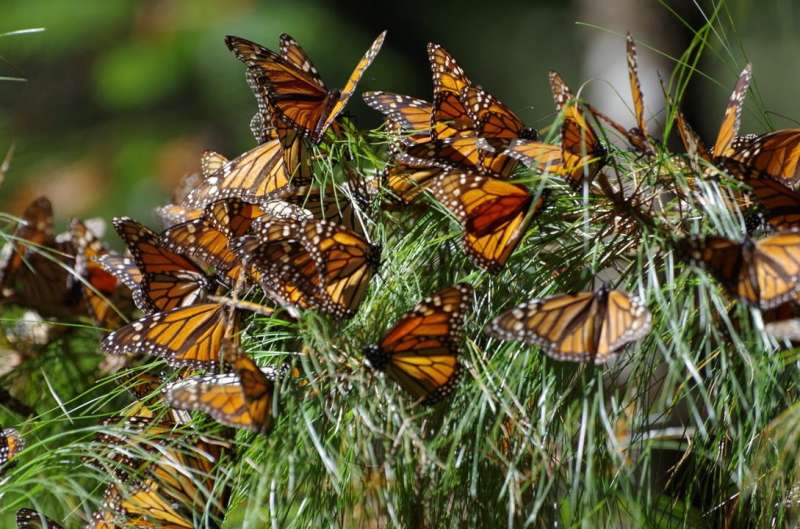
With their relatively large 3- to 4-inch wingspan and bold orange-and-black coloration, monarch butterflies are one of the most identifiable insects in Wisconsin.
Arguably one of the most popular, too.
But like many insects, monarchs have undergone a population decline in recent decades. In December 2024 the U.S. Fish and Wildlife Service announced a proposed rule to list the monarch as threatened under the Endangered Species Act. The status of the proposal, including a special species assessment, is listed as “pending” and a decision isn’t expected soon.
No matter the outcome, many conservation and environmental organizations are working to improve the future for monarchs.
Here’s some additional information about monarch butterflies.
A complex life cycle
Monarchs, like other butterflies and moths, undergo complete metamorphosis, meaning they have an egg, larva (caterpillar), pupa (chrysalis) and adult stage. The egg and caterpillar stages occur only on species of milkweed (genus Asclepias), whereas adults feed on the nectar of a variety of flowering plants.
Female monarchs lay eggs only on milkweed plants. The milkweed plant provides both food and shelter for a caterpillar for approximately two weeks while it eats almost constantly, pausing only to shed its skin. The period between each shedding of the skin, or molt, is called an instar. Monarchs have five larval instars and grow to almost 2,000 times their original mass, according to Monarch Joint Venture.
A late fifth instar monarch will generally crawl away from the milkweed plant it was feeding on to find a secure location where it forms a silk pad and hangs upside down in a J shape before shedding its skin one last time to expose the bright green chrysalis. In eight to 15 days, an adult emerges, pumps fluid to its wings to give them shape, and spends several hours drying before it is ready to venture off to find nectar or a mate.
Monarchs migrate to Mexico for winter
Monarchs are one of the relatively few insect species to migrate hundreds or even thousands of miles to its wintering habitat.
For monarchs living in Wisconsin or southern Canada, the migration is about 2,000 miles to forests in Mexico. The butterflies spend the winter in the cool but above freezing conditions before starting north in late winter or early spring.
This generation of monarchs mates and dies in the southern United States.
Monarchs have multiple generations each year
The first three generations live only two to six weeks, mating and migrating north during spring and summer.
The fourth generation is born in late summer or early fall and lives six to eight months. This generation migrates to Mexico and overwinters before beginning the flight north and starting the cycle again.
Monarch wintering population status
Monarch watchers received some good news in the winter of 2025-26 when the eastern monarch population overwintering in Mexico’s fir forests occupied 2.93 hectares, a year-over-year increase of 64%, according to a report by Mexico’s National Commission of Protected Natural Areas (CONANP) and the World Wildlife Fund (WWF).
The population is surveyed each winter as the insects cluster at their overwintering sites in central Mexico. Rather than counting individual butterflies, scientists estimate population size by measuring the total area of trees occupied by monarch clusters. Past work has found a median of 21.1 million wintering monarchs per hectare.
This winter, there were nine colonies of monarch butterflies, including five inside the Monarch Butterfly Biosphere Reserve.
However, even with the uptick this winter the eastern monarch population remains below levels considered necessary for long-term sustainability. Research suggests that at least 6 hectares of occupied overwintering habitat are needed to support a stable eastern migratory population.
How far can monarchs fly?
Monarchs in eastern North America make an annual migration to winter central Mexico.
Depending on where they originate, this trip can require the insects to fly as much as 3,000 miles.
During migration, monarchs typically fly 25 to 30 miles each day, according to Monarch Joint Venture. When weather conditions are favorable, they may be able to go farther, but poor weather conditions may also prevent them from traveling at all.
How do monarchs find milkweed?
Monarchs find milkweed using their senses of sight and smell, according to Journey North. The insects have sensory receptors on the sides of their heads, in their antennae and on their front legs. Females will “taste” milkweed with their feet before laying eggs on it. Female monarchs continuously move across the landscape in search of milkweed on which to lay their eggs.
Are monarchs toxic to other animals?
Milkweed produces glycoside toxins to deter animals from eating them, but monarchs have evolved immunity to these toxins, according to the National Wildlife Federation. As they feed, monarch caterpillars store up the toxins in their body, making them taste bad, which in turn deters predators from targeting monarchs.
The toxins remain in their system after metamorphosis, protecting them as adult butterflies as well.
What can I do to help monarchs?
One way to help monarchs is to plant native milkweed and other nectar-producing plants and to refrain from using pesticides.
The National Wildlife Federation has a Garden for Wildlife program to help participants select plants. The federation also maintains a guide called the Native Plant Finder for host plant species favored by butterflies and moths. It is searchable by zip code.
And the Wisconsin Monarch Collaborative has a Safe For Monarchs program to connect gardeners to nurseries that grow plants in ways that are safe as nectar sources for adult monarchs and host plants for monarch caterpillars.
The Safe For Monarchs logo is placed on pots of plants that are extra-good for monarchs, according to the collaborative. You might see signs or flyers near these plants too, depending on the nursery.
For more information visit wimonarchs.org/safe/.
This article originally appeared on Milwaukee Journal Sentinel: As they move north, here’s what to know about the popular monarch butterfly
Reporting by Paul A. Smith, Milwaukee Journal Sentinel / Milwaukee Journal Sentinel
USA TODAY Network via Reuters Connect