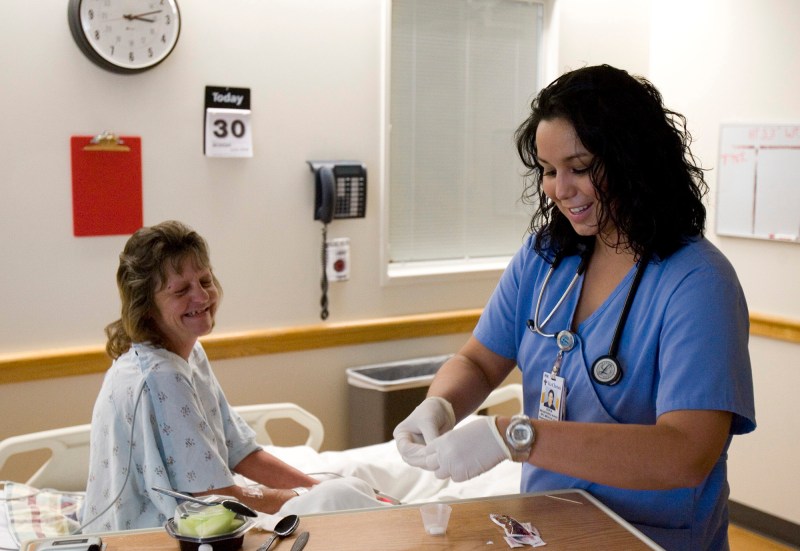
“In 2024, upon fulfilling the rigorous requirements of my nursing degree, I encountered a significant challenge,” said Pamela Rubalcava of southern Wisconsin.
Rubalcava is a graduate of Carroll University’s nursing school in Waukesha. She was, until now, legally barred from getting a nursing license in Wisconsin.
The Deferred Action for Childhood Arrivals (DACA), adopted in 2012 under President Barack Obama, provides temporary protection from deportation and work authorization to certain undocumented immigrants who were brought to the US as children. The United States is often the only country they’ve ever known—though the program does not provide recipients with legal status, a path to permanent residency, or citizenship.
Gov. Tony Evers said the program has given kids who’ve grown up here an opportunity to apply for and obtain legal work status.
“But here in Wisconsin—whether it’s restrictions on obtaining a driver’s license to operate a vehicle or certain work-related credentials—unnecessary barriers are holding hard-working people, as well as our workforce, economy, and communities, back,” he said.
Wisconsin protects more than 5,000 DACA recipients, commonly known as “Dreamers.” State law, however, bars them from state-level licenses, often resulting in them moving to other states for work.
“Despite my clinical readiness, my career was indefinitely deferred, and at that time, Wisconsin’s policy regarding professional licensure for DACA recipients created an impossible barrier for me,” Rubalcava said. “It prevented me from entering the very profession that I had dedicated so much to.”
New opportunities ahead
A new Wisconsin bipartisan law, signed by Evers in April, allows DACA recipients like Rubalcava to get state professional and occupational licenses.
Evers said Dreamers will be able to join several key areas of Wisconsin’s workforce that have a need for future workers, including registered nurses, dentists, teachers, emergency medical technicians, and trade workers, among others.
“Immigrants play a critical role in our economy and our communities in every corner of our state—and they have for generations,” said Evers. “In Wisconsin, we’ve always believed that if you work hard, obey the law, pay taxes, and play by the rules just like everyone else, you should have a fair shot at pursuing the American Dream, including having the opportunity to join our professional workforce.”
“We’re not only doing the right thing for Dreamers to help make sure they can pursue their higher education and career goals to give back to the communities that raised them, but we’re doing the right thing for our state and our economy, too, by making sure smart, talented, and capable people can join our workforce in high-need areas.”
Research shows that Dreamers’ participation in the workforce has helped to reduce unemployment rates and increase wages for all US-born workers.
The American Immigration Council points out that DACA recipients are vetted, pay taxes (estimated at more than $62 million annually in Wisconsin), and their inclusion in the workforce boosts the economy. The Center for American Progress (CAP) shows Wisconsin would lose $427 million in GDP annually without them.
Under the law, workers will still be required to have a valid, unexpired employment authorization document issued by the US Department of Homeland Security, and as long as the federal work authorization is renewed, their Wisconsin credentials may continue to be renewed.
Trump rescinded DACA
The law will only apply to DACA recipients under the original DACA program. President Donald Trump rescinded the DACA program in September 2017. The provision in the state law means that should DACA be reopened to new applicants, they would not be eligible for occupational licenses.
According to the Migration Policy Institute, as of September 2025, there were more than 505,000 active DACA recipients from close to 200 different countries of birth residing all over the US.
“President Trump can try to instill fear and sow division all he wants, but here, we know the facts,” said Evers.”Immigrants make essential contributions to our workforce and economy, enrich our communities with their culture, heritage, insights, and perspectives, and they are good neighbors.”
Rural DACA hopes
The Wisconsin Farmers Union (WFU) is praising the law signing, saying it opens more workforce opportunities for DACA recipients and addresses labor shortages in the state—especially in rural areas.
“Wisconsin Farmers Union was proud to support this bill and we applaud the governor and Legislature for working across the aisle to pass this critical piece of legislation,” said Darin Von Ruden, WFU president.
WFU Government Relations Director Michelle Ramirez-White told UpNorthNews that “members of the Wisconsin Farmers Union recognize the value and inextricable tie that immigration has to our ag industry here in Wisconsin.”
“Immigrants make up a large portion of ag labor in our state, and we want to make sure not only that we are protecting a workforce, but we are protecting the neighbors in these rural communities that we go to church with and we send our kids to school with.”
Rural Wisconsin is experiencing critical shortages of teachers and nurses, with rural districts comprising nearly three-fourths of the state’s more than 400 school districts and struggling to attract staff. High turnover and retirements mean rural schools face a projected shortage of over four teachers per school, while rural healthcare facilities struggle with a lack of nurses.
Ramirez-White is hopeful that with opening up teaching credentials for DACA holders, rural public schools will have “great teachers that every student deserves to have.”
According to a 2024 Wisconsin Department of Workforce Development (DWD) report, the state faces a projected deficit of 12,000 to 19,000 registered nurses by 2040.
“We’ve dealt with a lot of hospital shortages in rural areas of our state, specifically in the Chippewa Valley over the past few years, and there have been many instances where hospitals are underrun and don’t have enough employees,” said Ramirez-White. “Having the ability to go through the schooling to be a real estate agent or a cosmetologist, or a dentist, or a plumber, or an emergency medical technician and then not actually able to practice in our state—we were losing a lot of really valuable people that could have been helping us here in Wisconsin.”
“These people are really needed—especially in the rural areas.”