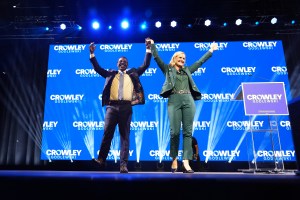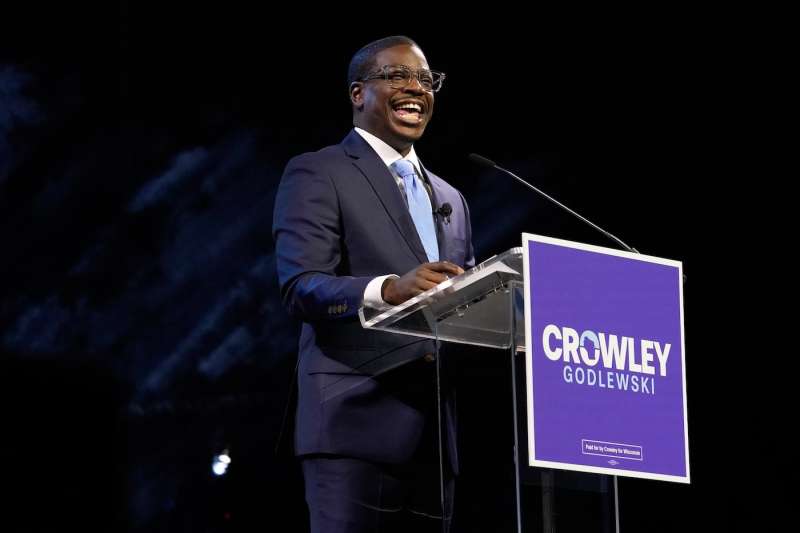
Rarely does a November rain carry the same emotional triggers as the springtime showers that signify the end of winter and the start of new growth. But something was different as the clouds opened up last Wednesday morning in Milwaukee’s Deer District — the scene of Governor-elect David Crowley’s victory party. Democrats saw the raindrops as remnants of a “blue wave,” washing out Republican incumbents, rinsing away the rhetoric of attack ads, and cleansing the capitol corridors for what they hope is a bumper crop of good governance.
It is, of course, far too early to say if this is a high-water mark for Democrats that can last. It is true that the only comparable outcome in contemporary memory was the post-Watergate 1974 wave that brought about two decades of Democratic dominance, but a more recent (and traumatic) event for progressives was the wave of 2006 and 2008 that came crashing down after the Tea Party election of 2010.
Until history records the staying power of this Democratic sweep, it may be best to look at these five ways to measure how this wave has breadth, depth, and flow.
Can Democrats harvest the low-hanging fruit?
Voters come from all parts of the ideological spectrum, but there are still issues that most can rally around — and the voter frustrations in 2026 that manifested in a Republican washout stemmed from the GOP’s inability to handle easy-to-see priorities like affordability issues, healthcare, and education. Republicans chose instead to embrace extremism and acquiescence to President Donald Trump’s war whims (both trade and military).
“Our elected leaders in Washington should be fighting for us,” said Opportunity Wisconsin Program Director Meghan Roh. “Every day we see the impact of rising costs and cuts to BadgerCare and other essential services. We’re going to make sure our representatives in Congress are held accountable for their votes. We’re calling on them to reverse cuts to Medicaid and lower prices for Wisconsinites.”
Now it’s Democrats who will be expected to pick the low-hanging fruit. Even if Democrats don’t achieve everything, they will get points for moving the ball forward on some issues, like the school funding system in Wisconsin. School districts’ increased reliance on local referendums to increase property taxes has put the spotlight on how the state’s share of school funding has consistently lagged inflation while Republicans were in charge.
“The school funding formula is broken, and it has failed our children, our schools, and entire communities for decades,” said Superintendent of Public Instruction Dr. Jill Underly. “I am hopeful we are in a position to make meaningful change to the way we fund Wisconsin public schools.”
And there are other issues that regularly see at least 70% approval in public opinion polls: eliminating partisan gerrymandering, banning stock trading by lawmakers, paid family leave, a pathway to citizenship for undocumented immigrants, universal background checks for firearms purchases. Democrats won’t have to be overtly partisan to pass state or federal measures that will have voters saying, “it’s about time.”
Will Democrats overreach?
“This is not an affirmation of the Democratic Party in any which way,” a veteran Democratic pollster working on Senate campaigns told Politico. “It is very much a rejection of Trump.”
“Don’t confuse them losing with us winning,” said another senior advisor.
The party’s long-running punchline involves a news headline that proclaims, “Democrats in disarray!” and party infighting is already well underway. There are progressives will want more than the low-hanging fruit, and it means Democrats will have to thread a political needle in 2027 — pursuing some bold changes without losing some of the independent voters who put them in the majority.
“With this trifecta, we will end decades of Republican obstruction and build great schools, help families feel financially secure and to save for retirement,” said Assembly Democratic Leader Greta Neubauer (D-Racine), who may become the first woman elected Speaker. “We will hold big tech accountable, protect our rights and freedoms, and make Wisconsin a state where everyone can thrive.”
To do that, Neubauer and Senate Democratic Leader Dianne Hesselbein (D-Middleton) will need to show voters how they’ll put a multi-billion dollar state budget surplus to work: investing in school funding reform, expanding healthcare options, protecting families from cuts made over the past two years in Washington, DC, raising the minimum wage, and putting guardrails on data center construction without looking to appear hostile to economic development.
And once Democrats create those plans, they will need to show some degree of immediate value. Otherwise, Republicans will get an early start on the 2028 campaign with a claim that Democrats overreached and spent away a $3 billion surplus, with little to show for it.
The minimum wage might be the easiest barometer for the political peanut gallery to monitor. Stuck at $7.25/hour since 2009, one national calculator says it should be $21.88 in Wisconsin to keep up with rising costs. Democrats would face loud opposition from businesses if they tried to raise it that high in a single act. Going too slow, on the other hand, triggers the opposite concern…
Will Democrats be too timid?
Democrats will be told repeatedly by activists to the left that voters didn’t choose “Republican Lite.” They want to see real progressive change and have little patience for politicians who appear to be more focused on winning reelection than on winning battles.
William Garcia, co-chair of the La Crosse County Democratic Party, told Politico that even in rural Wisconsin, hardly a hotbed of liberalism, there will be expectations.
“I think we’re going to have a great night on Nov. 3. And then all these Democrats are going to have to deliver on all of these things we’re talking about,” Garcia said. “If we get to the end of 2027 summer and we haven’t passed bills to make a substantial difference in people’s lives, that’s my biggest fear. We gotta deliver.”
It may not be timidity alone that is the issue. It could be old fashioned internal gridlock. Take the Wisconsin Parental Choice programs that offer taxpayer-subsidized vouchers for private, usually religious schools. With an annual price tag approaching $1 billion, it has public school advocates, nearly all of them on the political left, calling for it to be ended immediately but there are Democrats — including Crowley — who say an abrupt shutdown would overwhelm the Milwaukee Public Schools district. If the standoff leads to no change, voucher opponents will howl at the new majority’s lack of action.
Campaign finance reform is another danger spot in the legislative minefield. After another cycle of record spending, progressives are adamant that Democrats do something to reduce the influence of campaign cash from corporations and billionaires. If there is no change or a change that seems designed to not upset the largest liberal donors, Democrats will again hear from critics who claim there is little difference between the two parties.
Will Democrats build a strong case for 2028?
Once Democrats have results to share, they will need to communicate that — forcefully. Party faithful still harbor a grudge that the Biden-then-Harris campaigns in 2024 were confusingly low-key about trumpeting their many accomplishments in economic recovery, job creation, pandemic response, technology investments, and consumer protection.
The 2028 campaign in Wisconsin will be dominated by a presidential election and a US Senate race—with or without Sen. Ron Johnson, whose third term will be expiring. Democrats will have a short window to impress voters before the larger races use up most of the political oxygen of the moment.
Will Republicans learn to co-govern?
In 2010, Sen. Mitch McConnell (R-KY) was famous for spelling out the Republican agenda in a single plank: Deny President Barack Obama a second term. It’s a strategy that didn’t work because voters didn’t want a party rooted in obstruction; they want alternative ideas.
During Gov. Tony Evers’ two terms, Republicans in the Wisconsin Legislature showed they had not learned the lesson. They refused to engage in bipartisan compromises rather than give Gov. Tony Evers a “win” on certain issues. They refused to consider every bill authored by minority Democrats, even though Democrats regularly processed Republican bills when they were in charge.
And the GOP-controlled Congress in Trump’s second term chose to shut down and go home multiple times rather than take up matters where Democrats and a handful of moderate Republicans could have taken action on matters like releasing the Epstein files or pursuing impeachment for Defense Secretary Pete Hegseth.
Republicans are now in such a small minority that their votes aren’t needed by Democrats in many legislative chambers. They will have to decide if they want to be solely an opposition party or if they are ready to trade in obstruction and arrogance for opportunities to have input and even partial credit on some pieces of legislation.
One barometer will be whether Republicans will label all new Democratic initiatives as “too expensive.” It’s a line that lost a lot of its effectiveness when Republicans demonstrated no deficit concerns about giant corporate tax cuts, massive healthcare cuts, and paying for another war in the Mideast. Somewhere along the way, Republicans equated fiscal conservatism with refusing to fund vital services. Their path back to electoral success will involve showing a more mature approach to financial stewardship that recognizes waste can come from overspending on the very rich as well as overspending on anything else that isn’t truly necessary.
Like it or not, talk has already begun about 2028 and the conversation will eventually center on whether Democrats delivered on their 2026 promises in 2027. If they don’t, it won’t matter if it was because of GOP obstruction or the much joked-about “Democratic circular firing squad.” Democrats need to move beyond talk and right into action or they will have poured all of that effort into building a blue wave that went right down the drain.