Reporting by Ricardo Torres, Milwaukee Journal Sentinel / Milwaukee Journal Sentinel
STURTEVANT – Just before 11:30 p.m. on election night, Republican Congressman Bryan Steil walked to the stage at Route 20 accompanied only by his wife, Kaley, to give his concession speech.
A few dozen people were still in the restaurant.
After the polls closed the place was packed, but for roughly 90 minutes leading up to the speech, Republicans slowly exited the restaurant as results came in.
It seemed that they did not want to witness to the end of the Republican Party’s 30-year hold on Wisconsin’s 1st Congressional District.
Republicans had held the seat through other Democratic waves like in 2006, which was led by opposition to the Iraq War; in 2008 when electing President Barack Obama; in 2018 when the nation rebuked President Donald Trump in his first term and voted him out of office in 2020.
Republican Paul Ryan held the seat for 20 years and during that time nearly became vice president in 2012 and rose to be speaker of the House from 2015 to 2019, before deciding not to run for re-election. Ryan campaigned with Steil in 2018, helping him win and keep the district in Republican hands.
Standing on the stage at Route 20, Steil’s speech lasted just 2 minutes.
Afterward, campaign staffers and volunteers sipped beers at the bar, talked quietly among themselves almost in total shock and bewilderment at the wave that crashed upon them.
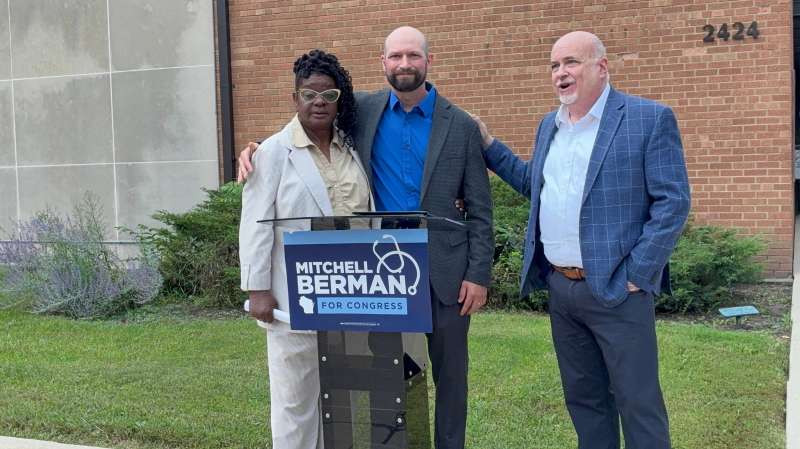
This was a once in a 50-year national political wave that helped deliver the election upset and boost Democrat Mitchell Berman to victory.
Or to put it on a local level, Berman won every ward in Janesville – Steil’s hometown.
Ryan also claims Janesville as his hometown. The last time Ryan was on the ballot, 2016, he won every ward in the city except two.
“Flipping the 1st Congressional District was my big shock on election night,” said Devin Remiker, chairman of the Democratic Party of Wisconsin. “I’d been telling people literally for months that I thought the 1st Congressional District was likely to be the sleeper race in Wisconsin.”
A campaign spokesman said, “Rep. Steil ran a strong reelection campaign against historic national headwinds.”
“Over the last year, Steil attended hundreds of public events, including church festivals, parades and veterans’ ceremonies. Steil outperformed other Republicans on the ticket nationally and locally,” the spokesman said.
Officials with the Republican Party of Wisconsin did not respond to request for comment.
Steil campaign had huge fundraising advantage
In the 1st District, the Democratic wave came from a perfect storm that was a mix of candidate quality, voter sentiment toward the party in power, and organizers continuously working every two years for 15 cycles.
And to say Berman’s campaign was lean would be an understatement. Supporters and the county party organizations had to buy their own “Mitchell Berman for Congress” signs.
From a fundraising standpoint, the Berman campaign was at a major disadvantage.
Since being elected in 2018, Steil had built up a huge war chest between his committees Steil for Wisconsin and Steil Victory Fund which, together, raised more than $8.5 million this election cycle, according to the most recent Federal Elections Commission records.
The Berman campaign raised less than $2 million, nearly $350,000 less than what Democrat Peter Barca raised in 2024 in his campaign against Steil.
One thing Berman had going for his campaign was the new congressional boundaries, which included parts of southern Milwaukee County and took out parts of Waukesha County.
The new maps were drawn to make the district more competitive, but it was not a guarantee that Berman would win. Steil won in 2022 and 2024 under the same map.
The Berman campaign needed to win over voters.
In the 2022 midterm election in Kenosha County, Steil received nearly 35,700 votes vs. Democrat Ann Roe, who received nearly 29,600. Fast forward four years in Kenosha County, Berman received 33,913 votes to Steil’s 32,315.
A similar story unfolded in Rock County, where Berman defeated Steil by more than 9,000 votes. Just four years earlier, Steil won Rock County by more than 4,200 votes.
Even in southern Milwaukee County, Steil won in 2022 by more than 4,300 votes but in 2024, Berman won by 6,600 votes.
Late primary put Berman at disadvantage
Democrat voters didn’t seem enthusiastic for the Aug. 11 Democratic primary election.
Berman won easily but Milwaukee Common Council member Peter Burgelis, who dropped out of the race in early July, came in second.
The general election seemed to be setting up for another Steil victory.
“With a primary, a lot of people don’t get involved,” Democratic Congressman Mark Pocan said. “The race became a full-on sprint after Aug. 11. That doesn’t give you a lot of time to put it all together.”
Pocan, who represents the 2nd District that includes the Madison area, is not a stranger to the district, having been born in Kenosha, and he’s stumped for Democratic candidates for the last several election cycles.
The national polling suggested a wave was coming, but the feeling was Republicans would still hold the district.
“The Republican spin was ‘Well, instead of winning by 10, he’ll win by 3 or 4.’ And people kind of fell for it,” Pocan said. “I made many calls with Mitchell, and a lot of people assumed Steil would win again.”
But even at the national level, Pocan said it was difficult to convince the Democratic Congressional Campaign Committee that this race was in play “until we had polling.”
“A lot of people thought that this was a little bit further down the list of what was reachable,” Pocan said. “Then when they started putting money in and did a poll, they’re like ‘Woah. This is a race.’”
An Aug. 12 memo from the firm Impact Research showed Steil had a one-point advantage on Berman. Then an internal poll from the DCCC in September showed the race virtually tied.
Steil’s positions may have hurt his chances
While in office, Steil rarely had a quote that made a headline or was a topic on cable news.
“He’s a nice guy, that kind of carried him through,” Pocan said.
But after winning in 2024, Steil began to introduce legislation on preventing members of Congress from buying and trading stock that Democrats termed weak and introducing federal voter identification requirements.
“He put out a bill that does not stop members of Congress from buying stock. In fact, it still says you can own stock as a member of Congress. You can still buy stock with dividends as a member of Congress,” Pocan said at a Berman campaign event in September.
Steil was also receiving thousands of dollars in campaign contributions from the cryptocurrency industry while a member of the House Finance Committee and the chairman of the subcommittee Digital Assets, Financial Technology, and Artificial Intelligence, which discusses crypto legislation.
“People started to connect this idea that accepting big money for your campaign and how you vote and the fact that he was the head of the cryptocurrency subcommittee and kind of looked the other way … turns people off,” Pocan said.
Steil was also unable to separate himself from the Trump administration and national Republican politics.
Berman in-person events were key
Both campaigns did in-person events to try to rile up the base to get voters excited to go to the polls.
But the Berman team and Democrats felt that Steil wasn’t doing enough in-person events that could sway independent voters.
Max Winkels, chairman of the Kenosha County Democratic Party, said he interpreted the events that Steil was doing as “for show.”
“It’s great that Bryan went to the county fair, and I saw one where he was hanging around with students at [University of Wisconsin] Whitewater,” Winkels said. “That’s all well and good, and that’s something he should probably do, but he really failed to engage, I think, on the key issues that most voters were concerned about.”
The Steil campaign has pushed back on Democrats claim he didn’t do many events saying his campaign was aggressive and he participated in 120 events both in his capacity as a congressman and as the candidate.
Steil also appeared with Trump administration officials such as Veterans Affairs Secretary Doug Collins in May; visited WPC Technologies in Oak Creek with Kelly Loeffler, the administrator of the Small Business Administration; and Scott Turner, the secretary of Housing and Urban Development.
But appearing with Trump officials ultimately was not a move that contributed to winning.
“Bryan was stuck with the policies of the national GOP. He couldn’t go out there and say ‘Hey the economy is bad and we’re going to try to fix it,’” Winkels said. “Bryan didn’t have that latitude because he’s tied to Trump … and for whatever reason he couldn’t bring himself to distinguish himself from those unpopular positions.”
During the only debate between the two candidates, Steil said the cost of living is too high “but we’ve made progress by reducing taxes.”
In areas where he separated himself from Trump, Steil said during the debate he disagreed with Trump during his first term on removing sanctions for Russian oligarchs and he opposed reducing funding for the National Institute of Health.
In his closing debate arguments, Steil connected himself to the Trump administration policies he said were working.
“We need to continue our work to reduce the cost of living. Build on the success that we’ve had in reducing taxes for hardworking families right here in Wisconsin,” Steil said. “Build on the success of expanding the child tax credit, no tax on Social Security, no tax on overtime.”
Remiker said Berman put in the work to talk to voters months before the election was on their minds.
“I saw Mitchell working at events for basically almost an entire year when not as many folks were paying attention to this race, when there wasn’t as much focus as we saw in say our statewide gubernatorial primary,” Remiker said. “He grinded it out with humility but also with dedication to doing the work.”
On the campaign trail, Berman talked about working for the Department of Veterans Affairs as a nurse and leaving the job when an email from the newly formed Department of Government Efficiency asked what he did the prior week to justify his employment.
The email was a trigger of sorts for Berman, who was able to tell a relatable story of how government was impacting people daily.
Berman showed had an ability to relate to people on a personal level.
At a town hall event in Cudahy on Oct. 28, Berman was asked about what he would do to ensure access to fertility treatment when he said he and his wife, Jillian, “struggled quite a bit very early on in pregnancies, had multiple losses.”
Berman said they were seeing an OB-GYN in Illinois during the Democratic primary when they got the news that they embryo transfer that they thought was a normal pregnancy turned into a nonviable pregnancy.
“We found out we lost our last viable pregnancy and we had to have a conversation with our doctor about where we were going to get the medication that we needed to prevent my wife from potentially developing sepsis and having a risky situation arise that could risk her life,” Berman said. “Because [the doctor] said ‘sometimes my patients have had problems getting this medication in Wisconsin. But in Illinois I know that you can get it.’”
Berman said it was a difficult and emotional discussion with his wife on if they should get the medication Illinois or risk being rejected by a pharmacy in Wisconsin that chooses not to provide what she needs.
“That is a conversation that should never have to happen,” Berman said to the crowd.
‘Worth the fight’
Pleasant Prairie resident Kurt Pearl knocked on roughly 1,300 doors for the Kenosha County Democratic Party, leading up to the election.
“It was definitely an uphill battle, and I knew that and most of the people I work with knew that,” Pearl said. “It was definitely worth the fight to try to flip things, and I thought there was definitely a possibility that it could happen.”
Pearl describes himself as a “center Democrat” with some conservative beliefs.
And while he is happy with the result, he knows that Democrats like Berman can lose in two years.
“Now the tough work starts. They actually need to make things more affordable for everybody,” Pearl said. “I think this victory is mostly against the current administration … the Democrats, they need to prove themselves after this. I hope they focus strictly on affordability.”
This article originally appeared on Milwaukee Journal Sentinel: How Wisconsin Democrats flipped a seat Republicans held for 30 years
USA TODAY Network via Reuters Connect