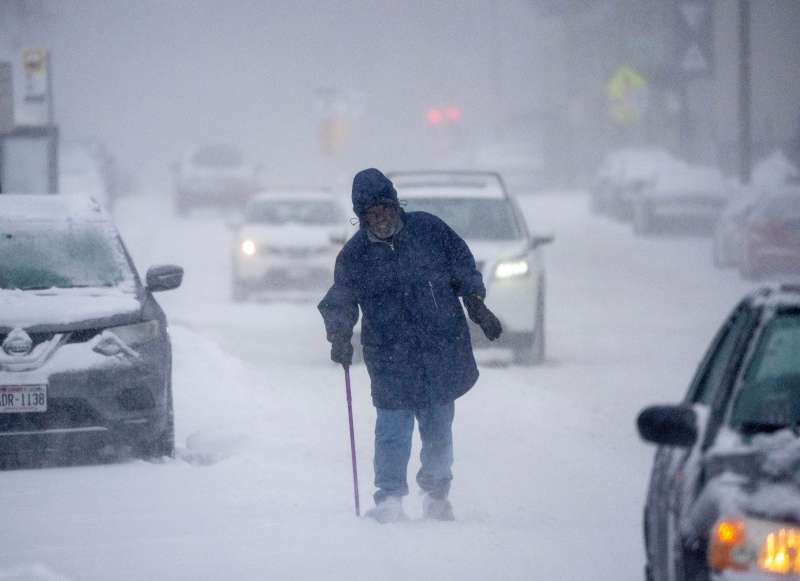
Reporting by Blaise Mesa, Milwaukee Journal Sentinel / Milwaukee Journal Sentinel
There’s a high likelihood Wisconsin gets hit with a very strong El Niño. An analysis of past El Niño winters found that those years had less snow and dozens of days with warmer-than-average temperatures. It will still get cold, but it shouldn’t be as cold as often.
That seems to suggest that heating bills will drop this year. But that’s not necessarily the case, said Mark Wolfe, executive director of the National Energy Assistance Directors Association.
“We’re just in year after year of these rapidly rising prices,” he said. “Even if you are using less of it, you’re using less of a more expensive product.”
However, some households should be spared rising costs.
The National Energy Assistance Directors Association estimated that heating costs will rise 7% nationwide. But the total rise in costs depends on what type of fuel is used to heat the home.
The association said natural gas users won’t see an increase in winter heating costs. They paid $686 to heat their homes last winter and will pay $686 to heat their homes this winter. The largest increase is in homes using heating oil. They paid $1,749 to heat homes last winter and will pay $2,977 to heat their homes this winter – that’s a 70.2% increase.
The wars in Iran and Ukraine are to thank for that.
But Wolfe said heating oil is used by only a small percentage of people. That type of fuel is more common in the northeast in states like Maine where heating oil is used in half of homes.
Electricity heating costs are up 6% and propane is up 5%.
Electricity costs have been rising steadily for years, Wolfe said. Data centers are partially to blame for the increasing cost. And Wisconsin has its fair share of data centers. But Wolfe said modernizing the electric grid is also driving up costs for residents.
These increasing costs will offset the reduced use of energy.
Which Midwest states pay the most in heating costs, according to MoneyGeek?
Finance website MoneyGeek is also projecting a rise in costs. MoneyGeek broke its numbers down by month rather than season, and it had the Midwest being hit the hardest by rising heating costs.
Wisconsinites pay about $81 a month for heating bills in 2026, MoneyGeek said. That ranks eighth out of 12 Midwest states. Wisconsin also ranked 27th in the nation for monthly cost.
Wisconsin has the eighth-highest increase in heating costs, with Wisconsinites paying $4 more a month. Michigan and Missouri lead the way, paying $8 more each month. Other monthly prices include:
- Michigan – $143
- Missouri – $140
- Ohio – $120
- Illinois – $110
- Kansas – $102
- Indiana – $84
- Minnesota – $84
- Wisconsin – $81
- Nebraska – $77
- Iowa – $62
- North Dakota – $60
- South Dakota – $46
I can’t pay my utility bill, what should I do?
Wolfe noted that Wisconsin does have strong utility assistance programs, but he said residents would likely have to bear some responsibility for lowering their bills. The average Joe can’t end the wars overseas and can’t stop data centers from popping up, so letting the house get colder is one of their strongest cost-cutting options.
“For families reading this and going, ‘I don’t think I can pay these bills,’” Wolfe said, “(Utility assistance programs are) another sort of thing they can use.”
Those programs may say low-income assistance, but Wolfe said it covers moderate-income families, too, including households that make 60% of Wisconsin’s median income.
For Wolfe, this winter is a sign that it’s time to shift to renewable energy. Those prices are far less variable than fossil fuels.
“The volatility is real,” he said. “Prices are showing an upward trajectory right now.”
This article originally appeared on Milwaukee Journal Sentinel: A warmer Wisconsin winter could still mean a costlier heating bill. Here’s why
USA TODAY Network via Reuters Connect