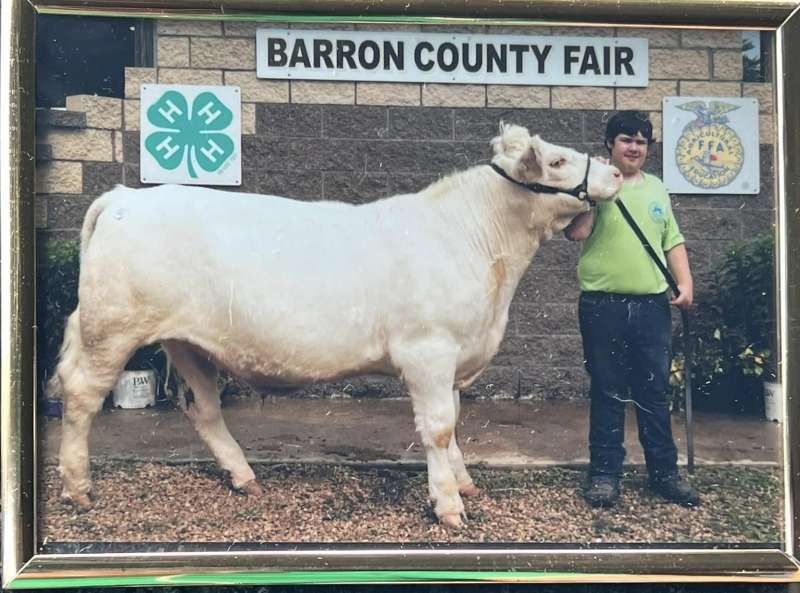
Auction day at a county fair in Wisconsin is an emotional, bittersweet experience that means parting ways with an animal you know and trust. Just ask AJ Kangas.
“I’ve had plenty of times where I’ve walked my son’s steers onto those trailers and had tears going down my face—you grow a bond with these animals and when they leave the farm, it’s hard,” the Barron County beef farmer told UpNorthNews.
For the Kangas family and others like them in rural Wisconsin, shedding tears after selling a market beef animal is a sign of respect and reflection for the care they invested and the cycle of agriculture they completed.
While the five Kangas kids at Go Broke Farms, ranging in age from 5 to 16, are taught through their own farm, 4-H, and FFA that market livestock are raised for food, they take pride in knowing they provided their animal with a humane, high-quality life. They understand the food chain—each buyer of their animals is feeding their own family.
“I wouldn’t change it for anything—having our kids grow up knowing where their food comes from,” Kangas said.
Nearly all Wisconsin beef farms have fewer than 50 head of cattle. Kangas has 43 in Dallas, near Chetek. This small size lets farmers notice changes in eating habits or spot early signs of sickness right away. Kangas watches his small herd closely, which differs from large corporate operations that manage thousands of animals in industrial feedlots.
“I know where my meat comes from,” Kangas said. “I know how my animals are taken care of; I know how they’re fed.”
“Most consumers don’t and it frustrates me because a lot of people don’t understand that [a] one-pound package of ground beef that they’re buying at the store probably has 30 or 40 animals in it. A one-pound package of ground beef from us—I can probably tell you the name of that animal that it came from.”
Beef prices are not getting better
President Donald Trump recently enacted his plan to import up to 300,000 tons of beef into the US in 90 days, mandating that the meat be sold at 25% below the current market value to lower record-high grocery prices.
Early data shows that the spike in beef imports has not lowered consumer costs, and some agricultural economists agree that the policy is unlikely to provide meaningful relief at the grocery counter.
Brenda Boetel, a professor of agricultural economics at the University of Wisconsin-River Falls and a UW-Extension commodity marketing specialist,
told UpNorthNews the type of beef that’s coming in may be going to the food service industry—places like school lunch programs or fast food restaurants.
“I don’t know how we’re going to see ways he can definitively state that there’s 25% lower beef prices—because basically that’s just going to get mixed with other beef,” Boetel said.
A recent analysis by the American Farm Bureau Federation (AFBF) tracking 41 major grocery stores across 22 states revealed that ground beef prices remained entirely unchanged at roughly 75% of tracked retailers in the weeks after the imported beef began arriving on September 1.
Imports ‘undermine’ WI beef producers
The National Cattlemen’s Beef Association and local organizations like the Wisconsin Farm Bureau and Wisconsin Farmer’s Union said flooding the market with cheap foreign beef undercuts American producers. They contend it disincentivizes long-term herd rebuilding.
Wisconsin Farmers Union President Darin Von Ruden said the imports could undermine beef producers while doing little to address the consolidation and lack of competition driving problems in the beef marketplace.
“Families are frustrated by high grocery prices, and farmers understand that frustration because our costs have gone up, too,” Von Ruden said. “But increasing beef imports sidesteps a bigger question: Why is there such a wide gap between what consumers pay for beef and what makes its way back to the farm?”
The spike in price is driven by a shortage of domestic cattle. Prolonged droughts in major ranching states and skyrocketing feed costs have forced US ranchers to cull their herds over several years. As a result, the national cattle herd shrank to its lowest level in more than 60 years, resulting in an inadequate domestic supply of lean beef trimmings to meet consumer demand.
“Where we are in the cycle for the US herd industry is not going to be solved in 90 days—we can’t grow that herd in that short of a period of time,” Boetel said. “It’s going to take a couple of years before we have that capacity, to be able to grow.”
Kangas said the import plan “infuriated” him and wasn’t thought out. “How is that going to increase the cattle herd over 90 days?” Kangas asked. ”It takes at least three years—if not four—to get from the time a calf is born, to grow that up to a breeding weight, then you’re looking at another nine months before you get a calf out of that animal.”
The Wisconsin Cattlemen’s Association said Trump’s decision cuts directly into local farmers’ bottom lines—sometimes knocking nearly a dollar off per pound on a 1,400-pound steer.
Boetel and Kangas said the short-term import plan ignores the increased input costs of fertilizer, diesel and corn prices—and could run the risk of prolonging the time needed to grow the herd up from the record-low levels.
“People don’t realize what it takes to run a farm,” Kangas said. “They don’t realize the input costs.”
“A lot of people think, ‘You have an animal, you feed it, and it grows up and you butcher it.’ There’s a lot more to it than that—the fencing, the feed cost, the insurance cost, the fuel costs. We’ve got to take all of that into consideration when figuring out what to do with our animals.”
Going into winter after a drought, beef farmers like Kangas have to decide if the high cost of hay will be worth the final sale price of their beef. The imports are making that risk higher.
“This is at the prime time when those farmers are trying to decide whether or not they should keep these animals and pay the cost to overwinter them,” Boetel explained.
Keeping cattle through the winter requires a heavy investment in feed and health management, while selling early might mean accepting lower seasonal prices. Selling in the spring means gambling that market prices will rise enough to offset the substantial winter input costs.
“The frustration I hear is the way it is being presented as if this is something that is supposed to be helpful for the cattle producer—it’s not,” Boetel said. “This isn’t bringing in beef from this other country—even though we already import beef—but bringing in this much additional beef at this time of year to create this volatility in the market doesn’t help the cattle producer make those decisions.”
Kangas said he and other producers are trying to keep small farms alive long enough for the next generation. “It’s about whether there will still be an American cattle industry here for our kids to inherit,” he said. “This is how we pay our utility bills, put food on our tables, pay our insurance, put clothes on our families’ backs, and shoes on our feet— bottom line—this is how we make a living.”
Keeping family farms in business
Though it represents a niche impact on the national total beef inventory, buying directly from small beef farmers in Wisconsin helps improve their financial viability, which can encourage them to maintain or modestly expand their herds.
“I think that’s the biggest thing—getting consumers to realize that if they make that shift—even a 50% shift from buying their stuff from a big box store to buying directly off the farm, I think you’re going to see farmers increase their herds,” Kangas concluded.
Within the last several weeks, Kangas has started an online retail store that he said has taken off quickly.
“We have people contacting us from Oregon to Maine, from Minnesota to Texas—wanting to know how to get our product, because unfortunately, there are a lot of people that don’t have access to the rural farm that offers the cuts.”
Kangas said he’ll continue to look for candidates who don’t threaten the career his family loves.
“I didn’t vote for this,” Kangas said. “I would have never voted for anyone that would hurt the agriculture industry because ultimately that’s going to hurt the entire country—that’s where our food comes from for everyone.”
READ MORE: Another challenge for WI beef farmers