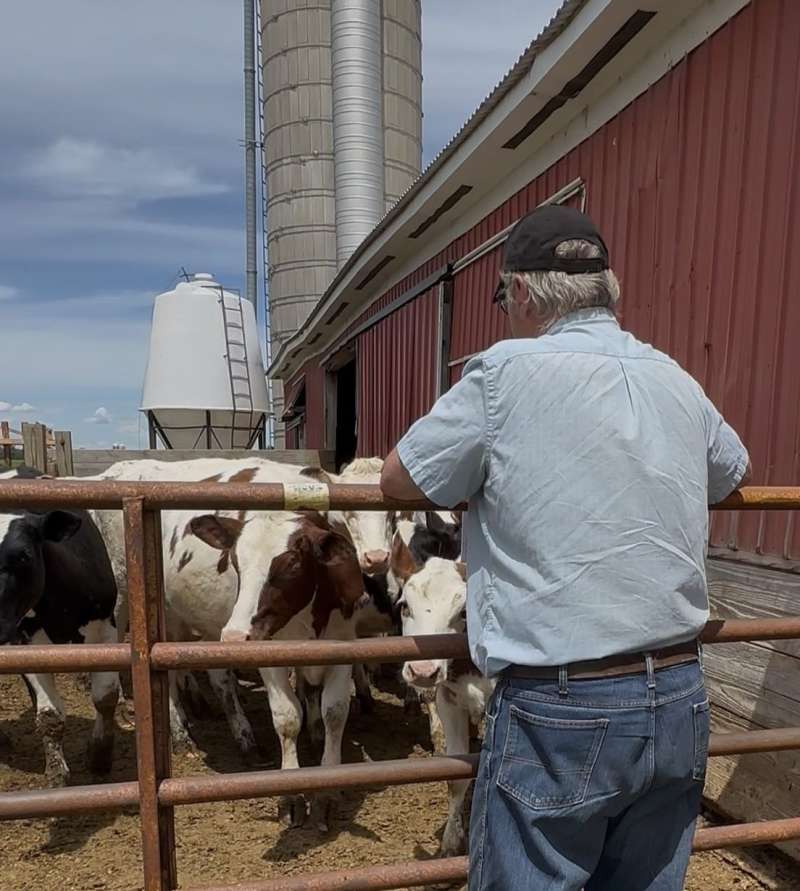
“I’m concerned about what’s happening in agriculture and I’m concerned about what’s happening in the farming community,” said Chippewa County farmer George Polzin. “I’m concerned about what’s happening in our rural communities.”
Polzin has been farming his whole life near Cadott, but today, the very community that sustained him is disappearing.
“I live in a ghost town—literally,” Polzin said. “We used to have three machinery dealerships, four car dealerships, two or three grocery stores, and three hardware stores.”
“Now we have none of that. We used to have three doctors. Now we have none. That’s what’s happening to rural America.”
A fourth-generation dairy farmer, Polzin operates his family’s Century Farm, a Chippewa County fixture where he earned acclaim for his expertise in dairy genetics and sustainable practices. But none of his experience can buffer the loss of community identity and economic devastation.
Wisconsin dairy farms hit a historic low
“For the first time in history, we are under 5,000 dairy farms in the state of Wisconsin,” Polzin lamented.
According to its February 2026 Farms and Land in Farms report, the US Department of Agriculture (USDA) estimated that the United States lost 15,000 farms in 2025. That year, Trump returned to office, imposed sweeping tariffs in April, and set off a trade war that led China to stop buying US soybeans for months.
The official number of licensed dairy herds in Wisconsin slipped to 4,991.
“The family farms that used the breeding stock that we had are gone,” said Polzin. “I am very concerned about the extent we are losing a whole generation of family farms.”
“It’s virtually impossible for a young person to take over a farm.”
READ MORE: “This is how we make a living”: Wisconsin beef farmers grapple with rising beef imports
Local farmers and agriculture experts point out that the losses reflect disrupted trade relationships from tariffs, global trade wars, rising operational and input costs, and reductions in federal support.
Harvesting on fumes
Harvest is supposed to be the culmination of a year of grueling labor—a time of pride and reward. Instead, it has been transformed into a period of financial worry.
“It costs $6 a minute to run your chopper—which would be about the cost of a Starbucks coffee every minute,” Polzin explained. “Everybody thinks, ‘a cup of coffee a day or whatever’—no—it’s a cup of coffee a minute.”
“And that’s just the chopper—that’s not the wagons and blowers and everything else that comes along with it.”
Hiked diesel prices—climbing past $6.50 a gallon due to the war in Iran and Russia’s invasion of Ukraine—are hitting multi-generation families right during the fall harvest, the most high-stakes season of the year, said Cyndi Greening, Chippewa Valley Indivisible Group Leader.
“Farmers feed all of us, and right now they’re being bled at the pump during the one stretch of the year they can’t skip,” said Greening. “Farmers didn’t vote for a war or a trade fight.”
“Their representatives did, and the billionaires bankrolling those campaigns are doing fine. We’re standing with the people who put food on our tables, and we’re naming the votes that put this bill in their laps.”
Wisconsin dairy farms caught in a war and a trade fight
Greening points to federal policy as a key driver of the challenges facing local producers. She connects the ongoing economic pressures directly to the legislative voting records and policy decisions of US Representatives Derrick Van Orden (R-Prairie du Chien) and Tom Tiffany (R-Hazelhurst). So does Van Orden’s Democratic challenger for the 3rd Congressional District, Rebecca Cooke.
“I think what’s frustrating for a lot of folks and especially for people that voted for this administration—Trump campaigned on no more foreign forever wars and an America first agenda,” Cooke told UpNorthNews. “This is exactly the opposite of what farmers and what a lot of people in rural communities thought they were voting for.”
Van Orden voted against War Powers Resolutions aimed at limiting military action involving Iran, a conflict that critics say is the reason for spikes in global crude oil and fuel prices.
High diesel and energy prices also directly increase daily operating expenses for tractors, combines, grain dryers, and delivery trucks.
“You have a really tight window of opportunity to do things—you can’t say, ‘Well the price of fuel is pretty high right now—I’ll wait til next week to harvest,’” Polzin said. “When it’s time to farm, it’s time to farm—regardless of what the prices are.”
Cooke said if she’s elected to represent the district, she’ll take on the issues that have been plaguing rural America for decades and work to undo Trump administration policies that she believes are making those problems worse.
“There’s a lot of fingerpointing about who did this and it’s certainly right squarely at Republicans who have the House, the Senate, and the White House,” said Cooke. “But we have to offer solutions—and some of my solutions—first is ending the war in Iran.”
“I think we can do that right away if Democrats are able to win back the House. It would bring costs down in a very big way. I think we’ve got to have a farm bill that caters toward small and midsize ag and not these big agricultural conglomerates.”
When farming doesn’t add up anymore
When a lifelong farmer says costs have escalated “beyond belief,” it means the fundamental math that has sustained American agriculture for generations is breaking down.
“Beyond what I ever would have imagined,” Polzin said. “This will be—without a doubt—the most expensive crop that I have ever put in the ground, and it will be the most expensive crop that I have ever harvested.”
As Polzin’s voice illustrates the emotional toll, he warns that the “Golden Era” of the American family farm is facing an existential threat because the modern cost of simply producing food has outpaced what a small independent business can afford to risk.
“A lot of farmers are just worried about how they’re going to make it through the end of the year—they’re looking at, ‘How am I going to make this work for our family,’” Cooke said. “You can’t budget these things.”
Polzin has made a tough decision to retire, made even heavier by worries for the future of small family farms left behind.
“It’s very hard for those of us who grew up in this business to see that change happening and to drive up and down the road and half the barns you drive by are just standing there empty,” said Polzin.
“The current policies that are being put out are not in favor of agriculture,” Polzin told UpNorthNews. “What we’re doing is not sustainable.”