Wisconsin is in the waning days of the Evers administration and possibly the waning days of Republican dominance of the Legislature. It may also mark the end of a partisan strategy of taking bills Gov. Tony Evers would veto and turning them instead into constitutional referendums.
Since Evers’ 2018 election, GOP lawmakers have put nine constitutional amendments in front of voters and seven of those changes were approved by voters. On Tuesday, Republicans will take one more crack at getting around a governor who vetoed more than 200 bills during his eight years in office. But unlike bills that need Evers’ signature to become law, constitutional amendments cannot be vetoed by a governor. If a proposed amendment passes in two sessions of the Legislature, it goes directly to voters in an up or down vote.
Assembly Speaker Robin Vos (R-Rochester), who is not running for reelection, was unapologetic when asked in 2024 about whether the strategy was a case of constitutional mischief and abusing the process of how a bill is supposed to become a law.
“I actually want to double down,” Vos told the CapTimes. “I think we need to do a lot more amendments so that the voters ultimately have the chance to make the decision and we don’t go down a different path.”
The different path is trying to override an Evers veto, which Republicans were never able to do.
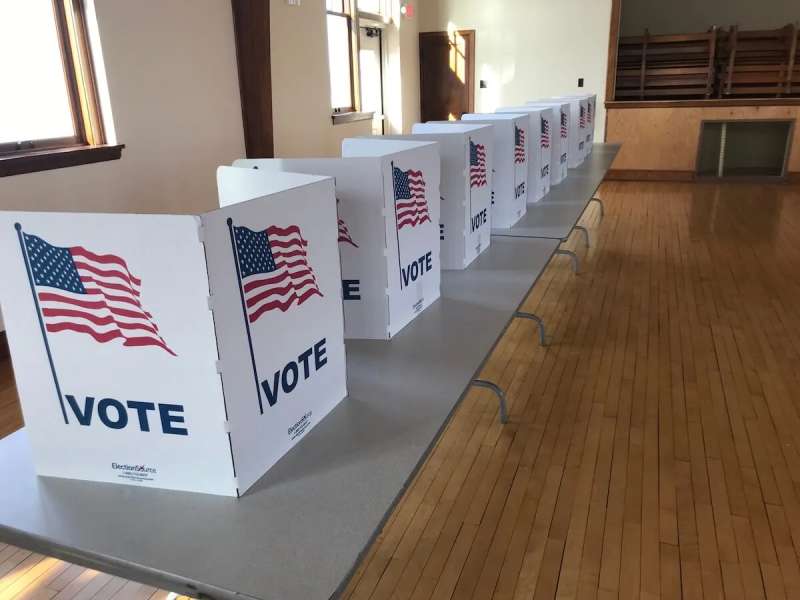
There are three proposed amendments on Tuesday’s ballot.
The “400-year veto” as a bogeyman
Wisconsin school districts face strict state-imposed per-pupil limits on how much revenue they can take in to educate children. When the Legislature sends the governor a budget that has ample state aid for school districts, they won’t have to levy as much revenue through local property taxes. But during 16 years of Republican control of the Legislature, overall state aid over that period has trailed inflation — so that while Republicans say a current per-pupil average of $19,000 per year is adequate, education advocates respond that the number should be about $3,300 higher per pupil just to maintain current services and not need a continuous series of referendums that allow property taxes to be raised beyond those state-imposed limits.
In the 2023-25 state budget bill, Evers used a partial veto to strike specific numbers in a way that boosted the state-imposed revenue limit by $325 per pupil annually until the year 2425. While the move gives school districts a little certainty that they won’t have their limits frozen by future legislatures, the $325 is still far from enough to keep up with inflation.
But a “400-year veto” makes for good politics, which is why Republicans, who could have chosen to improve state aid, chose instead to ask voters for a constitutional amendment to prevent governors in the future from using their partial veto power to create or increase any new taxes or fees.
The question will be on all state ballots, including in more than 70 school districts that have referendums to make up for underfunding by the Legislature.
Churches as super-spreaders
The next constitutional proposal would prevent state and local governments from closing or forbidding large gatherings in places of worship, even in the event of a public health emergency.
During the 2020 pandemic, Evers issued an order that banned in-person public gatherings of 10 or more people. Republicans convinced the Wisconsin Supreme Court, controlled at the time by a conservative majority, to strike down the order.
Amendment supporters frame their arguments around religious liberty. Opponents point out a history of protecting religious liberty in the United States and how that differs from protecting residents during a public health emergency.
Locking in racial and gender disparities
The third constitutional proposal is framed by supporters as promoting equality, while opponents say it would have the opposite effect.
While the amendment reads that the constitution would prevent any “governmental entity” from “discriminating against” or giving “preferential treatment” to certain groups, the historical disadvantages of certain groups would be locked in and could no longer be addressed by the people’s elected officials, say critics.
The League of Women Voters of Wisconsin notes that the amendment, if passed, would stop programs that study and try to address a range of disparities: Higher rates of chronic illness, disease and mortality and maternal mortality for Black women. Changes to UW admissions, scholarships, grants, courses, textbooks. Head Start and social-support networks for operating food banks, homeless shelters, and domestic violence shelters. Workplace initiatives for women. Public contracts for certified minority-owned firms. Policies that enable equitable hiring, promotion and retention, and more.
“What will be gained? Nothing,” according to the League. “What will be lost: 60 years of progress for women and people of color.”
Government-based discrimination is already illegal, meaning this amendment would not be about protection as much as denying government action to help marginalized groups who would still be suffering from institutional, systemic, and tangible discrimination were it not for programs enacted over the past several decades.