If there is a “deep, dark secret” that causes unease in US Rep. Tom Tiffany’s campaign for governor, it might be the fear that voters will discover that for all of his arguments against hiking property and sales tax, he was in the Wisconsin Legislature helping to create the state’s current public school funding issue—and the endless referendums that accompany it.
“Public schools have not had a cost of living increase in 18 years,” said Denise Gaumer Hutchison of the nonpartisan Wisconsin Public Education Network. “I can’t run a household without a cost of living increase for 18 years. How is that fair? How is that right? And how is that in the best interests of the state of Wisconsin?”
Republicans have controlled the legislative agenda in Wisconsin for the past 16 years. Tiffany, the GOP candidate for governor, served in the Legislature for the first nine of those years.
The legislative branch has consistently failed to send a state budget to governors of both parties that would let public school districts keep up with inflation. The cumulative effect of those annual shortfalls has led to election cycles where dozens of school districts have to ask voters via referendum to increase their local property taxes to make up for the state shortfall.
The fiscal challenges are made worse by lawmakers still using a funding model from the early 1990s while also sending more state money to private, usually religious, schools through an expanding series of voucher programs.
“What we’ve seen in the past couple of decades is a lot of decisions about public schools that kicks the can down the road,” says Heather DuBois Bourenane of the Wisconsin Public Education Network, “forces costs onto local property taxpayer, and forces school districts to tighten the belt while expanding unaccountable privatization schemes that impact every school in the state.”
“The cumulative impact of this over the years has been that more and more schools have to go to the ballot box to ask voters to raise local taxes just to keep up with operational costs.”
Referendums aplenty
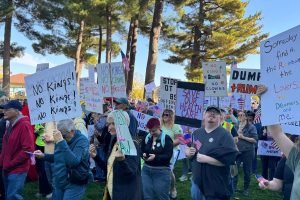
This election, 71 of Wisconsin’s 421 school districts have referendum measures on the ballot, and Bourenane says 60% of districts have had to go to referendum since the last state budget was passed in 2025.
“We’re in the second year of a two-year state budget that provided our public schools with zero dollars of increase in what they’re allowed to spend at the local level,” Bourenane told UpNorthNews. “That means they can’t keep up with massive inflation. We’ve got diesel at $6 a gallon right now. That is a huge cost for so many districts.”
Democrats are poised to make gains at all levels in the November midterm elections. Dissatisfaction with President Donald Trump is evident in public opinion polls, but Hutchison and Bourenane also believe Wisconsin voters are ready to change out the state lawmakers who created and support a system that underfunds their local schools.
“Voters should be finding out where candidates running for office in my community stand on this?” Bourenane said. “How sick are they of having to go to the ballot box to raise local taxes to fund schools? We need to reform how we pay for public schools in this state. Look for leaders who are paying serious attention to this so we can move forward and get out of this endless cycle of begging at the local level.”
It’s not the 400-year veto
Education advocates show exasperation at having to explain why politicians are wrong if they claim schools get more money because of a “400-year veto” created by Gov. Tony Evers.
In the 2023-25 state budget bill, Evers used a partial veto to strike specific numbers in a way that boosted the state-imposed revenue limit by $325 per pupil annually until the year 2425. It gives school districts a little certainty that they won’t have their limits completely frozen.
“We used to call this the Tommy Thompson standard,” Bourenane said. “It was about making sure districts got a regular, predictable increase that corresponded to inflation every single year. The little lift that Gov. Evers was able to do, $325 per student per student per year, doesn’t keep up with inflation, isn’t nearly enough to meet the needs. If we wanted to meet that mark (keeping up with inflation for 18 years), it would have been $3,300 per student.”
Crowley already fixed one fiscal crisis
If Crowley becomes governor, he would have an opportunity to repeat his success in solving a different long-term issue caused by chronic state underfunding — a problem that predated his time as Milwaukee County Executive but one he helped fix with a bipartisan, statewide coalition.
A pension scandal rocked the county in the early 2000s when it was discovered that officials offered extremely generous payments to workers who put off their retirement, in exchange for accepting a slightly reduced monthly pension once they did retire. But the payments quickly ballooned and the county’s pensions surplus disappeared with the bursting of the Wall Street dot-com bubble.
Years of punishing budget cuts followed, led by Scott Walker who took over as county executive in 2002 and as governor in 2011. At the same time, state-shared revenue from the Legislature was no longer keeping up with inflation, similar to schools.
Crowley was elected county executive in 2020 and led a bipartisan group of local officials from across Wisconsin in 2023 who demanded the Legislature reform its shared revenue program. One part of the package — passed by a GOP-controlled Legislature and signed by Democratic Gov. Evers — allowed Milwaukee to rely less on state taxpayers and more on its own success by adding 0.4% to the local sales tax.
It is that sales tax increase that Tiffany uses to attack Crowley, despite Tiffany’s own role in creating the conditions that decoupled local government and school aid from the cost of living.
Hutchison is hoping voters are ready to look beyond the numbers when it comes to taxes and look instead at what children need to be successful and stay in Wisconsin.
“I believe it’s still there,” she said, “the care and compassion and support that we had 50, 60, 70 years ago, when they believed children deserve the same benefits and values that they had. I really hope they do and that they vote yes because our future’s depending on it. The economy of our state is depending on it. Our kids are not failing in the state of Wisconsin, they’re starving.”