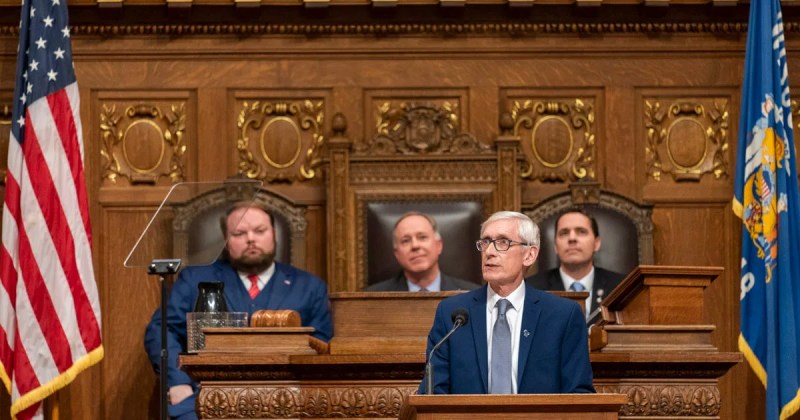
Democrats who have been hoping to win control of the Wisconsin Legislature may have just lost the budget surplus they would use for long overdue school funding reform, at the hands of an outgoing Democratic governor and the two outgoing Republicans who run the state Senate and Assembly.
Gov. Tony Evers said Monday he and Speaker Robin Vos and Senate Majority Leader Devin LeMahieu reached a “blockbuster” deal that puts $1.8 billion of a projected $2.5 billion surplus into tax rebate checks, a one-time increase in education funding, and permanent elimination of state income taxes on tips and overtime.
“It’s been important to me throughout this process that we make sure our kids and our schools have the resources they need,” Evers said in announcing the agreement, “while also lowering property taxes and giving working families a little breathing room in their household budgets. After months of hard work, I’m proud we were able to put politics aside on a plan to use a portion of our historic state surplus to do the right thing for Wisconsinites across our state.”
“This deal will provide immediate relief with $600 in surplus refund payments and provide permanent property and income tax relief for Wisconsin families,” said LeMahieu in the joint announcement.
“We’re sending [the surplus] back to help families with the pressure of increasing costs, reward hard work, and to continue investing in schools to help stabilize rising property taxes,” said Vos.
But the deal still needs to pass both houses of the Legislature and lawmakers from both sides of the aisle immediately blasted the plan as “a bad deal” and “the height of fiscal irresponsibility.” And the top Democrat in the State Senate, who was not part of the negotiations, indicated she saw no reason to support it.
Checks, aid, and tax cuts
Here are the five main components of the agreement over the current 2026-27 budget period:
- $300 million in general school aid for K-12 schools, which has seen no new state dollars added last year in what is now the current state budget law.
- $300 million in one-time increased funding for special education, so that state reimbursement to local school districts reaches 50% of total special education costs. This includes $16 million that will be allocated for voucher and charter schools’ special needs scholarships. Voucher schools already get 90% of their special education costs reimbursed by the state.
- $850 million in direct checks to an estimated 3 million Wisconsin taxpayers, which is being framed as property tax relief as well as “support to help respond to rising costs and help Wisconsin households make ends meet.” The checks will go to people who filed an individual income tax return for tax year 2024 and for which at least 90% of their earnings were Wisconsin income. Individuals will get a $300 refund, and married couples who file jointly will receive $600, or their net tax liability, whichever is less.
- $50 million to offset levy limits on Wisconsin Technical College Districts as a way to reduce the need to increase property taxes.
- $102 million to permanently eliminate state income taxes on tips.
- $328 million to permanently eliminate state income taxes on overtime. Evers had vetoed previous Republican bills on tips and overtime because the breaks expired in 2028.
Evers, Vos, and LeMahieu are all retiring and not seeking reelection this November.
Bipartisan blasts
Democratic legislators had quietly been critical of Evers for negotiating a package with Vos and LeMahieu, fearful that a deal would squander a multi-billion dollar surplus that could be used to make structural reform to a school funding system widely criticized as unequal and out of date. Some Democrats broke that silence in the aftermath of Monday’s announcement.
“This latest deal is the height of fiscal irresponsibility,” said Sen. Kelda Roys, one of more than half-a-dozen candidates for governor. “It spends a projected ‘surplus’ before it’s in the bank, even though that projection was estimated before Trump’s attack on Iran that disrupted our economy and caused gas prices to skyrocket. It gives a little one time money to public schools while permanently cementing unfairness in our tax structure. Worst of all, it blows nearly a billion dollars on an election year gimmick to send out rebates, squandering the ability of a new Democratic majority to make the long-overdue investments in our kids that they deserve.”
“More funding for our schools and special ed programs is a win for Wisconsin and Governor Evers deserves credit for finding the common ground to make this possible,” posted David Crowley, the Milwaukee County Executive and another gubernatorial candidate. “But a one-year property tax break is not a long-term affordability plan.”
“It does nothing to address the cost-of-living crisis that is still crushing Wisconsin families on things like childcare, healthcare, and gas and utility prices,” said candidate Joel Brennan, who served in Evers’ first term as Secretary of Administration. He also called the deal “very disappointing” and said it “misses the mark in many other ways.”
The group Wisconsin Association of School Boards said the deal “will not solve the longer-term problem” of the state not keeping up with inflationary increases in school spending limits.
There was praise from state Superintendent of Public Instruction Jill Underly, who stated: “Today’s action is a positive first step in the right direction. This investment is a down payment on what Wisconsin kids need and deserve and I hope this momentum continues.”
Sen. Steve Nass, one of six Republican senators choosing not to run for reelection, pointed out the agreement was reached between three lame ducks.
“I can’t support another bad deal cut by leaders that will never face the voters again,” Nass said.
Minority Leader Dianne Hesselbein was sharply critical of the three outgoing dealmakers.”From my perspective, there is no deal: Three men who will not be in elected office next year have come up with this proposal which Senate Dems will be reviewing,” Hesselbein posted. “Any proposal must pass both houses of the legislature and no one knows if Republicans have the votes to pass it.”