Control (kɘn-’trōl) transitive verb 1) to exercise restraining or direct influence over: regulate, 2) to have power over: rule. —Merriam-Webster
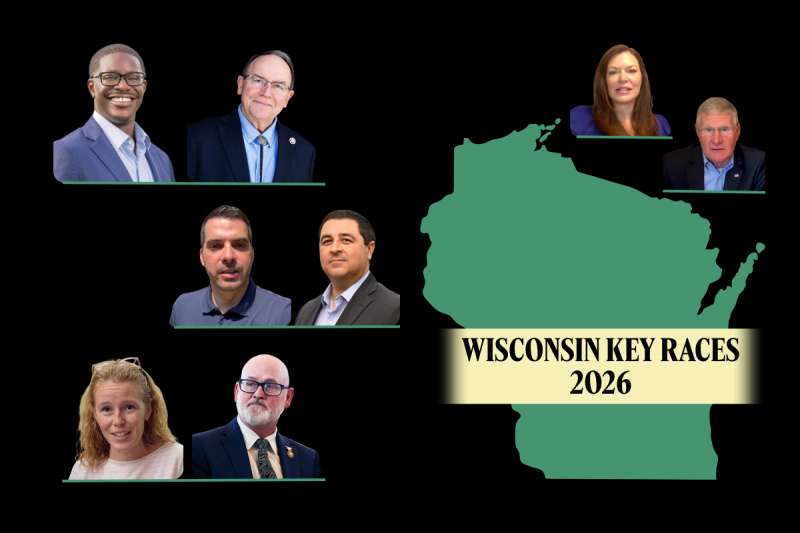
While every election cycle is about a series of wins and losses, there are only certain cycles where the concept of control is a dominant theme. Welcome to the 2026 election cycle in Wisconsin, where control is the name of the game — several games, actually.
Control of the governor’s office is, of course, what’s at stake in the marquee race on Nov. 3, along with control of the state attorney general’s office and other individual posts. It is control of legislative bodies, however, that truly motivates candidates, supporters, donors, and voters this year. In Congress, Democrats and Republicans are wrestling for control of the US House and the Senate. There is no US Senate race here this year, but control of the House of Representatives may hinge on a single congressional district in western Wisconsin.
And in Madison, control is at stake for both chambers of the Wisconsin Legislature: the state Senate and Assembly. All 99 Assembly seats are up for reelection to two-year terms, while the 17 odd-numbered Senate districts are also in play, with Democrats pushing for a trifecta: control of the Senate, Assembly, and governor’s office. Sixteen years of Republican control of the Legislature may come to an end if voter dissatisfaction manifests itself in a Democratic “blue wave.”
Now you know the stakes. Here are the races being watched most closely in Wisconsin.
Governor and Lieutenant Governor
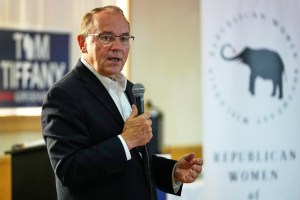
You know the names at the top of the ticket. They’ll be at the top of everyone’s November ballot: Democratic Milwaukee County Executive David Crowley and Republican US Rep. Tom Tiffany are the nominees for governor. You might not be familiar with their running mates. That’s because Wisconsin law requires the lieutenant governor’s post to have its own primary election; the winner then becomes the running mate of the gubernatorial nominee.
For Crowley, there was no drama. Democratic Secretary of State Sarah Godlewski was the only candidate. But there was a surprise for Tiffany, who had been campaigning with Will Martin, the party-endorsed candidate and a former staffer to past Republican governors. Martin, however, was defeated by David Varnam, former mayor of Lancaster and a former staffer with the Christian nationalist group Focus on the Family.
Either Crowley and Godlewski or Tiffany and Varnam will succeed retiring Democratic Gov. Tony Evers and Lt. Gov. Sara Rodriguez.
Attorney General
Democratic Attorney General Josh Kaul is facing a rematch from 2022 with Republican Fond du Lac District Attorney Eric Toney. Read our coverage to see that while Kaul has been part of dozens of lawsuits challenging President Donald Trump’s executive actions and funding cuts, Toney would be more likely to go along with some of Trump’s actions that target voting rights and reproductive healthcare.
State Treasurer
Of the state’s five constitutional offices, the treasurer’s post is the only one currently held by a Republican. John Leiber is seeking reelection and will face Yee Leng Xiong, a Marathon County Board member who emerged from the Democratic primary. As state treasurer, Leiber signs checks and serves on certain state boards. If Xiong is elected, he would become the first Hmong American in the country to hold a statewide office.
Secretary of State
Republican primary voters rejected the party-endorsed candidate and chose a 2020 election denier who wants to implement the Trump MAGA strategy of replacing bipartisan election oversight with a partisan secretary of state.
Jay Schroeder handily defeated three other Republicans, including Nate Pollnow, who had been endorsed at the state GOP convention.
Schroeder has been quoted describing himself as an “authentic MAGA activist” and a “MAGA aligned candidate on election integrity” who wants to abolish the Wisconsin Elections Commission.
The secretary of state’s office is largely official — administering the official state seal and the ceremonial validating of the certificate of Wisconsin’s electoral votes in presidential elections — but for years some Wisconsin Republicans have floated the idea of using the office to control election administration.
On the Democratic side, with current Secretary of State Godlewski running for lieutenant governor, the nominee is JoCasta Zamarripa, a Milwaukee Common Council member and former state legislator.
Assembly control
If Democrats can flip at least five Assembly seats in November, it will give them control of the chamber for the first time since being swept out of the majority in 2010. With Trump’s popularity at historic lows for a sitting president, Republicans have been heading for the exits across the country — including 20% of the GOP lawmakers at the state Capitol, all the way up to Speaker Robin Vos.
Among the key races that could determine control of the body are:
District 21 – Rep. Jessie Rodriguez (R-Oak Creek) is not running. Republican Dylan Pfaffenbach faces Democrat Dan Bukiewicz.
District 30 – Rep. Shannon Zimmerman (R-River Falls) is being challenged by Hudson educator Kevin Knoke.
District 51 – Rep. Todd Novak (R-Dodgeville) is not running. Republican Todd Novak faces Democrat Ben Gruber.
District 53 – Rep. Dean Kaufert (R-Neenah) is not running. The candidates are Democrat Becky Nichols, Republican David Daniels, and independent Rachael Dowling.
District 61 – Rep. Bob Donovan (R-Greenfield) faces Democratic challenger Ben Brist.
District 85 – Rep. Patrick Snyder (R-Weston) faces Marathon County Board member John Kroll.
District 88 – Rep. Benjamin Franklin (R-De Pere) is running for a second term and is being challenged by Democrat Brandy Tollefson.
District 92 – Rep. Clint Moses (R-Menomonie) faces Democratic challenger and former teacher Jeremiah Fredrickson.
District 94 – Veteran Democratic Rep. Steve Doyle (D-Onalaska) is being challenged by Republican Keith Purnell.
Senate control
Democrats need to flip two spots to gain control of the Senate. Six Republicans chose to retire rather than defend their seats. Among the key races are:
District 1 – Sen. André Jacque (R-New Franken) is not running. His former staffer, Nic Cravillion of New Franken, won a four-way Republican primary. There is no Democratic candidate, but independent Mark Becker will be an alternative choice for non-MAGA voters. Becker stepped down as chair of the Brown County Republican Party after Trump’s 2016 election and backed Vice President Kamala Harris in the 2024 presidential election.
District 5 – Sen. Rob Hutton (R-Brookfield) is not running. Rep. Robyn Vining (D-Wauwatosa) is running for the seat and will face Republican business owner Mike Roberts.
District 17 – Sen. Howard Marklein (R-Spring Green), co-chair of the Legislature’s powerful Joint Finance Committee, will be challenged by Rep. Jenna Jacobson (D-Oregon).
District 21 – Sen. Van Wanggaard (R-Racine) is not running. Democrat Trevor Jung, a former Racine alder and the city’s transit director, faces Republican Jim Croft.
District 25 – Sen. Romaine Quinn (R-Rice Lake) now lives in the 23rd District after the adoption of new maps, leaving the 25th District open. Democrat Charly Ray will face Republican former state Rep. Erik Severson.
US House
District 1 – US Rep. Bryan Steil (R-Janesville) will be challenged by Democrat Mitchell Berman, an emergency room nurse.
District 3 – US Rep. Derrick Van Orden (R-Prairie du Chien) faces a rematch from Democratic challenger Rebecca Cooke of Eau Claire, who narrowly lost the race two years ago.
District 7 – US Rep. Tom Tiffany (R-Hazelhurst) is leaving the seat to run for governor. Former Democratic state Rep. Fred Clark (D-Bayfield) will face Republican Michael Alfonso, son-in-law of US Transportation Secretary and former US Rep. Sean Duffy.
District 8 – Rep. Tony Wied (R-Green Bay) will be challenged by Democratic retired US Army lieutenant colonel Rick Crosson.
State constitutional referendums
Republican legislators have placed (three) state constitutional amendments on the November ballot.
The “Governmental Entity Discrimination Prohibited” amendment reads like it would ban official discrimination based on race, sex, color, ethnicity, or national origin — but such discrimination is already illegal and the amendment would have the opposite impact, according to the Wisconsin League of Women Voters.
Instead, it would prohibit the state from granting preferential treatment to marginalized people, such as healthcare initiatives that would address higher rates of chronic illness, disease, and maternal mortality for Black women.
“If this amendment passes, it will eliminate the equity-based gains Wisconsin has made over the last 60 years,” according to the League’s website. “While framed as promoting equality, this amendment would reduce Wisconsin’s capacity to address long-standing disparities. It would strip public systems of tools essential for promoting equal opportunity and equitable access to the vulnerable in our society.”
The “Wisconsin Prohibit Partial Veto to Increase Tax or Fee” amendment is designed to address a specific partial veto from Gov. Tony Evers that Republicans refer to as the 400-year veto. While signing the 2023 state budget, Evers struck individual characters in a way that allowed school districts to get a guaranteed increase in their state-mandated revenue limits until the year 2425. Evers and Democrats said it was the only way public schools could be assured of keeping up with inflation after 16 years of Republican budgets shortchanging education.
The “Wisconsin Prohibit Government Closure of Places of Worship During Emergencies” amendment would make it harder to address public health emergencies, as was seen during the COVID-19 pandemic. The measure would “prohibit the state or any political subdivision from ordering the closure of or forbidding gatherings in places of worship in response to a state of emergency, including public health emergencies.”
Local
At the county level, sheriffs and clerks of circuit court will also be on the ballot in this November midterm cycle. (Other four-year county posts such as district attorneys and county clerks have their elections during presidential cycles.)