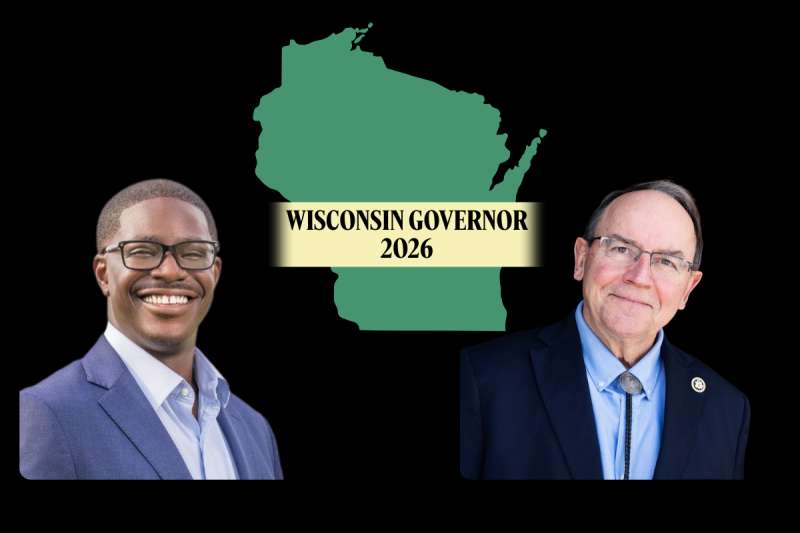
There is little doubt that the election to choose Wisconsin’s next governor will blow past the record $165 million that was spent by candidates and groups in 2022. There will likely be so much outside advertising that it might feel like that much is spent just by Labor Day.
It may be an impossible task to tune out anything that isn’t being said directly by US Rep. Tom Tiffany (R-Hazelhurst) and Democratic Milwaukee County Executive David Crowley, but they both have their own personal stories along with a lengthy record of statements, votes, and accomplishments that can inform how voters determine who will be Wisconsin’s next governor in Nov. 3 general election.
Both men proudly refer to themselves as “girl dads,” with three girls at home. While they also share a common path that will take one of them to the governor’s residence, their personal stories both have much more humble starts.
Tiffany’s story
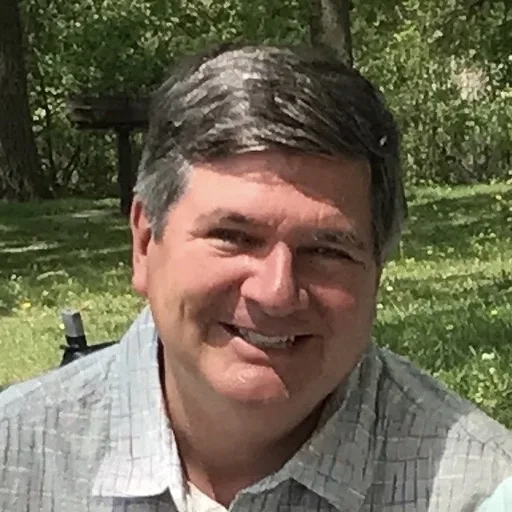
Tom Tiffany, 68, was born in Wabasha, MN, and raised along with seven siblings on a farm near Elmwood, in Pierce County. As Tiffany has told his story, he got an agriculture degree from UW-River Falls and worked for a time in Minnesota before moving to Minocqua, where he met his wife Chris. Then, he worked as a dam tender and then an excursion boat operator, and won a legislative seat in 2010, and a seat in Congress in 2020.
Tiffany is less likely to tell the part of the story where he assisted in President Donald Trump’s scheme to overturn the results of the 2020 election by voting not to accept the certified votes from two states on Jan. 6, 2021. Tiffany also said he would have voted not to accept Wisconsin’s certified results, if given the chance. He supported a Texas lawsuit that sought to overturn the will of Wisconsin voters and will still not state publicly that Trump lost the 2020 election to President Joe Biden.
Crowley’s story
David Crowley, 40, grew up in a Milwaukee neighborhood known by a number as much as a name: the 53206. That ZIP code represents one of the most economically disadvantaged parts of the United States and Crowley lived it as a kid. He’s gone on to acknowledge the challenges that come with having parents who struggled with addiction issues and were frequently homeless.
Crowley said he chose to become a community organizer so that other kids from neighborhoods like the 53206 would be less likely to face that kind of life. That path led to his becoming an organizer with Sen. Russ Feingold’s campaign, then an aide to his state senator, and later getting elected to the state Assembly at age 30.
“I saw what happens when extremists have total control,” Crowley said in a launch video that shows outgoing Assembly Speaker Robin Vos.
Three years later, Crowley was elected Milwaukee County Executive and he was sworn in on May 4, 2020, at the height of the COVID pandemic.
Crowley’s signature accomplishment in this office was organizing a bipartisan coalition and convincing a Republican-led Legislature to increase state-shared revenue to benefit communities statewide. The measure allowed for a 0.4% sales tax increase that provided property tax relief. But it didn’t come without a fight from Republicans who originally wanted the Legislature to have control of some local budget decisions.
Crowley’s promises and priorities
Because political ads and candidate debates only scratch the surface when it comes to all of the issues a governor can influence, campaign websites offer the chance for a deeper view into a candidate’s positions and priorities.
Crowley’s website features a “Badger Basics” page that lists 93 different initiatives or pledges.
In the healthcare section, Crowley says he would “open BadgerCare enrollment to any household that wants it, using federal Medicaid matching funds to cover portions of cost.”
When it comes to the construction of AI data centers, Crowley says he would “require mega-users to pay the full cost of grid upgrades” needed to power those server farms.
On economic development, Crowley says he will “use state incentives to prioritize storefront growth in commercial corridors, not just corporate subsidies.”
Tiffany’s promises and priorities
Tiffany’s website features a brief “Solutions” page that is comparatively scant on specific ideas, with much of its language dedicated to bashing Democrats and offering broad and vague concepts of a plan. (“Tom will deliver real results, higher standards, and honest report cards.”)
One of the slightly more detailed proposals says Tiffany “will ensure able-bodied adults without children work in order to receive welfare benefits.” But that’s already the law.
Tiffany makes a promise to “repeal Governor Evers’ massive 400-year tax increase,” but it’s undermined by the fact that there isn’t a 400-year tax increase, only an increase in school district revenue limits that the Legislature can address with adequate state funding in place of local property taxes.
In fact, Tiffany said on his website and in his launch video that he will “freeze property taxes,” but did not say how he would address a freeze that would leave a massive hole in education funding. There was no suggestion of how — or even if — he would replace those dollars.
Tiffany also pledges to “cut burdensome regulations to make housing, childcare, and healthcare more affordable” will draw criticism for gutting safety measures in order to boost profit margins.