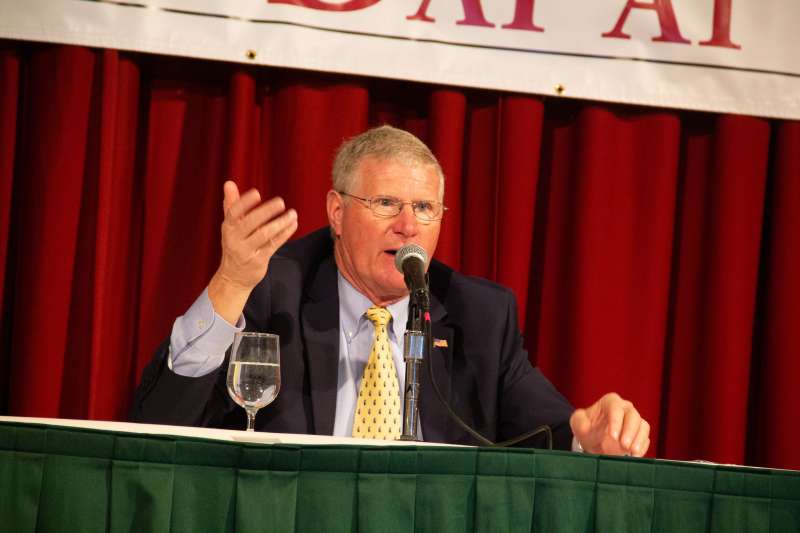
If you’re a parent trying to keep childcare affordable, a family waiting for BadgerCare expansion, or a community member worried about PFAS in your water, the lawmaker who has had the most power over those decisions isn’t Democratic Gov. Tony Evers. It’s actually been Republican state Sen. Howard Marklein (R-Spring Green), who is running for reelection to represent the 17th Senate District this November.
RELATED: Property tax relief? GOP says no.
According to the state’s Joint Finance Committee motions from 2019-2025, for four straight state budgets, Marklein has used his positions as committee member and co-chair on the Legislature’s budget-writing committee to vote out more than 1,600 of Evers’ proposals, including funding for childcare, school meals, clean water, and paid family leave, often in a single early vote that most legislators and Wisconsin voters never see. At the same time, campaign ads and social media posts present him as a “bipartisan” problem solver who says he’ll work with anyone to “move Wisconsin forward.”
What do the receipts show?
Every two years, the state budget answers questions that affect the lives of everyday Wisconsinites. Will BadgerCare be expanded to more low or middle-income families, so they can see a doctor without going into debt? Will programs like Child Care Counts stay funded so daycares don’t close or spike their rates? Will the state replace lead pipes and clean up PFAS?
Evers has put answers to such questions into all four of his budgets for the state’s Joint Finance Committee (JFC) to review. But each time, Marklein has been one of the main people taking them out before most lawmakers ever vote. He joined the committee in 2015 and since 2021, has served as co-chair.
The JFC is a 16-member panel that rewrites the governor’s budget before it goes to the full Legislature. Currently, Republicans hold 12 of those 16 seats.
On paper, the JFC is supposed to review the governor’s plan, make changes, and negotiate. In practice, under Marklein’s leadership, the committee’s first major move each cycle has been to vote on a huge “delete” motion that wipes out hundreds of of the governor’s ideas in one pass, and to operate under rules that make it almost impossible to bring those items back later.
After Marklein and other Republicans on the JFC voted last year to remove more than 600 of Evers’ budget items, the Democratic Party of Wisconsin’s Deputy Communications Director Haley McCoy blasted the move in a statement.
“By voting to gut Governor Evers’ budget, Howard Marklein is insulting the will of the people and offering Wisconsin more of the same old tired playbook that voters have rejected time and again,” McCoy said. After 15 years of partisan games, Wisconsin deserves better than what Howard Marklein and the Wisconsin GOP have to offer.”
The timeline of deleted provisions
In 2019, when Evers submitted his first budget, the committee’s opening move was a motion to delete 131 provisions. Marklein supported it. That vote removed Evers’ plan to expand BadgerCare, which would have covered more low-income adults and brought in additional federal dollars. It also killed his proposal to legalize marijuana, restore collective bargaining rights for most public employees, and cap enrollment in private school voucher programs. Once these items were swept out in that first vote, they never made it into the final budget.
By the 2021 budget cycle, Marklein had become co-chair. The first big vote that year was on a motion he wrote with the Assembly co-chair to delete 384 Evers provisions at once. That vote knocked out another attempt at BadgerCare expansion, a phased-in minimum wage increase, universal background checks for gun purchases (including online and gun-show sales), a repeal of Act 10’s limits on most public-sector unions, a ban on police use of no-knock warrants, extra funding for four-year-old kindergarten, and $5 million in new aid aimed at business in underserved communities.
During this time, Marklein and his colleagues also changed how the budget was built. Instead of treating Evers’ bill as the starting point, they began from what was essentially the previous cycle’s budget with a few technical updates. Under that approach, nothing new that the governor proposed was in the committee’s version unless the Republican majority voted to add it—and they additionally adopted a rule that made it so that deleted provisions could never be reconsidered.
In 2023, the pattern repeated with bigger numbers. The first substantive vote on Evers’ new budget removed 545 provisions, again under a motion authored by Marklein and the Assembly co-chair. That one vote eliminated Evers’ proposals for paid family leave, caps on insulin co-pays, another push for BadgerCare expansion, a $235 million school mental health initiative, legalizing marijuana, and restoring public-sector union rights lost under Act 10, with the same no-reconsideration rule in place.
Marklein’s election-year “bipartisan” label, and another 612 deletions
In 2025, as Marklein’s reelection campaign ramped up and his public messaging started leaning hardest on “bipartisan work,” the JFC opened the new budget with the same move as before but on a larger scale. On May 8, 2025, the committee took up a motion from Marklein and the Assembly co-chair to delete 612 of Evers’ provisions from the 2025-27 budget bill. Marklein voted yes.
Cut from that list was $442 million for the Child Care Counts program, another plan to expand BadgerCare, a paid family and medical leave program, funding for Healthy School Meals, more than $300 million to replace lead service lines and tackle lead paint poisoning, over $145 million to deal with PFAS contamination, new scrutiny of health insurance claims denials, and a sales tax break for basic items like diapers, period products, and over-the-counter medications.
So where does “bipartisan” come in?
Budgets are where Wisconsin makes its biggest choices about healthcare, schools, wages, childcare, and clean water. Budgets are where Evers has repeatedly proposed aggressive, popular agendas—and where Marklein has repeatedly led the committee in clearing out the governor’s priorities before most people ever get to see them.
If you’ve wondered why BadgerCare still hasn’t been expanded, why paid family leave keeps stalling, why childcare, school mental health, and PFAS funding haven’t matched the governor’s proposals, UpNorthNews has found that a key reason has been Marklein using his position to take those ideas off the table, well out of sight of the folks who will see his bipartisan campaign ads.
READ MORE: Meet the 3 Democrats who want to unseat a powerful but vulnerable legislator