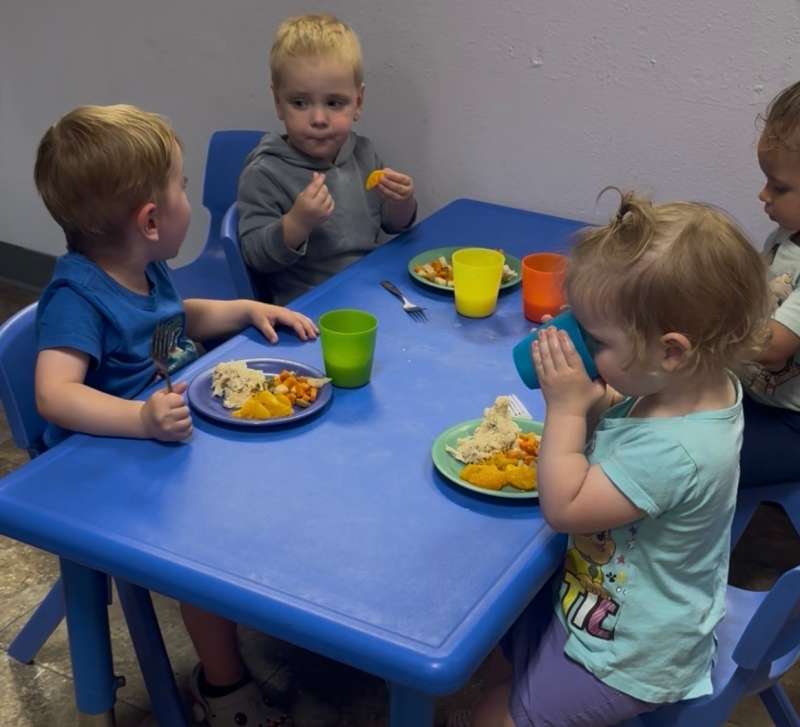
It was 7 a.m. Wednesday, June 17, and at home in Madison, dad Christian was getting his little boy ready for the day so he could head off to work. Christian happened to see an email come in. It was from his son’s childcare provider.
“The email essentially said that because of financial pressures there was going to be a consolidation of services and that the building would close on July 10, 2026,” Christian told UpNorthNews.
In the moment, Christian said he could barely grasp that the center would be closing in three weeks.
“It was a punch in the gut while trying to get a 3-year-old off to daycare in a timely fashion,” he recalled.
As he arrived at the daycare, he could tell some parents were unaware of the situation, going about their cheery drop-offs as normal. Christian said the teachers told a different story.
“It was hard seeing the looks on their faces.”
The news wasn’t anything anyone expected. “The rug was completely pulled from beneath us,” Christian said.
Why more closures are imminent
While the circumstances for the Madison provider’s closing are a little more isolated, what isn’t is the fact that many parents across Wisconsin could soon be in a similar position as Christian.
During the COVID-19 pandemic, the federal government designated funds to subsidize childcare programs. In Wisconsin, the funding is called Child Care Counts (CCC). It was intended to help cover providers’ operating budgets while they weathered the pandemic, according to the federal Administration for Children and Families in 2021. The program’s initial federal funding ran out a year ago, and some federal funds that were redirected by Gov. Tony Evers expired at the end of June.
A poll of childcare facility directors last year, commissioned by the state Department of Children and Families (DCF), showed up to 25% of them are considering closing altogether as a result of CCC ending.
“Between 2013-2020, there was an estimated 30% decline in licensed childcare programs,” Sen. Sarah Keyeski (D-Lodi) said. “Then, the COVID-19 pandemic hit an already struggling industry hard.”
She continued: “The Child Care Counts program provided direct payments to childcare providers to stabilize the industry during this tumultuous time. But that program ended in June 2025. While costs to operate and serve families were on the rise, our childcare providers were still in great need of assistance to keep their doors open, retain staff, and avoid having to raise rates on families.”
Evers proposed permanently extending the program using state funds, but Republican lawmakers on the Joint Finance Committee, which is co-chaired by Sen. Howard Marklein, voted to strip Evers’ request—a $442 million allocation—out of the 2023-2025 state budget.
Related: Sen. Howard Marklein is running as a bipartisan problem solver. His budget record says otherwise
“We’ve tried multiple times through the governor’s budget proposal and through other amendments and bills that we have proposed to put money back into it so it continues because these childcare centers have relied on that money to be able to pay their employees, to be able to keep their employees, to stay open, and bring relief to families and parents who can’t afford that childcare otherwise,” Sen. Jeff Smith (D-Brunswick) told UpNorthNews.
Instead of directly funding centers, Republicans passed a state budget that lowered safety and regulatory standards, claiming it would help providers increase capacity.
Using the interest earned on the federal COVID-19 funds, Keyeski said the 2025-2027 budget established the Child Care Bridge Payments Program, “which temporarily filled the gap left by the end of CCC by continuing to provide direct payments to childcare providers every month from July 2025-June 2026.”
The Wisconsin DCF says CCC helped more than 5,700 childcare providers keep their doors open, ensured the employment of more than 75,000 childcare professionals, and allowed providers to continue care for more than 430,000 kids.
“As a parent of young kids, childcare is really personal for me,” said Sen. Kelda Roys (D-Madison), a candidate for governor. “I know how expensive it is and how hard it is to find good childcare.”
“Wisconsin is about to see the collapse of the childcare industry because the few state dollars that were in there are running out.”
Providers rely on Child Care Counts
In her office at Beautiful Minds Child Care Center in Eau Claire, Assistant Director Ashley Matysik feels the emotional toll of fielding sometimes up to 10 calls a day from panicked parents who realize that a lack of childcare directly threatens their ability to keep their jobs. She often has to tell parents they’ll be put on a waitlist.
“They call and they’re already so worked up—you can tell they’re at their wits’ end—they give a long sigh,” Matysik said. “It hurts because you want to be able to help every single person—we’re in a field of helpers, that’s what this is—so to have to turn someone down is really hard.”
Statewide, providers report that they are under capacity by 33,000 children. But at the same time, half of providers report having a waitlist. With a lack of staff, childcare providers are stuck closing classrooms and serving fewer children while watching their waitlists continue to grow.
“As centers close, we’re going to see a desert occur,” Matysik said. “We won’t have enough facilities to take on what the need is of the area.”
Matysik, who’s been in childcare for 14 years, said the industry relies on CCC to afford to pay teachers. She said that’s what her center used the funding for. “We make sure that the staff are receiving the wages that they deserve as well as additional bonuses from time to time just to kind of help them out as well,” Matysik said. “We want to make sure that our staff is our priority because they’re the ones who are taking care of the children, keeping them safe, maintaining their curriculums—maintaining everything.”
According to the Wisconsin Policy Forum, historically, to keep doors open without help, Wisconsin centers could only afford to pay lead teachers an average of $13.55 per hour, compared to the state’s average hourly wage of $28.34.
Renee Ernsting is the Director of Child Care Partnership, promoting positive outcomes for young children and their families in 10 western Wisconsin counties. Ernsting has worked for more than 20 years to develop solutions to complex childcare challenges.
She said because childcare operates on razor-thin margins, centers used these funds to remain operational, increase wages, and retain staff without having to pass extreme costs onto parents.
“The childcare profit margin is so very small. That’s part of the problem,” Ernsting said. “About 90% of their money that comes in goes right back out in staffing—so you just don’t have wiggle room and can’t afford the wages that we would really like to have for that profession.”
“People think we’re just raking in the cash,” Matysik said. “That’s not true.”
“And childcare is so fundamentally important, especially when it comes to brain development—there’s so much development in birth to five years. It is essential.”
Roys added that every child deserves access to high-quality early childhood care. “We understand that it’s in society’s interest to provide universal public education so all children can reach their potential, yet we’re rationing access to early childhood education based on a parent’s wealth and zip code.”
“High-quality childcare helps kids begin school ready to learn, and it can prevent opportunity gaps before they form.”
Childcare costs more than college
Meanwhile, a new state report shows childcare costs in Wisconsin are rising faster than inflation. The Department of Children and Families’ 2026 Market Rate Survey found full-time infant care now costs an average of $17,400 per year at centers and $13,000 at family based programs.
Sen. Smith points out that it outpaces the in-state academic tuition at the University of Wisconsin-Madison, which sits around $9,000-$11,000.
“At the gas pump and grocery store, everyone is feeling the national affordability crisis,” said DCF Secretary Jeff Pertl. “But the end of Child Care Counts and Bridge payments are leaving families with growing childcare bills in addition to everything else.”
“Most Wisconsinites can agree that no hardworking family should have to choose between having childcare or keeping the lights on,” said A Better Wisconsin Together Communications Director Lucy Ripp. “But sadly, Wisconsin Republicans are continuing to prove they are dangerously out of touch with most Wisconsinites.”
“Parents can’t afford to pay more,” shared Ernsting. “They’re already paying more than their mortgage in many of the areas that I’m dealing with.”
The lack of accessible, affordable childcare is costing Wisconsin at least $1.1 billion per year in lost economic productivity, earnings, and revenue.
Senate Democratic Leader Dianne Hesselbein (D-Middleton) joined Smith in hosting a community roundtable at the end of June in Eau Claire to discuss childcare affordability challenges facing Wisconsin providers, families, and the regional economy.
“Childcare is infrastructure—it’s essential to our economy and our communities,” said Hesselbein. “When facilities close, parents leave the workforce.”
“When costs skyrocket, working families struggle to afford basic needs. We need long-term, sustainable solutions that make childcare more affordable.”
Solutions for the next session
At the roundtable, Smith and Hesselbein committed to developing solutions to ensure childcare remains accessible and affordable for all Wisconsin families.
“I’m hoping for a different makeup of the Legislature come January—after the November election—and I can guarantee that if that happens, the makeup being leaning towards the Democratic Party, we will be introducing legislation to prop up our childcare system, to prop up our healthcare, to prop up our schools—the things that people are right now struggling with,” Smith said.
“It didn’t need to be this way,” Keyeski said. “This session, I was the lead author of a bill to create a new program (the Child Care Quality Improvement Program) that would allow us to continue providing direct assistance for our valued childcare providers indefinitely.
“As is extremely common with Democrat-authored bills under the Republican majority leadership, this bill did not get a hearing in the Senate or Assembly and died in committee.”
Keyeski said she too will remain committed to making childcare affordable and helping providers “so they don’t have to constantly worry about being able to adequately pay hardworking staff, having to raise rates, or closing their doors for good.”
As for Christian and his 3-year-old in Madison, “it’s scheduling tours and interviews with executive directors to try to get him into another childcare center before July 10th.”
“The best outcome is that he has a graceful transition, some of his classmates will also be at the same childcare center, and that the prices don’t change too much within our budget. Also, that his teachers also find new jobs.”
If he doesn’t have a spot by July 10th? “We expand our search and just take it one day at a time.”