Jenny, along with her husband William (not their real names), gets up every Saturday with the mission of protecting pregnant patients who need abortion care. Here, Jenny shares her story with UNN special correspondent Bonnie Fuller.
I’ve been a volunteer abortion clinic escort every Saturday at an independent clinic in Milwaukee for six years. So instead of having my Saturdays off, I go and get screamed at by anti-abortion protesters.
I’d wanted to be a clinic escort for a long time, but I was finally freed up on weekends after my son turned 16 and was able to drive himself places, so he wasn’t reliant on me.
My husband joked that I would need to find a “hobby” now that my son was more independent, and I wanted to do something to help other people. I grew up Catholic, but I had always questioned things, including religion.
I remember seeing protesters outside abortion clinics on the news and feeling like I wanted to help the patients trying to get inside, because I don’t like bullies.
My husband doesn’t like bullies either, and he also feels strongly about reproductive rights. When I signed up to do clinic escorting work, I asked him if he wanted to do it too, and he said, “Heck, yes!”
So now we go together every Saturday for a four- to five-hour shift. If I were a trust-fund baby, I would do this work full-time.
‘No matter what their journey was to make that choice, I’m proud of them’
There is one woman that I think about often and hope that she is safe. I remember seeing her walking down the street with a companion toward our clinic, and I could tell that she was really upset.
I walked toward her and asked, “Do you mind if I put my arm around you?” And I told her, “We’re going right in the door. I’ll get you inside. Try not to cry in front of the group of anti-abortion protesters on the sidewalk, because that’s what they want to see. We’re going to keep our heads high and we’re going to walk in there together.”
Once I got her inside and the door closed, she began to sob hysterically, and I gave her a hug. She told me that she was escaping a domestic violence situation. The man she was with was physically abusive to her.
She was also afraid that she might have an ectopic pregnancy, and she knew that ectopic pregnancies could be deadly.
Thankfully, her pregnancy turned out not to be ectopic, and she was able to get an abortion. After the procedure, I walked her back to her car, and we were followed by one of the anti-abortion protesters, who kept harassing her.
When we finally arrived at her car, she gave me one of the longest hugs I’ve ever had as a clinic escort. It makes me emotional just thinking about it, because I think about how she’s safe now.
If she had not been able to have that abortion, she might have been trapped with that guy, unable to leave because they had a child together.
If I was able to play even a small part in her being safe, that’s a reason for me to do this work.
I’m able to help patients who are in difficult situations—and also for those who may not have faced a tough decision to have an abortion. No matter what their journey was to make that choice, I’m proud of them.
‘The name-calling doesn’t bother me’
I feel very strongly that every person who is going to see a medical provider for reproductive healthcare—whether it’s for an abortion, a Pap smear or IVF—should be able to do that without harassment or fear, just like anybody else going to any other kind of healthcare appointment.
My first day at the clinic in Milwaukee was a surprise. I didn’t think in a million years that I would be shoved as much as I was out there.
Read More: ‘Protesters spit on us’: Why this Wisconsin abortion clinic escort won’t back down
But I think that even if I had been warned that I would be shoved, elbowed in the back of the head, or pushed onto the road, I still would not have been deterred.
I wasn’t actually freaked out by the situation. My background has helped me prepare for chaos—both my current work in social services and the fact that I used to be a member of the military police force for eight years.
I was a police officer on a military base in Washington state, and as part of my job, I trained other law enforcement officers in de-escalation techniques. Because of that training, it has helped me with both protesters and patients when they are upset.
I’m really good at talking with them and grounding them so I can bring them back down.
At our clinic’s old location, there was nowhere for patients to park, so they would have to walk three or four blocks to and from the clinic. There also wasn’t much space between the protesters, the clinic escorts, and the door into the clinic.
Fortunately, we moved over a year ago to a new location with its own parking lot, so the situation is much easier for patients and escorts.
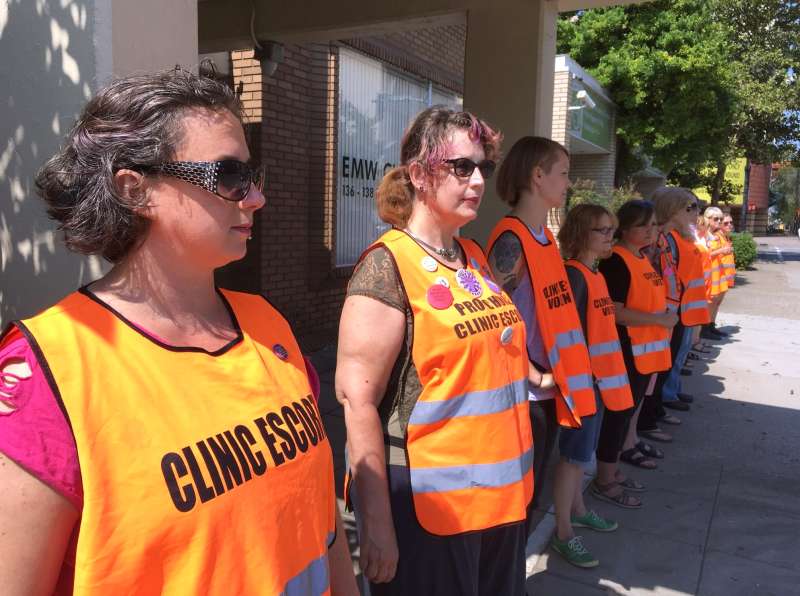
But at the old clinic, we escorts would often have to form a wall with our bodies to prevent aggressive protesters from getting inside the door of the clinic. Or we would form walls around patients, holding hands, so there would be a small group of us surrounding a patient so we could safely get them inside the door.
It was the Wild West out there.
Protesters yell disgusting things at patients, like, “Mommy, mommy, please don’t kill me,” or, as patients leave the clinic, “You’re still a mom, but the mom of a dead baby.”
They’ll shove rosaries in their faces and call them “whores and murderers.”
They call us female escorts “Jezebels, Nazis, harlots and sluts.” But the name-calling doesn’t bother me at all.
When I bring patients into the clinic past the protesters, I’ll ask them how they are doing and try to give them strength and confidence as they enter the building.
‘Patients have told me horrific stories’
I’ve heard so many things from patients that I will never forget. There are patients I walked into the clinic years ago that I still think about and wonder how they’re doing. I hope that they’re living their best lives. What they went through that day with those protesters should never happen to anyone.
There are stories that patients have told me that are horrific. Some had been raped. There are women with a wanted pregnancy, but for a particular reason the pregnancy can’t continue, and they are very emotional.
There are people who are in a good mood because the abortion will be a relief.
We’ve had patients who have come in and their cars are barely running, and there are two kids’ carseats in the back, and you’re thinking that this is probably the best thing for them. It’s an investment in the future of their family.
But no matter what a patient’s circumstances are—even if getting an abortion was an easy decision for them—the fact that they’re getting screamed at as they come into the clinic isn’t easy. I try to better their day in any way possible.
When I would walk patients out to their cars three or four blocks away after their appointments, we would often be followed by a protester. I would ask them about their plans for the rest of the day or crack a joke about the protester following us and say, “Yeah, that guy’s still a virgin.”
I’d be trying to take their mind off the protester screaming at us and make my patients feel as comfortable as possible. After walking patients to their cars, I’d get a lot of hugs and thank-yous. Sometimes they would say, “I couldn’t have done this without you.”
Many of the same protesters have been here for years. It’s like it’s their full-time job. The majority are men, and they tend to be the “angry” ones. The women tend to be friendlier to the patients and say, “Oh mama, can I talk to you?”
They call themselves “sidewalk counselors” and try to convince patients to go to a crisis pregnancy center instead of coming into the clinic.
But I doubt these “sidewalk counselors” have had any formal training.
Crisis pregnancy centers are not actually staffed by licensed medical professionals, they aren’t legally obligated to provide accurate information, and the people there try to convince pregnant women to continue their pregnancies.
When the Supreme Court decision to overturn Roe v. Wade came out, I happened to be in Washington, DC on a preplanned vacation. It was rumored that the decision would be released that day, so I went to the front of the Supreme Court building, and I was there when the court’s ruling came out.
I was devastated.
On one hand, there was a group of Students for Life supporters in front of the courthouse, and they cheered. But they were outnumbered 3 or 4 to 1 by pro-choice supporters.
I remember hugging a young woman who shared with me that an abortion had saved her life, and she couldn’t imagine that young people weren’t going to have that choice anymore.
There were a lot of tears and many very sad people. Rights had been stripped away, and we knew what this would mean for some states, including Wisconsin.
The moment that decision came down, abortion was deemed illegal in Wisconsin by a preexisting 1849 Criminal Abortion Statute, and the clinic was closed for a year and a half.
We’re lucky here because abortion is legal again (since December 2023), but in many other states there are abortion bans.
We knew that Roe being overturned would kill pregnant people, and it has.
Editor’s Note: A major study reports that pregnancy-related deaths have increased by 21% in abortion ban states.
I was very angry and sad about the Supreme Court’s decision. I wanted to cry. But I also told myself that I had to use my anger, and I went into “we’ve got to fix this” mode.
I wanted to work toward restoring access. I also donated to abortion funds so they could help people travel to states where abortion was still legal to get care.
‘We want to be a comfort to the community as a whole’
Once abortion became legal again in Wisconsin, I was back at the clinic as an escort. I always wear a medical mask, and I go by a pseudonym so that none of the protesters know my true identity.
You have to be brave physically and mentally to do this work. It can be mentally draining because you are in a state of hypervigilance the entire time you’re there.
We all know about the history of violence at abortion clinics. Eleven abortion doctors and an abortion clinic escort have been murdered.
Editor’s Note: Since 1973, 11 abortion providers and clinic staff have been murdered in the US and Canada, and another 26 have been wounded by gunshots, nail bombs, and arson attacks. Snipers have targeted physicians in their homes and even churches. One doctor and his wife were kidnapped and held hostage for a week in 1982.
I am watching every car that drives by, and if one drives by in any unusual way, I’ll catch the eye of the closest escort—usually my husband—and we ask each other, “Did you see that?”
You’re also absorbing the patients’ emotions—their sadness or anger—and the anger of the protesters. If a patient walks out looking happy, it angers the protesters.
They’ll yell at patients getting into a car to leave, they yell at us, they yell at cars driving by and at people just walking down the street. I will listen to music and dance so I don’t hear the protesters screaming all the time.
I tell people that if you drive by an abortion clinic, you can tell who the escorts are because we’re the ones with friendly body language. We wave at people. We dance to music that we bring.
We’re not the ones yelling at people and telling them that they are “murderers.”
We’re not just out there as a comfort for patients but also for passersby. I’ll say, “Good morning” to people walking by. If they have a dog, I’ll ask if I can pet it. I always try to bring dog treats with me.
We want to be a comfort to the community as a whole because we don’t want people to feel as if having an abortion clinic in their neighborhood is a threat.
There are four or five protesters out of the dozen or so there most days that I say good morning to and ask, “How are you?” when I arrive. We do talk to the protesters because you are out there with them for hours.
Some of them have never been married and some have never had kids. I’ll ask them, “Why not?” They will say things like, “The time wasn’t right,” and I point out the hypocrisy that they made a choice, yet they are out here yelling at patients who are also making a choice.
One couple that was protesting said they wanted to adopt a baby, but that there aren’t many babies to adopt unless they went overseas.
I asked them, “Why does it have to be a baby? Toddlers still need love. Preteens and teenagers who are in foster care need love.
“Why don’t you love those children as much as you love babies or the ‘preborn’ babies who are not here yet?”
I haven’t gotten a good answer to that question yet, or to another question I’ve asked anti-abortion protesters.
I’ll say, “You support these ‘moms,’ but you vote against social services. You don’t support universal healthcare, affordable daycare, SNAP, or affordable housing. How is that helping moms?”
I’ve had some say, “That’s not my problem,” or “The government shouldn’t pay for that,” or “I took care of my kids. They should take care of theirs.”
They try to get into debates with us, and I let them know, “You’re not going to change my mind, and I’m not going to change yours.”
Often they will tell me, “I wish you would repent.”
I have to reply to that: “I probably won’t. I’m still here. I’m here every week. You’re not going to get rid of me. I’m still going to be here.”