Even when the national economy is struggling, there are things individual state leaders can do to cushion the blow, as outlined Wednesday night by Milwaukee County Executive David Crowley, the Democratic candidate for governor, in an UpNorthNews live event.
Speaking to an audience at the Overture Center near the state Capitol, Crowley began by noting how a perpetual string of school referendums could be stemmed and property tax relief could be gained by the state government returning to a standard of two-thirds funding for public schools, a benchmark put in place during the administration of Republican Gov. Tommy Thompson.
“By fully funding public schools and increasing the reimbursement rate [for special education], that’s going to naturally ease the property tax pressures that so many families are facing across the state,” Crowley said.
Crowley said there are other ways his administration can “put more money in people’s pockets,” which include giving more bargaining power to workers, ending anti-union “Right to Work” laws, and putting upward pressure on all wages by starting with a minimum wage that hasn’t moved in 17 years.
“We need to raise that to $20 an hour,” Crowley said. “More importantly, everybody deserves the ability to come to the table to negotiate for better wages, for better benefits, and safer working conditions. And we’re going to do that by eliminating Act 10 and ‘right to work for less,’ putting in place project labor agreements, creating pipelines for our young people to go into apprenticeships and build their own businesses.”
Wisconsin has long struggled with “brain drain,” ranking second worst in the country (only ahead of North Dakota) when it comes to college-educated workers moving out of the state compared to the number who move into Wisconsin.
“I want this state,” Crowley said, “when my daughter graduates from college, she can actually see a future that she wants to stay here in the state of Wisconsin.”
Crowley makes news on killing AI tax break
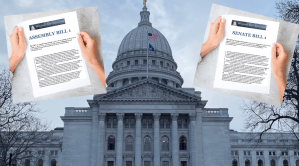
Although the Legislature is no longer in session this year, four Republicans recently introduced a bill that would end a sales tax exemption for the construction and operation of data centers in Wisconsin. Republicans included the measure in the 2023 state budget, but the incentive has come under fire as data center construction has metastasized and is approaching a $2 billion hit to state revenue — so Crowley was asked if he would sign such a bill.
“Absolutely,” he said. “Because of the fact that these tech companies are getting billions of dollars on the backs of hard working families. My opponent [US Rep. Tom Tiffany] is consistently trying to run away from his record on data centers. We’re going to be aggressive when it comes down to holding data centers accountable — making sure that we protect our land, protect our water, have strict environmental standards, and that communities have a seat at the table.”
“Congressman Tom Tiffany, I think he kind of forgot that he voted to give $70 billion to these tech companies that are steamrolling our communities today. He’s running away from the fact that he was the deciding vote to put a ten-year ban on artificial intelligence regulations on states like Wisconsin. He also voted to fast-track the development of data centers without any environmental standards or with local communities having a seat at the table.”
Instead of data centers “extracting resources from our state, we need to extract as much as possible from these data centers,” Crowley said. “They should be subsidizing our energy use and our utility bills.”
Addressing the data centers being used for increased artificial intelligence computing and the resulting harms that can come to minors through sexual imagery and tactics to encourage social media addiction, Crowley said he would push for age restrictions on chatbot access and social media accounts. He also proposed safeguards against consumer scams and the use of personal data to create targeted advertising.
The conversation with Crowley also addressed questions on affordable housing, reproductive rights, and addressing the shortage of affordable childcare for parents.
Kaul makes his case for third term
Earlier in the event, state Attorney General Josh Kaul spoke about the reasons he believes voters will elect him to a third term running the Wisconsin Department of Justice, such as his record of holding corporations accountable for bad practices in areas like social media addiction and the harmful spread of opioid drugs.
“We worked to address the opioid epidemic,” Kaul said. “We helped to secure the recovery of over $800 million, and those dollars are now going to communities across our state. From 2023 to 2024, there was a reduction of over 40% in opioid deaths in Wisconsin.”
Kaul explained why he has joined other Democratic attorneys general in opposing President Donald Trump’s executive orders that have, in many cases, attempted to end or freeze funding for previously approved services.
“We’ve now joined more than 70 lawsuits against the Trump administration,” Kaul said. “I do wish he didn’t have a federal government adopting policies that are harmful to Wisconsinites. If you’re not one of the states that are involved in these cases, you don’t benefit from the relief that happens. You’re relying on the good graces of the Trump administration.”
Kaul said his opponent, Fond du Lac County District Attorney Eric Toney, could not name a single lawsuit where he would stand up to the Trump administration.
And Kaul said his agency has played a role in keeping Wisconsin safer overall.
“We had the lowest violent crime rate since 2011,” Kaul said.