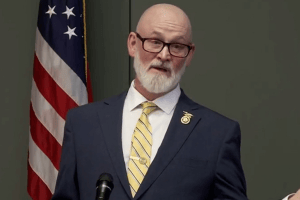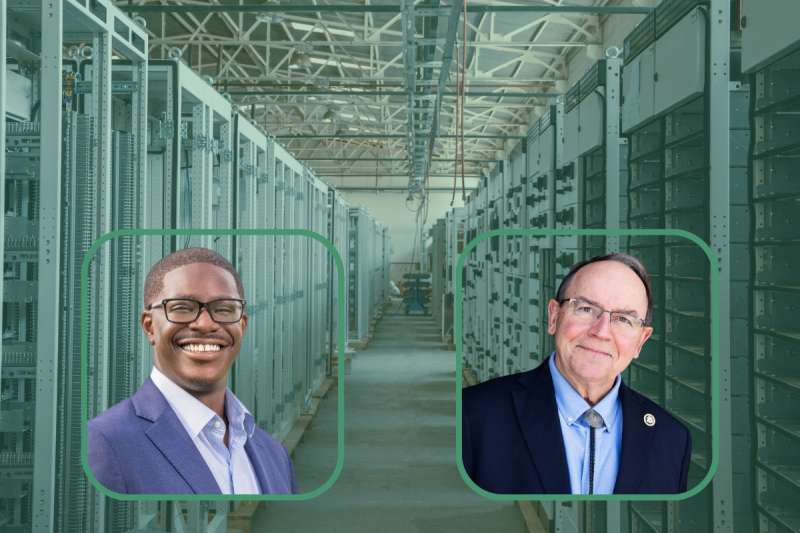
US Rep. Tom Tiffany spent weeks preparing to face state Rep. Francesca Hong in the November race for Wisconsin governor. With the surprising primary election win by Milwaukee County Executive David Crowley, Tiffany had to jettison an entire strategy built on Hong’s democratic socialist record and find a new initial line of attack on the Democratic nominee. Tiffany chose to focus on the construction of data centers used for artificial intelligence (AI) computing, but the topic does not provide Tiffany with the bright line of contrast he needs in what could be a close November race.
Tiffany’s record as a Republican lawmaker — first in the Wisconsin Legislature, then in Congress — signals support for AI technology, corporate tax breaks for data center construction, a federal veto over state efforts to regulate AI technology use, and opposition to renewable energy sources and environmental protections.
What Tiffany says now
Tiffany was not a household name even in the weeks leading up to the gubernatorial primary — with a Marquette University Law School poll showing about 30% of Republican voters said they did not know enough about him to have a favorable or unfavorable view of him. Now he is trying to use that somewhat-blank slate to his advantage by saying things about Crowley and data centers that don’t stand up to Crowley’s record — or his own.
Tiffany’s campaign recently published a string of social media posts designed to make him look supportive of strong data center regulation and to make Crowley appear to be beholden to the large technology and construction companies that benefit from burgeoning data center growth, even though Tiffany said virtually nothing about data centers for the first 10 months of his campaign
“I will make sure that we protect our farmland, and we keep America’s dairyland as America’s dairyland – not America’s data land,” Tiffany said last week in visits that included a farm in Coon Valley.
Tiffany is also trying to draw a distinction between the two candidates on a current state sales tax exemption for data center construction, claiming he will end the tax break while Crowley promises to review the program.
“I will end those subsidies,” Tiffany said. “These companies do not need to be subsidized on the back of hardworking taxpayers here in Wisconsin.”
A Tiffany political ad wants voters to infer that “Crowley’s campaign is funded by the people building” data centers, meaning Big Tech — when it was actually coming from unions that would support data center projects, so long as they have protections for labor and natural resources.
Data centers are large warehouse facilities filled with thousands of computer servers that generate heat and need a consistent source of cooling, which has to come from air conditioning and/or nearby sources of cool water, both of which require a massive amount of electricity from the current grid or potentially new renewable energy sources. Tiffany makes it sound like the green energy option would be harmful.
“[Crowley] said that they should be powered by wind and solar with battery storage. It would take 100,000 acres of our farmland in order to power just Port Washington and Mount Pleasant when they’re up and running,” Tiffany claimed. “We’re going to end up covering tens of thousands of acres all across Wisconsin with wind and solar.”
“There should be no new data centers in Wisconsin without strong standards to protect our ratepayers, farmland, water, local communities and electric grid,” Tiffany says now.
That’s not what he said before data centers became controversial.
Tiffany’s record then
If Tiffany takes actions to regulate big businesses, protect the environment, boost union labor, support local control, and eliminate corporate tax breaks, it will mark a noticeable about-face for a lawmaker with a clear record supporting lower corporate taxes, deregulation of industry and environmental laws, union busting, and federal limits over state and local rules to protect natural resources from development.
Last year, Tiffany voted in favor of a bill that would have put a 10-year ban on state laws regulating artificial intelligence. (The language was later removed by US Senate Republicans.)
Tiffany also supported the SPEED Act, which was championed by the largest technology companies (commonly referred to as Big Tech) and targeted the timeline for environmental review of data center projects. Supporters called it “streamlining” bureaucratic regulations while critics called it “steamrolling” over environmental protection. Tiffany is no stranger to the subject, having authored legislation that would sharply curtail who could ask a court to protect natural resources under the National Environmental Policy Act.
Historically, Tiffany has spoken of supporting “local control” even while taking actions to pre-empt local control over frac sand mining and shoreland protection as a legislator — and, as a congressman, trying to give national park status to the Apostle Islands National Lakeshore despite intense local opposition.
Tiffany had already moved on to Congress by the time the state legislature passed a 2023 incentive that exempted the state’s 5% sales tax and local sales taxes on purchases for building and equipping data centers — with a potential state revenue loss of $2 billion — but his record shows strong support for other multi-billion dollar tax windfalls for corporations, including the original Foxconn proposal for southeast Wisconsin as a state senator and the so-called Big Beautiful Bill as a member of the US House.
Despite his pledge to protect Wisconsin land from the development of renewable energy sources, Tiffany is best known for his work as a legislator to overturn a state ban on metallic sulfide mining for metals like gold, zinc, and copper.
“People want to make things in America again,” Tiffany said in 2017 in defending the move. “Our neighbors, Minnesota and Michigan, have placed their shovels in the dirt of America’s future. It is Wisconsin’s turn to do the same.”
Even if Tiffany became governor and was sent a bill by legislators withhis stated goal for “strong standards to protect our ratepayers, farmland, water, local communities and electric grid,” there are indications he might refuse to sign the bill if it also included something else: a preference for union construction labor. Tiffany began his legislative career with a vote for the union busting bill later known as Act 10 and his labor record includes votes to weaken state child labor laws and oppose federal equal pay rules for women.
Crowley’s record
Crowley’s rhetoric on data centers has not been as absolutist as was Hong, who proposed a data center moratorium. But he has used his time since becoming the nominee to spell out a more deliberative platform on data centers focused on performance and local control.
“Local communities should be able to make a decision of whether or not it’s good for their community,” Crowley said last week in Eau Claire. “And if they don’t want a data center, they should be able to stop a data center in this state. But if the community decides that they do want a data center, the builder would have to use union labor. They need to make sure that they are paying for their own energy and paying for the infrastructure upgrades. They cannot pass one penny down to any Wisconsin taxpayer.”
As for the current state sales tax exemption, Crowley wants it reviewed to see if higher benchmarks would ensure higher construction and employment standards.
“If a data center wants that tax break, it has to earn it: 100% clean power, no secret deals, real money back to the community, and no increase on consumer rates. If it won’t do those things, it doesn’t get a dime of public support.”
Count Crowley among the skeptics that Tiffany has changed his approach toward big businesses, tax breaks, and regulations.
“We know that Tom Tiffany. He’s not going to protect us. He hasn’t passed one piece of legislation right now on anything related to the data centers. And now he wants to act like he’s going to protect us. Do y’all believe that? He’s actually voted in favor of these tech companies to get massive tax breaks. And I want you to know right now the free ride, these massive tax breaks that these big tech companies have been getting, will be no more under a Crowley administration.”