Reporting by JR Radcliffe, Milwaukee Journal Sentinel / Milwaukee Journal Sentinel
It’s been a long journey for diehard fans of the team who haven’t seen their team get this far since 1982. If you’re just checking in with this team, here’s the story of the franchise in 30 moments, including some good ones and some bad:
The preamble: The Milwaukee Braves leave (1965)
Before Milwaukee had the Brewers, it had the Braves, a World Series-winning team that arrived from Boston in 1953 and never had a losing season until it left after the 1965 season.
But it did relocate, moved by new owner Bill Bartholomay to what was seen as a more lucrative opportunity in Atlanta. Fans were crushed and, for five years, Milwaukee County Stadium sat empty.
Seattle Pilots fly to Milwaukee (1970)
Bud Selig tried unsuccessfully to quickly bring baseball back to Milwaukee, but a financially strapped expansion franchise in Seattle gave him the opportunity he needed.
After playing the 1969 season in Seattle, Selig arranged for a late-in-the-game move east, and 37,000 fans turned out to see the new Milwaukee Brewers in action.
A teenage shortstop (1974)
The Brewers didn’t have much to lose when manager Del Crandall decided a teenage shortstop from Arizona could handle an MLB assignment on Opening Day.
At just 18 years old, Robin Yount made his debut and, though it wasn’t a spectacular first season, he went on to spend 20 seasons with the Brewers, make the Pro Baseball Hall of Fame and become the best player in franchise history.
Harry Dalton hired (1977)
The man who would change the face of the franchise arrived from Baltimore in November 1977, replacing retiring Jim Baumer as general manager of the Brewers.
After 12 seasons with the California Angels and Baltimore Orioles, Harry Dalton reshaped the Brewers franchise into a World Series contender almost immediately, starting with the first major free-agent signing (Larry Hisle) in franchise history and then a winning season in 1978. He remained GM through the 1991 season.
The blockbuster trade with the Cardinals (1980)
During the winter meetings of 1980, Dalton swung a trade with St. Louis wheeler and dealer Whitey Herzog, acquiring Rollie Fingers, Pete Vuckovich and Ted Simmons in exchange for Lary Sorensen, Sixto Lezcano and two promising prospects, Dave LaPoint and David Green. Fingers and Vuckovich would go on to win the next two Cy Young awards, Simmons became a franchise cornerstone at catcher, and all three played huge roles in the team reaching the playoffs. LaPoint and Green would both play for the Cardinals in the World Series against Milwaukee in 1982.
Milwaukee breaks through to the playoffs (1981)
It was a strange strike-divided season, but when Fingers struck out Lou Whitaker of the Detroit Tigers on the second-to-last day of the season, the Brewers had their first playoff berth, 11 years after their arrival in Milwaukee, clinching first place in the American League East for the season’s second half. The Brewers went on to lose to the first-half champion New York Yankees in a divisional series.
Cecil Cooper’s hit helps Brewers reach first World Series (1982)
Brewers first baseman Cecil Cooper extended his arms as he begged the ball to “get down” in the seventh inning of the decisive Game 5 in the American League Championship Series, and that’s exactly what it did.
Charlie Moore and Jim Gantner scored on the play, turning a deficit into a lead against the California Angels that the Brewers would keep en route to the franchise’s first World Series. The Brewers had rallied back from a 2-0 deficit to win in five games with the 4-3 victory.
Heartbreak in Game 7 of the World Series (1982)
The Brewers led as late as the sixth inning in St. Louis, but the Cardinals rallied for a 6-3 win that sent Milwaukee to a heartbreaking series loss in the 1982 “Suds Series.”
The favored Brewers, known as “Harvey’s Wallbangers” after manager Harvey Kuenn, led the majors in home runs that year but still couldn’t beat the team that finished last in home runs in the World Series.
The star-studded team led by Paul Molitor, Robin Yount, Gorman Thomas, Ben Oglivie, Pete Vuckovich, Don Sutton and Cecil Cooper gained such an intense popularity that Milwaukee threw a parade for its heroes one day after returning home from Missouri.
Easter Sunday (1987)
“Team Streak” began the year with an unbelievable bang, winning 11 straight games in a run that included the franchise’s first (and still only) complete-game no-hitter from Juan Nieves.
But the team was facing a three-run deficit in the 12th game of the season, playing at home on Easter Sunday against the Texas Rangers. Then Rob Deer hit a legendary three-run homer with one out in the ninth to tie the game, and Dale Sveum added a game-winner later in the inning, lifting the Brewers to victory.
The streak would reach 13, though the team would also lose 12 in a row later that same year.
Paul Molitor’s 39-game hitting streak (1987)
Beginning immediately after the all-star break, Paul Molitor started collecting at least one hit per game, a run that reached 39 games in yet another dramatic chapter to the wild 1987 season (also including Teddy Higuera’s 32-inning scoreless streak).
In a strange scene, fans at County Stadium booed a walk-off winner by Rick Manning with Molitor stuck on deck and robbed of a chance for one last at-bat to extend the streak to 40.
No player in Major League Baseball has reached a 39-game hitting streak in the years since.
Three-Thousand for Robin (1992)
The 1992 season marked a return to playoff competitiveness, with a first-year manager (Phil Garner), two rookie of the year candidates (Pat Listach, Cal Eldred) and a team buoyed by aging stars Robin Yount and Paul Molitor.
Though the team’s run to the playoffs would ultimately fall short, finishing behind eventual World Series champion Toronto in the division standings, the game Sept. 9 will live forever as the night Yount reached the hallowed milestone of 3,000 career hits. He would eventually become a first-ballot Hall of Famer.
George Petak changes his vote (1995)
In an attempt to raise funds for a new stadium in Milwaukee, a proposal for a sales tax in five Milwaukee-area counties had failed the Senate twice and appeared on death’s door before Racine Republican George Petak swapped his vote at 5 a.m. after 16 hours of deliberation on the third attempt.
His decision swung it to a successful 16-15 vote on Oct. 6, 1995. Gov. Tommy Thompson, a major proponent of a new stadium plan in Milwaukee, signed the legislation and set in motion the plan that brought Miller Park to fruition and kept the Brewers in town.
The decision forever altered Petak’s political career, and he wound up losing a recall election … but the financing for Miller Park had been set in motion.
Bud Selig becomes Commissioner (1998)
He’d been interim commissioner of baseball since 1992, so this was more of a formality, but it was an important domino in the movement that eventually brought the Brewers to new ownership.
Selig had brought baseball back to Milwaukee, though the franchise had fallen on hard times under his stewardship, and now he was officially in charge of MLB at large.
Big Blue collapses (1999)
The construction of Miller Park was huge for the franchise, but it was also layered with tragedy.
A giant blue crane known as “Big Blue” collapsed on the construction site, killing three workers and setting the opening of the stadium back an additional year.
Miller Park opens (2001)
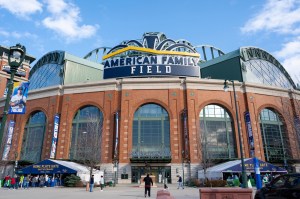
After saying goodbye to County Stadium at the end of the 2000 season, an emotional goodbye to a building that served as home to both the Milwaukee Brewers and Milwaukee Braves, the Brewers opened their new stadium with the first game April 6, 2001.
President George W. Bush threw out the first pitch. The stadium with the retractable roof marked an entirely new era for Milwaukee baseball, even if the team that struggled through the ’90s would continue to scuffle for the first few years in the new digs.
The All-Star Game tie (2002)
It was seen as a blight (perhaps unfairly) on Bud Selig’s tenure as MLB commissioner that the 2002 All-Star Game in his hometown of Milwaukee ended in a tie.
He famously threw his hands in the air in the stands as umpires conferred with him about what to do once the pitching had run out in extra innings.
MLB tried to counter future ties by implementing a short-lived idea of giving the All-Star Game winning league the home-field advantage in the World Series.
It’s back to being a simple exhibition these days.
Bob Uecker’s Hall of Fame speech (2003)
The moment is a perfect representation of Bob Uecker, the comedic genius who also happened to love calling baseball games for his hometown Brewers.
An iconic figure in Milwaukee sports history, the beloved broadcaster delivered a hilarious speech of deadpanned one-liners in Cooperstown as he accepted the Ford C. Frick Award, presented each year to an announcer.
His death before the 2025 season at age 90 marked a heartbreaking chapter for Brewers fans who wanted to see their voice of summer calling the action in a World Series. His presence around the franchise will linger for years to come.
How can an 81-81 season make a fan base so happy? Though the team wasn’t yet a playoff contender, it had its first non-losing season since 1992, a promising sign in the early years of the Doug Melvin, Ned Yost and, most importantly, first-year owner Mark Attanasio, who had purchased the controlling stake of the team from the Selig family.
CC Sabathia (2008)
Melvin swung a deal that would finally help the team break its 26-year streak without a playoff appearance in the summer of 2008, acquiring reigning American League Cy Young CC Sabathia from Cleveland.
He led Milwaukee on a dramatic ride with a Herculean performance, anchored by a series of late-season starts on short rest.
It was one of the biggest swings in Brewers history, and Sabathia’s half-season in Milwaukee became immortalized.
Ryan Braun’s homer in the season finale (2008)
Facing the Chicago Cubs and needing a win to try to secure the National League wild card, the Brewers won in dramatic fashion, with Ryan Braun’s eighth-inning homer against Bob Howry flipping the scoreboard.
Sabathia finished off a complete game by getting a game-ending double play in the ninth, and when the New York Mets lost, the Brewers had officially snapped their 26-year playoff drought. The exit came quickly in a four-game series against the Philadelphia Phillies, but Milwaukee had broken through.
The Tony Plush walk-off (2011)
Three years after the 2008 success, the Brewers had their first playoff series victory in nearly 30 years.
Nyjer Morgan, the energetic and popular center fielder who adopted the alter-ego he named “Tony Plush,” singled in the bottom of the 10th inning to plate the winning run in a heart-stopping walk-off win over the Arizona Diamondbacks in Game 5 of the NLDS.
That sent the Brewers to the NLCS, where an ugly loss to the Cardinals awaited, but it was another milestone on the journey back to relevance.
Ryan Braun’s PED suspension (2012)
Ryan Braun authored a litany of incredible moments in his career, and he was named the National League MVP after the 2011 season. That news came in November; in December came something else, a leaked report that he would be facing a suspension for using performance enhancing drugs.
He successfully appealed the decision and gave a defiant press conference early in 2012, but his words were given renewed scrutiny after additional evidence linked him to PEDs, and he wound up accepting a suspension in 2013.
For many fans, the revelation soured their relationship to Braun, and it minimally left him with a complicated legacy.
But he remains one of the greatest players the franchise has ever known, and he’s part of the organization’s Walk of Fame.
Yelich and Cain on the same day (2018)
The beginning of Milwaukee’s sustained relevance truly launched on Jan. 25, 2018, when the Brewers announced they had traded for Christian Yelich and signed outfielder Lorenzo Cain on the same day.
Cain, signing the biggest free-agent contracts in franchise history, came back to the franchise that drafted him before trading him to the Kansas City Royals.
Yelich, who had been with the Miami Marlins, became an immediate MVP in 2018 and steered the Brewers into a new direction. Both were essential components of a rebuilt team under general manager David Stearns.
Game 163 (2018)
The 2018 season was loaded with highlights, but Game 163 may have been the best of all.
A late-season run of consecutive wins put the Brewers in position to win the division, necessitating a one-game tiebreaker against the Chicago Cubs for the Central crown (a format no longer used by MLB).
The Brewers went to Wrigley and won, 3-1, then continued winning through a three-game NLDS sweep of the Colorado Rockies and a win over the Los Angeles Dodgers to start the NLCS.
The 12 straight wins triggered a famous George Webb free hamburger promotion for the second time in franchise history, but the Brewers ultimately lost the NLCS in seven games.
Brandon Woodruff vs. Clayton Kershaw (2018)
Pitchers no longer bat in the National League, so what Brandon Woodruff did in Game 1 of the NLCS against the Dodgers may never be replicated again.
The excellent Brewers starter (working as a reliever that day), took future Hall of Famer Clayton Kershaw out to right field for the first run of the game, winning a lefty-lefty battle in improbable fashion. The Brewers won the game but lost the series.
Christian Yelich fouls a ball off his knee cap (2019)
The final throes of 2019 brought a two-pronged dose of heartbreak. First, Christian Yelich fouled a ball off his kneecap in September, causing a devastating fracture that kept him out the rest of the year in the midst of what could have been a second straight MVP season.
Yelich, who re-signed on a massive contract before 2020, never quite replicated the production of those first two seasons.
Without him, the Brewers built a lead over the Washington Nationals in the wild-card game, but a costly outfield error by Trent Grisham allowed the Nats to take an eighth-inning lead and prevail, 4-3, to end Milwaukee’s season.
Corbin Burnes dominates for the Brewers (2021)
Home-grown pitcher Corbin Burnes put on a show in 2021, earning the National League Cy Young Award and playing a role on an elite pitching staff that also included Woodruff and Freddy Peralta.
It also included all-world closer Josh Hader, who conspired with Burnes to record the second no-hitter in franchise history on Sept. 11 of that season, with Burnes throwing the first eight innings in Cleveland.
Craig Counsell leaves (2023)
It was seen as a betrayal that Brewers fans simply didn’t see coming. Craig Counsell, the winningest manager in Brewers history who had been part of the franchise turnaround since taking over in 2015, had announced he wasn’t coming back to the Brewers and instead taking the job as manager of the Chicago Cubs.
Counsell, a home-grown former MLB player who grew up in Milwaukee suburb Whitefish Bay, took a big payday to manage the team’s most bitter rival.
He gets booed heartily upon returning, though his replacement (and his former college coach), Pat Murphy, has won back-to-back manager of the year awards and may win a third this season.
Pete Alonso (2024)
Unceremonious departures from the playoffs in 2020, 2021 and 2023 weren’t great. But nothing hurt as badly as 2024.
Tied at one game apiece in the wild-card series against the New York Mets, the Brewers took a 2-0 lead into the ninth and sent closer Devin Williams to the mound. But Pete Alonso clubbed an opposite-field three-run homer with three outs, and the Mets eventually won, 4-2.
Bob Uecker, calling what we now know was his last Brewers game, somberly noted that the loss “has some sting on it” as Milwaukee’s season came to an end.
Eliminating the Cubs (2025)
The 2025 season was sensational for multiple reasons, including a franchise-record 97 wins and a 14-game winning streak that matched the longest in franchise history.
But facing and then beating the Cubs in the National League Division Series, the only playoff series the franchise has ever played against a Chicago foe, may have been the sweetest.
The Brewers took a 2-0 lead in the NLDS before dropping back-to-back contests, then needed a 3-1 win in Game 5.
The only problem is that the team ran into a roadblock from there, a 4-0 series sweep at the hands of the Dodgers in the NLCS.
World Series (2026)
The postseason has already been full of magic moments: Garrett Mitchell’s catch, Jackson Chourio’s walk-off hit, beating the Dodgers’ four aces, Jake Bauers’ epic at-bats and Aaron Ashby’s relief pitching.
The regular season wasn’t so bad either, notably for the otherworldly work by eventual 2026 Cy Young winner Jacob Misiorowski.
Already owning 103 regular-season wins to obliterate the previous franchise record, the Brewers have a chance to do something even better.
This article originally appeared on Milwaukee Journal Sentinel: Relive the history of the Milwaukee Brewers in these 30 moments
Our editors independently choose our recommendations. Some content is produced with paid support from a third party, however our editorial decisions remain independent. If you buy through our links, the USA TODAY Network may earn a commission. Prices and availability may change.
USA TODAY Network via Reuters Connect