Otis East went to college to play basketball. But when he tore his ACL before his first game, he was benched for the season. It was a very, very hard time in his life.
But it was also a new beginning. Injured and largely confined to his dorm, Otis started playing Call of Duty. In the video game, he worked with other gamers to build teams, practice, develop strategies—it was a bit like playing ball again.
“I know it sounds dramatic, but gaming saved my life,” Otis said to me when we chatted over Discord. Fellow Call of Duty gamers encouraged him and talked him through this dark time. Some of those gamers remain part of his closest circle today.
Otis’ story changed my perspective of video games and gamers. Besides dabbling in Stardew Valley and playing Bee Swarm Simulator with my kid, I know little about gaming. But that doesn’t mean I haven’t been suckered in by the stereotypes of gamers: anti-social, neckbeard loners who are, at best, dull or, at worst, aggressive.
Every tree has a bad apple, but the stereotypes about gamers and online spaces are often wildly untrue.
Through the years, I’ve written about third places: social spaces that are distinct from homes or workplaces. I travel and work in rural America and have witnessed their decline firsthand. I’ve seen closed-up diners where old-timers used to spin a yarn.
I’ve seen newly built coffee shops with drive-through windows, but few tables inside. In many towns, third places have evaporated entirely as communities are squeezed between corporatization and budget cuts, with pro-privatization politicians gleefully gut-punching public libraries, parks, community centers, and even schools.
As a result, we’ve retreated inward and indoors. The pandemic seemed to cinch the deal: We Americans now get our entertainment at home and even do our grocery shopping from the couch. Instead of eating out, we DoorDash meals; instead of going to the movies, we stream.
But in all this anti-social gloom and doom, I’ve come to see there is actually one third space that is thriving. It’s what Otis found all those years ago: video games.
Virtual spaces, real community
Since meeting Otis, I’ve talked to gamers all over the country who have helped me understand the powerful impact of gaming as a community-building agent.
I spoke with Polly, who lives in California, who tells me that gaming helped them shape their identity as a queer person. Specifically, they told me about the way The Sims had been coded so that players could create characters along the gender spectrum. “As a kid, it was a place where I could make myself who I wanted to be,” they said. “It became a community where that was natural and there was no othering.”
I met CrumbCake, from New Jersey, who tells me about how gamers create wonderful support networks for each other. She told me about her organizing “raids” to support small-time streamers—a practice where gamers descend on one live stream together, driving up views and hijacking the algorithm to give that streamer more visibility. “It may not be a huge movement,” she said, “but it’s a way to support other creators in a place and within an algorithm that is otherwise alienating and unfair.”
And I talked to Prizzo, a Coloradan who not only met his wife through gaming but also spoke beautifully about how gamers work to keep game spaces healthy, coordinating to drive out bad actors and setting up positive guidelines for engagement in their chats and communications.
Otis, Polly, Crumbcake, and Prizzo are all part of The Players Alliance, a movement of gamers working to hold corporations accountable so video games remain creative and affordable. They connect over their love of the gaming community, and—I have learned—are pretty concerned about protecting these third places.
The work they are doing together is akin to consumer organizing around pocketbook issues. The global gaming industry is projected to reach around $205 billion in 2026 and 212 million Americans game in some shape or form. As a result, big corporations are seeing the huge profit possibilities and are trying to extract more and more money from gamers via in-game purchases, upgrades, and loot boxes.
Protecting the ‘digital neighborhood’
But The Players Alliance also engages in community organizing in its most basic sense. Like housing activists or small-town residents rallying against data centers being built in their backyards, gamers are banding together to build the power they need to protect the online spaces they inhabit.
And right now, that digital neighborhood is under threat. In what would be the largest leveraged buyout in history, game maker Electronic Arts is being purchased by Saudi Arabia’s sovereign wealth fund, an investment fund run by Jared Kushner—and a California-based private equity firm—for a whopping $55 billion.
This deal has The Players Alliance gamers worried—and fired up. Electronic Arts owns some of the most popular games, including Madden NFL, Battlefield, and The Sims. Otis pointed out that the size of this deal, especially because it includes private equity, likely means EA will squeeze players for ever-more profits, while Polly points out that the Saudi government’s track record on human rights doesn’t bode well for The Sims’ enormous queer fanbase: “Will the open and creative elements that made it so popular with the queer community be allowed to remain?”
With all this money and political influence entwined with games, Prizzo worries about the future of the third spaces he values so deeply: “These aren’t people or companies who are in it for the love of the game. They are here for the money.”
But gamers are trying to stop this deal—and to flex their numbers to influence the future of gaming. The Players Alliance launched a petition asking the Treasury Department not to approve the deal. At the time of writing, it had over 73,000 signatures.
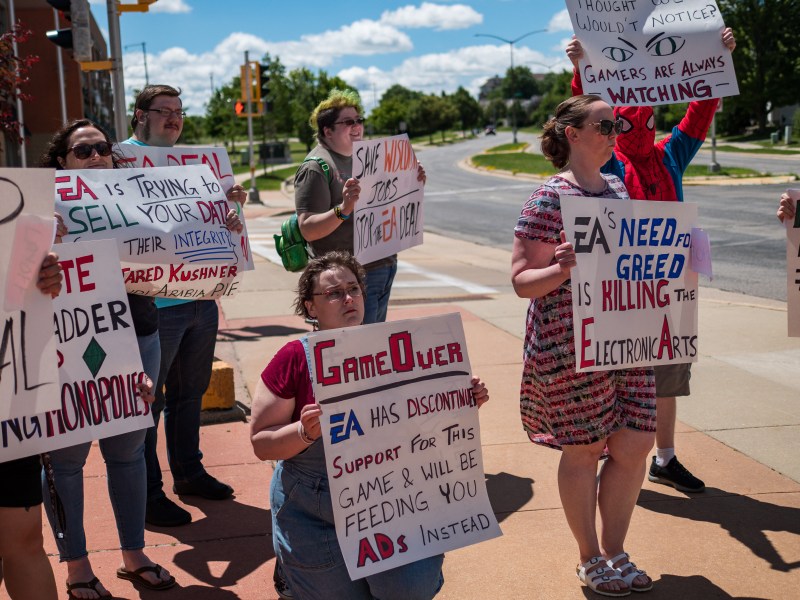
Even more interesting, the people who want to protect these online third spaces are now showing up offline: Over the last month, gamers have protested outside EA offices in Redwood City, California; Madison, Wisconsin; and Orlando, Florida. They’ve even gone to Washington to meet with their lawmakers IRL.
In a time of social decline, gaming is one of the few thriving third places left. What these gamers are doing is the absolute opposite of antisocial. It’s pro-social, it’s public, and it’s building a powerful community ready to take on monopolies and corporate power in defense of us all.
In other words, in a time of decline, gaming is a thriving third place we absolutely need– and should protect.