Reporting by Abigail Bottar, Harvest Public Media / Wisconsin State Farmer
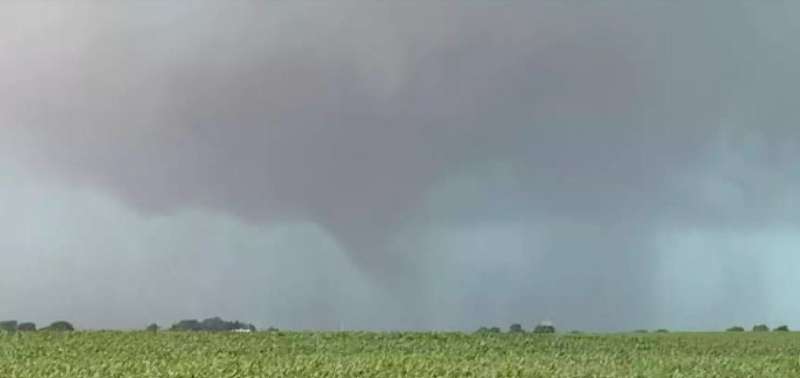
The U.S. has had a busy tornado season so far, and the majority of the storms are blasting through the Midwest, east of what’s traditionally thought of as Tornado Alley.
Wisconsin has seen a higher than average number of tornadoes so far this year, according to data from the National Weather Service.
“It’s been an active tornado year so far across Wisconsin with 39 documented tornadoes, which ties it with (2025) for the sixth most in an entire year since 1950,” the NWS wrote in an update released Monday.
The NWS says the average number of tornadoes for Wisconsin in a calendar year is 23. In recent years, the state has seen tornado totals around double that number.
Historically, tornadoes have most frequently touched down in the Great Plains, hitting states like Kansas, Oklahoma and Texas, but research has found since 1979 that pattern has been shifting.
“Tornadoes have been happening with less frequency in the Great Plains over the last 40 years,” said Victor Gensini, a professor and director at Northern Illinois University’s Center for Interdisciplinary Research on Convective Storms. “And they’ve been having greater frequency in places like Illinois and Indiana and Tennessee and portions of the Mid-South and the Midwest.”
NWS data shows some of the worst tornado years for Wisconsin have been recorded in just the past two decades. And the Wisconsin State Climatology Office’s June 2026 Climate Summary found storm warnings were common this year.
“With 183 severe thunderstorm and tornado warnings issued in the state (nearly double the monthly average), it was Wisconsin’s most active June since 2008,” the summary states.
And, as of July, Wisconsin has already tied with last year’s total number, according to NWS data.
Illinois leads the nation with 178 tornadoes so far, according to the National Weather Service. That’s more than three times the typical number of tornadoes — 54 on average — Illinois experiences annually.
Missouri also has far outnumbered the state’s average of 52 tornadoes in recent years. And Indiana broke the record for most tornadoes in the state this year with 77 so far, according to the National Weather Service. The state averages 22 tornadoes annually. In Iowa, there have been 68 tornadoes this year, while the state averages 50.
The growing number of tornadoes in the Midwest is a trend Gensini has been studying for nearly a decade. He published groundbreaking research in 2018 first showing that tornadoes are shifting east.
“If the last eight years have shown us anything since that paper was published, it’s that these trends are continuing,” he said.
While 2026 isn’t the worst year on record for Wisconsin tornadoes, the impact and severity of the twisters are notable.
The NWS has recorded three EF3 tornadoes statewide so far. The first hit on April 14, near Union Center in southern Wisconsin. The second came on April 17, in Buffalo County near the Minnesota border, and the third hit the same day near Ringle, in central Wisconsin.
There have been a number of smaller EF2, EF1 and EF0 tornadoes this year, according to the data.
In 2025, there were no EF3 tornadoes in Wisconsin, according to NWS data. There were four EF2 tornadoes, and multiple smaller twisters.
Changing trends
An EF3 tornado touched down in Effingham, Illinois, on June 17, downing trees and power lines and flattening a family-owned Corvette museum and parts store. Owner Michael Yager grew up in the area and was at home when the tornado touched down.
“I don’t ever recall anything of this nature being around here,” he said. “I mean we’ve had thunderstorms and winds and things of that nature, but never anything like this.”
Experts say warmer temperatures brought by climate change could be contributing to this increase in activity in the Midwest.
“The conditions are kind of favorable, right, if we have more of that heat and humidity laying around,” Gensini said.
Still, he said it’s impossible to tell if any single tornado in the Midwest is caused by climate change. He likens it to the steroid era of baseball, when a number of players were believed to be using performance-enhancing drugs.
“I don’t think anybody could have looked at a single home run and said, ‘That home run was directly due to steroids,’” Gensini said, “but if you look at the number of home runs during the steroid era, basically everybody that knows anything about baseball looked at that and said, ‘Whoah that’s a statistical anomaly.’”
Climate change can also impact when tornadoes occur, according to Missouri State climatologist Zack Leasor, creating a longer window for the possibility of severe weather.
“One thing I think that’ll really in the future start to show more with climate change is we’ll see some more severe weather and tornadoes in other parts of the year that were traditionally cold,” he said.
Still, experts say there’s no simple link that can be made between more tornado activity and climate change.
Steve Nesbitt, who heads the Department of Climate, Meteorology and Atmospheric Sciences at the University of Illinois Urbana-Champaign, said the pattern changes seem consistent with a warming climate — but more information is needed.
“Without doing a lot more research on this topic, it’s tough to attribute what we’re observing in severe weather directly to climate change,” he said, “but we do know that a lot of the impacts of climate change can lead to more severe weather.”
Even as tornado activity has increased in the Midwest, it hasn’t lessened the risk of tornadoes in what’s traditionally been considered Tornado Alley — South Dakota down to Texas’ panhandle.
“The trend has been for more tornadoes in Illinois and portions of the Midwest, but that doesn’t mean it’s shifted away from the Great Plains,” Gensini said. “The Great Plains — they’re still the highest density or the highest frequency of these events every single year.”
As for why Illinois is currently leading the nation, there’s no scientific reason the state has seen significantly more tornado activity than Indiana or Missouri, said Illinois State Climatologist Trent Ford.
“The fact that Illinois is getting pummeled at a disproportionately high rate relative to other similarly sized states nearby is chalking it up to bad luck, unfortunately,” he said.
Being prepared
As of May, there have been 763 tornadoes nationwide, according to preliminary data from the National Weather Service. Twelve people have died.
“I’m calling this year a huge success: record numbers of tornadoes but not record number of fatalities,” Gensini said.
Midwesterners should be prepared to continue seeing a large number of tornadoes, even if they don’t live in a typically tornado-prone state, he said.
“I think everybody regardless of where you live in the Midwest, I think really should have a tornado safety plan,” Gensini said. “Where are you going to go if a tornado warning is issued?”
He recommends going to the basement, lowest level of a building or an interior room without windows and making a safety kit.
“Your safety kit should probably have a bike helmet in it,” Gensini said. “Most of the injuries and fatalities that we see from tornadoes are blunt force trauma to the head, so what better way to stop that from happening then a bike helmet?”
While the number of tornadoes and severity is not changing nationally, Gensini said, property damage from these severe storms is. That’s due to the increase in the human footprint. A tornado that once would have passed through a cornfield might now tear down a strip mall.
“We have a lot more bullseyes on the dartboard for these events to hit,” he said.
Meteorologists have gotten a lot better at forecasting the conditions that can lead to tornadoes, but Gensini is worried cuts to the National Weather Service by the Trump administration could put that at risk.
“We are missing dozens of weather balloon launches across the country, especially in the center part of the country, which are having an impact on our morning forecasts for severe storms,” he said.
This story was produced in partnership with Harvest Public Media, a collaboration of public media newsrooms in the Midwest and Great Plains. It reports on food systems, agriculture and rural issues. WPR’s Avery Martinez contributed. This article was republished with permission from Wisconsin Public Radio.
This article originally appeared on Wisconsin State Farmer: Tornadoes are breaking records in Midwest states as Tornado Alley moves east
USA TODAY Network via Reuters Connect