Advocates say Build Back Better is needed to rescue a childcare system in crisis that pairs high costs and low availability for parents with low pay for providers.
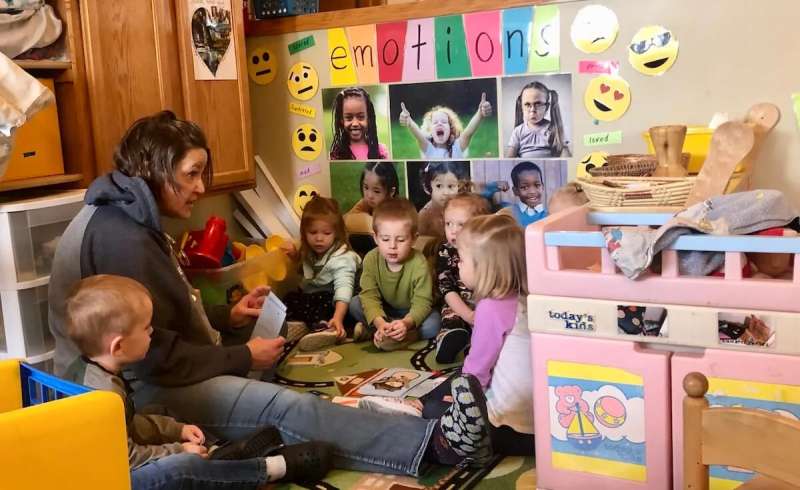
It’s a brisk January morning at Community Care Preschool and Child Care in Beaver Dam, and the center is teeming with activity. Students are busy playing games, singing songs, building playhouses out of old shipping boxes, and learning their ABCs.
The center, which has served rural Dodge County for years, has managed to hold on to a dedicated team of career-minded caretakers and early childhood teachers, but it lost three staff members in September as other industries were increasing their wages.The center was able to weather the storm by adjusting schedules and did eventually find skilled childcare workers to replace the staff they lost, but the process wasn’t easy.
“There are very few applicants, and you really have to sift through them … so it becomes a big challenge because [workers] in this industry have not been well-compensated.,” Community Care Administrator Renae Hennig said. “We say we were in crisis before, but now that the pandemic hit, our industry has crumbled”
While more than 80% of childcare workers in Wisconsin have at least some college-level schooling in early childhood education—58% have an associate degree or higher—most make less than $13 an hour, and only 1 in 5 receive health insurance through their employer.
The inability to compete with more typical businesses’ pay rates has left childcare providers in a lurch and parents struggling to find care for their young children. It’s also made rural Wisconsin’s many “childcare deserts” even tougher places to live for working parents. According to the Wisconsin Early Childhood Association (WECA), three-quarters of childcare centers are currently looking for workers.
“You can really tell that parents are scrambling to find childcare. One of the other centers in town is operating at 50% capacity because they can’t find qualified staff. I would say that every week, without exaggeration, I turn away two to three people, especially for infants to 2 ½,” Hennig said. “It takes a village to do this work, so the family childcare providers, the group childcare centers, we kind of make this net for the community, but the strings of the net are breaking.”

Build Back Better
The staffing situation, along with the mounting cost of child care for families—between $10,197 and $12,567 a year in Wisconsin alone—has childcare advocates calling on Congress to pass the Biden administration’s Build Back Better package. The bill—stalled due to opposition from all 50 Republican senators and Democrat Joe Manchin of West Virginia—aims to lower costs while guaranteeing a living wage to skilled early childcare workers and educators.
The measure would use federal dollars to subsidize the cost of child care for most families, using a sliding scale based on their income. Families making up to 250% of the state’s median income—a household income of up to $259,270 for a family of four in Wisconsin—would be eligible. Families would pay a portion of the cost of child care for children up to age 5 as a “copayment” and the government would pick up the rest. The goal under the legislation is for working families to pay no more than 7% of their income on child care. Today, many families in the state pay much as 18.5% of their income for child care.
A calculator set up by the education policy-focused Hunt Institute allows people to punch in their income and family size to see just how much of a break they would get on their current childcare bill if Build Back Better becomes law.
Lower-income families—those at or below the state’s median income—would be the first to receive subsidized care, and those in the 125-250 percentage range would follow in subsequent years, according to the Hunt Institute. A family at 100% of the median income or less—in Wisconsin, $103,708 or lower for a family of four—would see their entire daycare bill paid for by the government.
“We pay for child care on the backs of working parents, and working parents are tapped out,” WECA Executive Director Ruth Schmidt added. “Moving to a place where we see child care as a public good as opposed to a private marketplace is something that I think our nation needs to do. … So, in order to get revenues into child care, we need a public investment like Build Back Better.”

Universal Pre-K
Schmidt is also eager for the universal pre-K portion of Build Back Better, which would guarantee free pre-Kindergarten for all 3- and 4-year-old children, allowing for what providers call a mixed delivery system in which the government would subsidize programs in school settings and private childcare centers.
Designed as a state-federal partnership, the proposed expansion would build on—rather than replace—existing state prekindergarten infrastructure, providing additional funding and permitting so that more children could be served, according to the Hunt Institute.
“To me it’s the pairing of universal preschool with this enormous investment in childcare — you do those two things together, everybody wins,” Schmidt said.
A Critical Time
For Hennig, passing Build Back Better would mean that the country will finally invest in early childhood education in a way that will truly make an impact on the mental and emotional health of children, better preparing them for their K-12 education—and later, the workforce.
“We’ve always believed here in early childhood that if we do this right, and we care about the quality of where our children spend their time, that is going to multiply in investment in healthier social and emotional outcomes for children,” Hennig said. “If children don’t have [good emotional and social skills], it doesn’t matter how well they can read or do math. Because if they can’t problem-solve and get along well in a group or manage their big feelings, you can do all the math you want [and it won’t matter].”
She added, “We need this. It’s time for our legislative and business leaders to come together and recognize how important this is.”