Reporting by Colleen Kottke, Wisconsin State Farmer / Wisconsin State Farmer
The droughts that have challenged livestock and crop producers in recent years have tested the best of Midwest families, but they are a far cry from the crisis that engulfed central Wisconsin in 1934, when farmers across the state’s Central Sands watched their livelihoods disappear into the wind.
“You should’ve seen the dust,” Adams County farmer George Romell recalled years later to historian Michael J. Goc. “It buried the fence like snow.”
While haunting images of author John Steinbeck’s Oklahoma families in his 1939 novel The Grapes of Wrath captured the nation’s attention, Wisconsin farmers were fighting their own battle against the wind and heat in central Wisconsin.
In Goc’s article “The Wisconsin Dust Bowl,” published in the Wisconsin Magazine of History in 1990, he examined how drought and wind erosion created Dust Bowl–like conditions that took a toll on farm families living in central Wisconsin during the 1930s.
By spring 1934, farmers across central Wisconsin were already reeling from years of economic hardship. The farm economy had struggled since the end of World War I.
Late historian and former UW Professor Jerry Apps once penned that the sand counties of Central Wisconsin – Portage, Waushara, Marquette, Adams and Wood – were considered marginal at best (and declared worthless by some) for growing crops.
“Jokes about ag prospects of those counties abounded,” Apps wrote. “Even the crows carry their lunches when they fly over.”
Farmers there worked some of the state’s lightest soils – land so sandy that water quickly drained away and crops depended heavily on timely rainfall.
When the rain stopped, the land was extremely vulnerable and farmers began to worry.
“Two weeks without a decent rain and things were burning, three weeks, farmers are starting to pray for rain, and four weeks, they’re willing to sacrifice their firstborn,” said Justin Isherwood, whose family farmed in Portage County.
A drought unlike anything farmers had seen
U.S. Weather Bureau records confirm that the spring of 1934 was one of the most severe drought periods in Wisconsin’s recorded history. In the 70 years the agency had been compiling daily precipitation records, no April, May and June had ever been so dry. Midwest states of Minnesota, Iowa and Wisconsin were the driest of all. Crop production in the region was already scant due to a dry spell stretching back to 1930. In 1934, rainfall dropped to a fraction of normal levels statewide, leaving soils parched during the critical planting season.
U.S. Weather Bureau officials report that over 60% of the U.S. was in drought between 1930 and 1936.
According to weather records cited in The Wisconsin Dust Bowl, Wisconsin received only about one-third of its normal precipitation during May. Conditions were actually drier than those experienced in parts of the Great Plains that would later become synonymous with the Dust Bowl. In fact, Wisconsin’s worst dust storms occurred nearly a year before the infamous Oklahoma Panhandle storms of 1935.
After rains fell in early April, the Stevens Point Journal reported that the rain disappeared for more than two months. Worse yet, temperatures soared, with the Hancock weather station recording multiple days above 90 degrees in May, including a Memorial Day reading of 105 degrees. Pastures dried up and feed supplies dwindled and leaving many herds of cattle hungry.
Due to a warm, dry winter the year before, grasshopper populations exploded and fed on already struggling crops. Tinder-dry conditions on cropland and marshes increased the wildfire danger.
When the soil took flight
Then came the storm.
On May 9 and 10, 1934, powerful winds swept across the Upper Midwest, creating one of the largest dust storms ever recorded. The storm carried an estimated 300 million tons of soil, darkening skies from Canada to Texas and eventually reaching the Atlantic Ocean. In Washington, D.C., dust reportedly settled inside the White House, Goc wrote.
Some folklore notes that chickens headed into the coops to roost as the sunlight began to disappear.
University of Wisconsin Extension agent Henry Noble left a meeting early and drove westward into the dust, and was forced to turn on his headlights to see the road. The 60 mph winds bent top-heavy jackpines to the ground. Noble said he woke up the next day to see the outline of his body on the bed due to the blowing sand,” Goc wrote.
In Wisconsin, the damage was devastating.
The winds tore through central Wisconsin’s sandy soils, burying crops, filling roadside ditches and stripping valuable topsoil from fields. Farmers compared the drifts of sand to snowbanks. Corn, peas, soybeans, alfalfa and oats were cut down or completely buried. In Adams County, highway crews used snowplows to remove sand drifts from roads.
Researchers later estimated that up to a foot of soil was removed from some fields and that nearly 2 million acres in Wisconsin suffered some degree of wind erosion. Federal investigators identified the Plainfield Sand region of central Wisconsin as one of the most severely wind-eroded landscapes east of the Mississippi River.
Livestock feed crisis resulted in sold, destroyed animals
While the dust storm captured headlines, the immediate concern for many farmers was livestock feed.
Hay and grain production had already been devastated by drought. Pastures disappeared. In Wood County, officials reported cattle starving because farmers had exhausted available feed supplies. Some producers grazed livestock along railroad rights-of-way or roadsides simply to keep animals alive. Goc wrote that “90 percent of Wood County pastures were destroyed by the middle of May, and county agricultural agent Harold Lathrop reported cattle and work horses starving on local farms.”
Others talked openly about being forced to sell or destroy livestock they could no longer feed. The Wisconsin Rapids Daily Tribune reported that ‘hundreds of fine herds throughout the county are actually starving to death and can give no milk … gaunt animals with ribs sticking out their sides gave ample proof of the serious condition.”
The crisis eventually prompted significant government intervention. Federal drought-relief programs provided emergency feed, seed, livestock assistance and work projects. Adams County alone saw more than three-quarters of its farmers participate in drought-relief programs. Across central Wisconsin, assistance became essential to keeping many farm families on the land.
The emergency seed program proved to be one of the most effective drought-relief efforts. The federal government shipped surplus seed, including alfalfa, clover, oats, wheat, soybeans, millet, sudan grass and corn, into drought-stricken areas. Some crops were chosen simply because they were available, making once-rare crops such as millet and sudan grass common sights in Wisconsin’s Sand Counties, Goc noted.
The program succeeded largely because rains returned before the end of the growing season. While late-planted crops often failed to mature fully, they still provided valuable livestock feed. Relief efforts also helped absorb federal crop surpluses at a time when drought was sharply reducing yields across much of the Midwest.
Drought aid was provided as loans that farmers repaid with cash or labor. Many worked on public projects, especially highway construction, to earn relief assistance.
According to Goc’s report, Wisconsin received approximately $10 million in federal drought relief funds throughout the emergency that lasted until the end of 1936.
Most of them chose to stay
Unlike many Dust Bowl families on the Great Plains, most Wisconsin farmers did not abandon their farms and head west in search or work or a better life in southern California. Rain returned in June 1934, emergency government programs helped keep farms operating and many families chose to stay and rebuild.
Of course, economics played a major role in keeping farm families on the land. With unemployment soaring and little work elsewhere, most had little choice but to stay and endure the drought. In fact, like many rural areas of Wisconsin, the Sands gained population during the accompanying Great Depression as unemployed city residents sought a more self-sufficient life in the countryside. Even amid drought conditions, rural living often seemed preferable to the uncertainty of urban hardship.
Isherwood recalls hearing stories where down-on-their-luck relatives moved back to the home farm during the Depression.
“They would redo a chicken coop to live in because the relatives were out of work,” Isherwood said. “They didn’t come back to the farm to make a living, but seeking sustenance for survival’s sake.”
Once again, the Sands became a haven for people willing to gamble on a modest opportunity and a fresh start. That changed in the 1940s, when a stronger economy and growing job prospects off the farm prompted many residents to leave. This marked the beginning of a long, steady decline across Wisconsin.
Lessons learned from the wind, nature and the county agent
The county agricultural agent became one of the most influential people in rural Wisconsin during the Depression and drought. He was already known as a trusted adviser who promoted university-backed farming practices, who now took on an expanded role as the local administrator of New Deal programs. When drought hit, the county agent became the go-to person for farmers seeking relief and assistance to keep their operations going.
The county agent became the local face of the many government programs aimed at helping farmers through the Depression and drought. As he took on new roles, farmers were more willing to listen to advice he had been giving for years. With government funding and seed programs providing a helping hand, more growers tried improved crops, spread marl to reduce soil acidity and adopted soil-saving practices. Ideas that had once been discussed at meetings or demonstrated in field trials were now being put to work on farms across the region, leaving a lasting mark on the way agriculture was practiced.
“This face-to-face educational effort … served a social purpose as well,” Goc wrote. “The local farm community came together on meeting night to confront a common enemy.”
The drought of 1934 was more than a farm crisis. It was an environmental wake-up call that exposed long-standing problems with how parts of the Sands had been settled and farmed. The Wisconsin Resettlement Administration helped move families off isolated, unproductive farms, reducing service costs and returning marginal land to forests, wildlife habitat and other uses better suited to the landscape.
By the end of 1934, Wood County’s zoning ordinance set aside large marshland areas for cranberry production, recognizing that the wet soils were more conducive to growing cranberries than traditional crops. Subsequent dam and dike construction gave growers the water control needed to protect beds from frost, helping lay the foundation for the region’s modern cranberry industry. Today, Wisconsin is the top cranberry-growing state in the U.S.
The massive dust storm of May 9, 1934, created a sense of urgency that made people more willing to try new approaches. In response, agricultural agents like Henry Noble and Extension forester Fred Trenk, pushed conservation practices that worked with the sandy landscape instead of against it. The goal was not just to help farmers survive the immediate crisis, but to encourage farming methods that could better withstand the region’s challenging conditions in the years ahead.
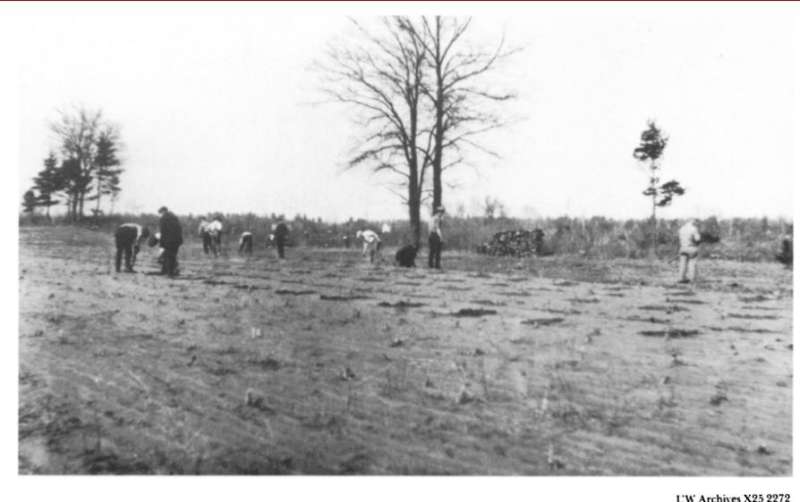
Perhaps the most visible legacy of the 1934 Dust Bowl was the massive shelterbelt program that followed. Shelterbelts are rows of trees planted along the edges of fields designed to slow the wind and prevent valuable topsoil from blowing away. University experts like Noble and Trenk and their predecessors had promoted the practice for decades, urging farmers to leave or plant tree strips as natural windbreaks. While only a handful of central Wisconsin farmers adopted the idea before 1934, interest grew after the drought and dust storms highlighted the need for soil protection.
“We had to do something, so we planted pines,” recalled Adams County farmer Floyd Reid, according to historian Goc’s article The Wisconsin Dust Bowl.
Trenk says farmers were amazed by how effective the shelterbelts, planted years earlier in Portage County, proved to be during the May storm.
“The protection given to fields by the oldest of these demonstration shelterbelts was little short of sensational,” Trenk reported. “Full crops of alfalfa and grain were harvested in the zones protected by the shelterbelts. Beyond this protected area, losses were extremely heavy.”
The state conservation department raised the trees from seed and shipped seedlings to local farms or town halls to be distributed to landowners to establish shelterbelts, windbreaks and woodlots. Farmers embraced the idea. Between 1935 and 1942, about 2,000 farmers each year planted nearly 3,300 miles of shelterbelts across seven central Wisconsin counties, reaching the program’s 10-year goal two years ahead of schedule.
A lasting legacy and a lesson for landowners
Perhaps most remarkable is that farmers planted millions of trees knowing they wouldn’t see the full benefits for many years. Many would never live to see their shelterbelts fully mature. But the dust storms of the 1930s changed attitudes about the land. Before then, only a handful of farmers had planted shelterbelts. Afterward, many farmers saw tree planting as a practical way to protect their soil and leave the land in better shape for the next generation.
The 1934 disaster ultimately transformed how central Wisconsin farmers managed the land. Farmers who had spent decades trying to conquer the sandy landscape increasingly embraced conservation practices designed to work with the land rather than against it.
The Dust Bowl years are often associated with Oklahoma, Kansas and Texas. But for many Wisconsin farm families, the memories were just as real.
In 1934, the Dust Bowl came to Wisconsin, and it changed agriculture in the state forever.
This article originally appeared on Wisconsin State Farmer: Wisconsin’s Dust Bowl, lessons learned from the storm changed farming
USA TODAY Network via Reuters Connect