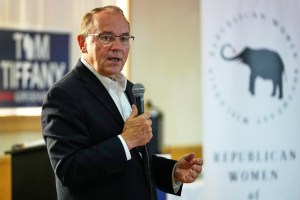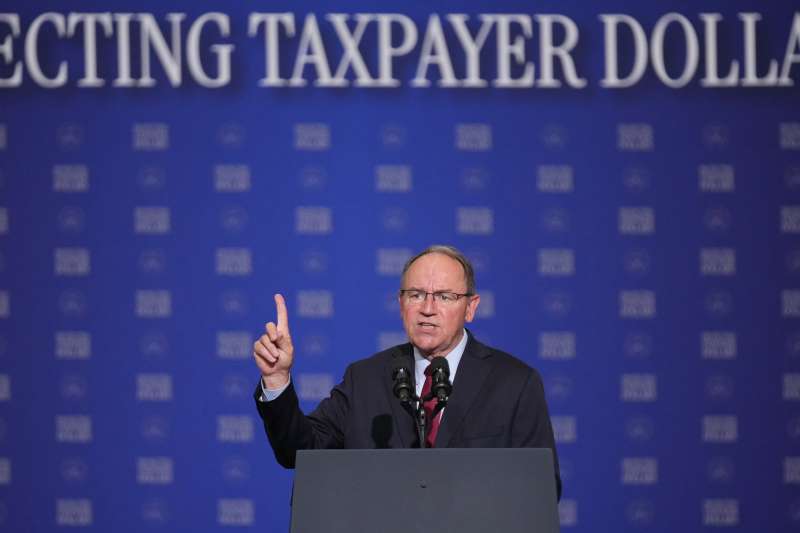
In a campaign ad this spring, US Rep. Tom Tiffany (R-WI) promised to cut red tape and stop Wall Street from buying Wisconsin homes. When Congress voted on a housing law that does both, he didn’t show up.
The 21st Century ROAD to Housing Act became law on July 11. It’s the most sweeping federal housing legislation in decades. Title X, central to the law, bars large institutional investors that control 350 or more single-family homes from buying additional ones. Violations carry civil penalties of up to $1 million. The restriction takes effect 180 days after enactment and clears barriers to building more housing in Wisconsin.
The House voted on the bill on Feb. 9, May 20, and June 23—and Tiffany missed all three votes, making him the only member of Wisconsin’s House delegation who didn’t vote yes. His spokesperson told Spectrum News scheduling conflicts were to blame, though the House released its 2026 voting calendar in November 2025.
Matthew Mleczko, an assistant professor of political science at Marquette University who studies housing policy, says the housing law targets a problem Wisconsin has felt directly.
“We’ve seen a lot of out-of-state investor activity in particular neighborhoods, particularly those that tend to be a bit more impoverished and majority Black neighborhoods on Milwaukee’s north side,” Mleczko said. “That raises real concerns about both access to housing and affordability. There’s been plenty of coverage of that over the years.”
He points to something already changing on the ground. “More recently, we’re starting to see a dip in that activity and more increases in homeownership for folks in Milwaukee,” he said. He also expects to see that pattern elsewhere in the state as the new restriction takes hold. Investors can still buy homes for build-to-rent and renovate-to-rent projects, but Mleczko called the ban itself “notable.”
A step toward closing Wisconsin’s housing gap
The investor rule is one piece of a much bigger problem: Wisconsin doesn’t have enough homes. Period. Forward Analytics, the research arm of the Wisconsin Counties Association, estimates the state needs at least 84,000 new housing units by 2030 to keep pace with its working-age population, and as many as 228,000 to reverse the population loss altogether.
Mleczko is confident this law moves that number, even if no single piece of it does the job alone. “It is certainly a step in the right direction,” he said. “There’s not necessarily one provision in the legislation that’s going to move the needle. It’s a collection of things that, over the years, housing researchers and advocates have called for that would be part of a comprehensive solution.”
He emphasized the new housing law’s $200 million innovation fund, which was built to reward local governments that clear the way for duplexes, triplexes, and multifamily housing—the types of housing Wisconsin most lacks. “This is a fund to really help local governments that largely want to step up and do the right thing, but might need some technical assistance or could use help in terms of financing those types of housing developments,” he said. “So that’s a positive thing.”
The housing law also opens Community Development Block Grant funding to new construction for the first time, rather than just rehab and rental assistance.
Historically, Mleczko added, Congress has stayed almost entirely out of housing policy, leaving it to local governments. “The fact that this legislation is removing regulatory barriers to certain types of housing and is incentivizing steps towards reducing restrictive zoning regulations… Congress hasn’t really done that in any meaningful way up until now.”
Rural Wisconsin’s housing squeeze
In the 7th Congressional District, which Tiffany represents, the housing conversation looks a bit different than it does in Milwaukee. It’s the largest district in the state geographically, and it’s predominantly rural.
Real estate agent Brock Fifrick told the Wausau Pilot & Review that outside investors aren’t the district’s core problem the way they are downstate. “From what I’m seeing in Wausau, the larger concern is the barriers to building new housing, not outside investors buying existing homes,” Fifrick said. “Investor activity exists, but it is not a primary driver of housing shortages in this market.”
The Wisconsin Policy Forum found that in 2022, Vilas County’s median home price ran 5.3 times the median household income—one of the highest ratios in the state—alongside Door County and Dane County. Sawyer and Burnett counties, also in the district, weren’t far behind. The Policy Forum noted that a high share of homes in those counties are used for seasonal and recreational purposes, which drives prices up for the people who actually live and work there year-round.
The rental market is even tighter. A 2021 regional housing study covering Forest, Langlade, Lincoln, Oneida, and Vilas counties found that only about a fifth of housing units in the area were rentals, compared to roughly a third statewide. Most available housing consists of single-family homes that people own outright. “You can either find a house that hasn’t been upgraded since the 1960s and it’s very affordable, but you’re going to have to put in $40,000 to $70,000 in upgrades—or a lake home,” Brittany Beyer, executive director of the economic development group Grow North, said of the region. That gap, she said, makes it harder for seasonal workers to take jobs there at all and can keep people from moving to the area for work in the first place.
The shortage hasn’t closed since. As recently as May 2025, a new Vilas County apartment complex needed more than $10 million in federal tax credits to get built, and local officials described a “significant shortage in affordable housing in the Northwoods” that’s holding back job growth.
Mleczko said that’s precisely the kind of market where the housing law’s manufactured housing provisions could help most. Public financing tends to be harder to come by outside urban areas, he said, which makes lower-cost construction methods more valuable where they’re available. “These tend to be particularly relevant outside of urban areas,” he said. “As attitudes change about what manufactured housing might mean, I think that will increasingly be a part of the solution.”
What Wisconsin households still need
Mleczko is direct about what the law doesn’t fix. It stops short of touching local zoning, which he calls one of the deepest roots of the housing shortage. Communities that don’t want more density, or don’t want to zone for it, aren’t required to change.
“That’s a problem that’s really at the root of residentially segregated communities,” he said. “This legislation isn’t going to do a whole lot to address that problem on the demand side.”
Nor does it meaningfully expand rental assistance for Wisconsin’s lowest-income residents. Only about one in four people nationally who qualify for a Housing Choice Voucher actually receive one. Mleczko said that the program is underfunded and landlords in many places can legally refuse to accept a voucher at all.
None of that erases what the housing law does accomplish. But, it does raise the question of who shows up to build on it.
The ROAD to Housing Act passed with the kind of bipartisan support that’s rare for any bill in this Congress, let alone a housing bill. That’s what makes Tiffany’s absence conspicuous, according to Wisconsin Democrats.
Emily Stuckey, a spokesperson for the Democratic Party of Wisconsin, told Spectrum News that Tiffany “had three chances to do what’s right for Wisconsin families struggling with the high cost of housing, and he couldn’t even be bothered to show up for the vote.”
Tiffany is now running for governor on a promise to fix the exact problem this law was written to address. Undoing decades of housing shortfall “is not going to get undone in the next couple years,” said Mleczko. Whether Tiffany would have voted for the housing law that starts that process is something Wisconsin voters will never know because, three times, he didn’t say.
RELATED: Tom Tiffany says affordability is a priority, so what does his record say on gas and utilities?