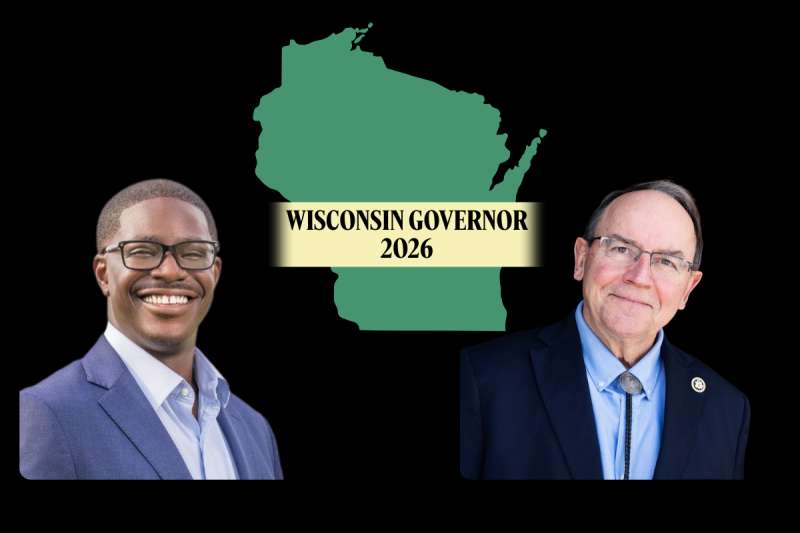
When Democratic gubernatorial candidate David Crowley unveiled an anti-corruption reform package on Monday, his Republican opponent Tom Tiffany said he would want an even stronger plan. But Tiffany was an architect of the Republican-written law that made it harder to investigate corrupt politicians and said at the time, “I can tell you I want this to be my legacy.”
Crowley, the Milwaukee County Executive, acknowledges that while most voters are focused on affordability issues like food and fuel prices and healthcare — he’s also trying to tap into voter frustration about politicians playing fast and loose with ethics rules in Madison as well as the nation’s capital.
“While the majority in Congress has failed to hold the President or Washington accountable, we can demand transparency and accountability from our state government,” Crowley said at a Monday news conference. “That’s why, as the next governor of Wisconsin and as part of my very first state budget, I will include four measures that stop elected officials from profiteering off their office and instead focus on public service.”
Crowley vs. corruption
Crowley’s four-point anti-corruption plan starts with banning state politicians from engaging in any stock trading based on insider information they learn from their privileged position. It would require lawmakers’ investments be in diversified, mutual, or index funds or a blind trust, rather than being bought and sold as individual stocks.
Prediction markets, including sites like Kalshi and Polymarket that have already been used by some insiders to place successful bets on political outcomes, would also be off limits to politicians. All public employees would be prohibited from using insider government knowledge to personally profit on these market sites under Crowley’s plan.
The third item addresses what’s known as a “revolving door” between public service roles and better-paying private sector jobs in the industries they used to regulate, especially in the utility/energy sector. Crowley’s plan is similar to an earlier Republican proposal that would write a state law banning Wisconsin utility or energy companies from hiring elected or appointed officials who oversaw them for two years after leaving office.
“Keeping Wisconsinites’ [utility] bills fair must be the priority,” Crowley said.
Finally, Crowley’s plan protects more public records from destruction by closing a loophole that had been used to hide records from the courts, journalists, and the public.
“State elected officials—whether they be governors, legislators, or regulators—are there to do public service, not sit in public office,” said Crowley. “They are there to use their offices to help people. What it should not be is a vehicle to get rich by gaming the system. We see that running rampant in Washington right now, while Wisconsinites are facing higher costs on everything from gas to groceries to healthcare. While we suffer, they profit.”
Tiffany, Trump, and opacity
Crowley’s approach on the issue is in contrast to Tiffany’s record, which includes votes while he was in the Legislature to limit John Doe investigations of political corruption and make it easier for wealthy individuals and corporations to flood campaigns with cash.
John Doe investigations are secret proceedings where a prosecutor, supervised by a judge, may seek documents and witness testimony in order to determine whether a crime has been committed. For political figures, that would include misconduct, doing campaign work during official business hours, campaign finance violations, and coordination with independent groups that are supposed to be independent from a candidate’s campaign.
Probes during Gov. Scott Walker’s first term focused on potential illegal campaign activity, reportedly including actions by Walker himself.
After Walker was elected to a second term, Tiffany was the lead author on a bill that all but ended John Doe investigations of politicians. The investigation already in progress was ended by conservative justices on the Wisconsin Supreme Court.
Republicans said the secret investigations put an unfair burden on those who had to testify behind closed doors and then could not talk about it in public. Democrats countered that the whole point of a John Doe investigation is to allow testimony and evidence to be gathered without accusing someone of wrongdoing until it could be determined if criminal charges were warranted.
“I can tell you I want this to be my legacy,” Tiffany said at the time about the bill ending one way to investigate potential political corruption.
“Why is this bill necessary?” asked then-Sen. Julie Lassa (D-Stevens Point) about eliminating John Doe investigations only for political misdeeds. “If you think the John Doe law is broken, then why aren’t you changing it for everybody in the state of Wisconsin and not just for the political class?”
Another bill, supported by Tiffany and signed into law by Walker, allowed unlimited contributions to political parties and political action committees (PACs) and raised contribution limits to $20,000 for candidates for statewide office.
Now Tiffany is seeking the governorship with the endorsement of President Donald Trump, whose pardons have included politicians, like former Illinois Gov. Rod Blagojevich, who tried to sell the former US Senate seat of Barack Obama after he was elected president in 2008; and at least 70 people convicted of wire fraud, securities fraud, Medicare fraud, and other crimes, leading to millions of dollars in repayments and restitution being wiped out by Trump’s pardons.
Trump also pardoned around 1,500 people who rioted at the US Capitol during an attempted insurrection on Jan. 6, 2021, a day that included Tiffany voting to deny accepting the certified election results from two states, as Trump tried to fraudulently overturn the results of the election.
Tiffany responded to Crowley’s anti-corruption plan by saying he would go even further, pointing to earlier pledges to seek a full audit of state government “to uncover waste, fraud, and corruption and make sure taxpayers are getting the results they deserve.” But Tiffany spent nearly a decade in the state Legislature before being elected to Congress and was in the majority the entire time, so any waste, fraud, corruption, or lack of oversight that took place would have happened while he and his caucus were in control of state finances.