Buses spew diesel fumes, but more communities are moving away from fossil fuels in their transit options. Smaller cities help lead the charge in Wisconsin.
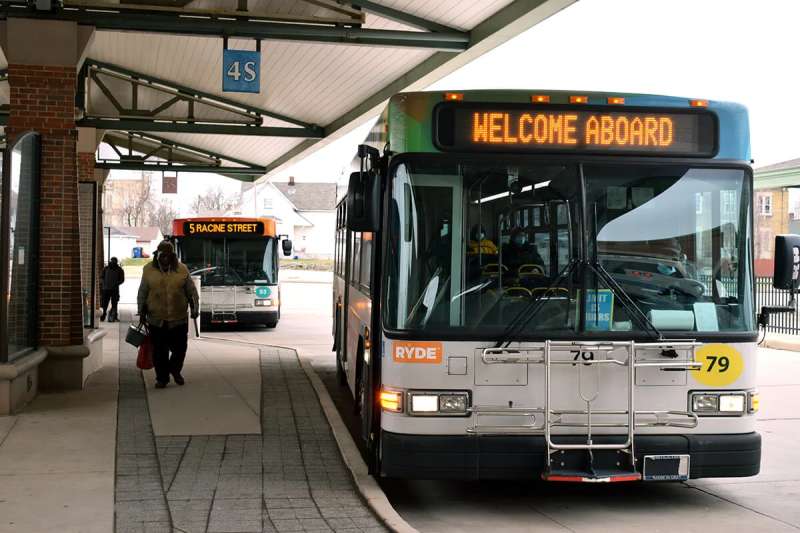
Come the end of this year, it won’t be Madison or Milwaukee operating the most zero-emission buses in the state. It will be Racine.
The state’s fifth-largest city aims to have nine electric buses up and running by November, replacing about a quarter of the city’s 35-bus fleet. Their additions are expected to make a significant dent in Racine’s carbon footprint.
“Understanding best practices at this scale, I think will be really beneficial to moving the needle on climate-change efforts,” said Cara Pratt, Racine’s sustainability and conservation coordinator, in reference to the importance for smaller cities and towns to launch their own sustainability efforts.
Even with poor gas mileage and a general reliance on diesel fuel, buses still produce about 33% less pollution than cars per mile traveled, according to the US Department of Transportation. But cities large and small across Wisconsin are making their mass transit options even greener as they replace old diesel-fueled buses—whether with electric, hybrid, or so-called clean diesel buses—as the nation’s climate crisis grows more urgent.
UpNorthNews spoke with Pratt and transit officials in Wausau, La Crosse, Eau Claire, and Milwaukee to find out what efforts are underway in each community to move their transit options closer to carbon neutrality. Some transit officials are just beginning to get clean diesel buses—which are equipped with filters to lower emissions by up to 85%, according to the Centers for Disease Control and Prevention—while others already have some hybrid or electric buses.
Earlier: Governor’s Climate Crisis Commission Releases Recommendations That Include More Green Public Transit
Not only do cleaner buses save cities money in fuel costs, but they also improve public health through reduced emissions, Pratt said.
“Diesel fumes in our urban neighborhoods are not welcome,” she said. “We want to have a better ridership experience for the folks who depend on our bus system, and also for our bus drivers so they’re not inhaling those diesel fumes every day.”
La Crosse is one of the state’s green transit leaders in its own right. It currently has three hybrid, 10 clean diesel, and two electric buses, with another two hybrids on the way. When La Crosse acquires the two hybrids, it will have just six traditional diesel buses remaining, according to figures from Adam Lorentz, the city’s transit manager.
“Is our goal to be completely electric? Absolutely,” Lorentz said. “The timeframe for that is still to be seen and see how these first two [electric buses] function.”
Cities looking to use electric buses face multiple hurdles—not the least of which is cost. Electric buses themselves, while they save money long-term on fuel, cost about twice as much as diesel buses and also require cities to have the right infrastructure to accommodate charging stations.
Federal and state dollars are available to offset the costs, in part because of the Volkswagen emissions scandal, which resulted in the company coughing up billions of dollars in penalties for cheating on vehicle emissions tests. About $2.9 billion went to state governments to help them set up state-level grant programs for cities to obtain greener buses. The Federal Transit Administration likewise has a Low or No Emissions grant program aimed at helping local entities afford more environmentally friendly buses.
“Most of these grants require a local match,” said Tom Wagener, Eau Claire’s transit manager. “And typically, the more the community is able to put toward the purchase of the vehicle, the more competitive that community is in the grant application.”
Wagener said Eau Claire has 22 buses in total: eight hybrids and 14 clean diesel buses. The city is in the process of getting a ninth hybrid bus.
Racine needed the help of three separate grant programs to acquire its nine incoming electric buses, Pratt said.
Despite available programs like those, it isn’t always possible for cities to jump straight to a hybrid or electric option, because of the requirement for a local match. Wausau, for example, is holding off on hybrid and electric buses for now, said Greg Seubet, the city’s transit manager.
“The funding available isn’t nearly enough to meet the need,” Seubert said. “So many transit directors around the state have opted to stick with the clean diesel so we can get more [green] buses rather than fewer.”
Wausau’s 26-bus fleet currently has 15 clean diesel buses, and the city is getting seven more, Seubert said.
More money could become available in the future. Nationally, Sen. Elizabeth Warren (D-Massachusetts) and Rep. Alexandria Ocasio-Cortez (D-New York) are pushing for President Joe Biden to include in his upcoming infrastructure bill a pot of money to help public transit authorities convert their fleets to all-electric.
In Wisconsin, the cold winters are also a speedbump to zero-transmission transit. Freezing temperatures take a toll on batteries, and on-board heating solutions even further sap the battery life of electric buses. That’s why Racine, La Crosse, and Milwaukee will be using diesel heaters in their initial electric buses when the weather gets cold.
“We found in other colder climates, the batteries just weren’t lasting that long,” said Kristina Hoffman, director of marketing and communications for Milwaukee County Transit System (MCTS), which will get 15 electric buses next year, surpassing Racine’s total.
Hoffman said Milwaukee is “dipping its toe into that technology” (the county will still have 353 diesel buses after acquiring the electric ones) and MCTS needs further guidance from the county board for its long-term goals for the fleet.
Pratt said any community with a transit system should at least look into greener options, even if they don’t act on it right away. With electric bus technology constantly improving, it’s only a matter of time before they’re the standard, she said.
“I’m not one to say that this makes sense for 100% of buses in the United States right now,” Pratt said. “I think within 10 years that will definitely be the case, but the technology is improving every day.”