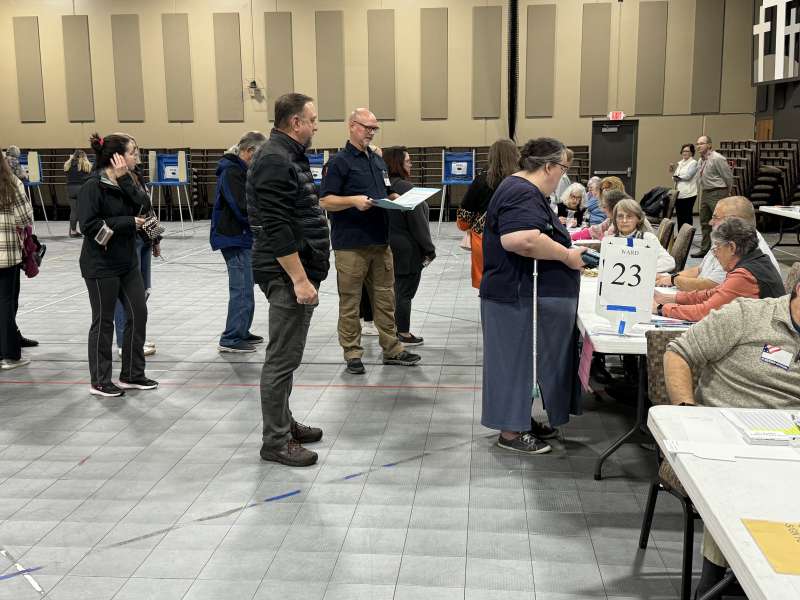
Eau Claire County Clerk Sue McDonald is proud of her department’s work ensuring election integrity. “We have full confidence in the accuracy of our elections,” she told UpNorthNews. “All of our elections—all of our audits have always come out perfect and the equipment works.”
McDonald is among the 72 county clerks and more than 1,800 municipal clerks who work with the Wisconsin Elections Commission to administer elections across the state.
“The county clerk is responsible for overseeing the elections for the whole county,” McDonald said. “I work with all of the municipal clerks who are responsible for election day poll workers and polling places.”
McDonald has been the Eau Claire County Clerk since 2021 and served as deputy clerk for nine years before that. She said clerks and other administrators proactively design “what-if” frameworks to protect the integrity and safety of the voting process.
“We’re always trying to think ahead and plan ahead and be prepared for things that could come up and how we’re going to deal with them,” she said.
The election process has traditionally been treated as routine public administration. Now there’s heightened election scrutiny stemming from political polarization and disinformation. McDonald said she feels it.
“It’s gotten a little bit more complicated over the past few years, it used to be less stressful, but I do enjoy the work,” said McDonald. “We’ve all been conscious of all the work we do and making sure that we’re very thorough and that we’re very organized because we want to reassure people that everything is being done to keep these elections fair.”
Many tests to ensure voting accuracy
According to the Wisconsin Elections Commission, Wisconsin requires a paper record of every vote that’s cast in the state.
State and federal election results are triple-checked. Results aren’t official until they’re checked at the municipal level, double-checked by the county, and certified by the state. As part of this review, election officials ensure that there are not more ballots than voters.
Local election officials use only certified voting equipment. Ballots are counted on local voting machines that have been certified at the state and federal level, ensuring the equipment is accurate and in good working order. Local election officials are required to conduct a public test of their electronic voting equipment before each election.
“We test the equipment—people can view us testing the equipment,” McDonald said. “There are reports and files that they can view after the election.”
“We have scanned images of all of the ballots. We have reports on how the machine reads each ballot.”
After November elections, the voting equipment in 10% of the state’s reporting units is randomly selected to undergo an additional test to ensure it accurately counted votes.
Most voting machines and electronic tabulators used in Wisconsin don’t connect to the internet. This isolates them from external cyber threats, remote hacking, or digital manipulation. McDonald said that’s true in Eau Claire County.
“After the election is closed and the results are processed by the machine, a text message gets sent to me here at the county and that text message just has the totals for the election—the numbers and the races,” McDonald explained. “There’s no outside internet.”
“There’s really no way of intercepting that and changing it. The next day the clerks bring in—there’s a USB stick in each of the voting machines and that’s got the information as far as the images of the ballots, then I can upload that into my election program, which is not connected to the internet at all and do the final reporting.”
The memory device must remain in the equipment with a tamper-evident seal used to secure memory device compartments. A chain-of-custody log is required to be maintained that documents any access to each memory device or tabulator.
The Election Commission wants Wisconsinites to know that it prioritizes transparency in the state’s elections. Anyone, other than a candidate, has the right to observe an absentee location or polling place and observe the voting process, counting of votes, and testing of voting equipment.
If you’d like to find more voter resources you can go to the Wisconsin Election Commission. Details on key election dates, candidates on the ballot, and more can be found on the UpNorthNews Election Hub.