Racism is a public health crisis, needing immediate attention.
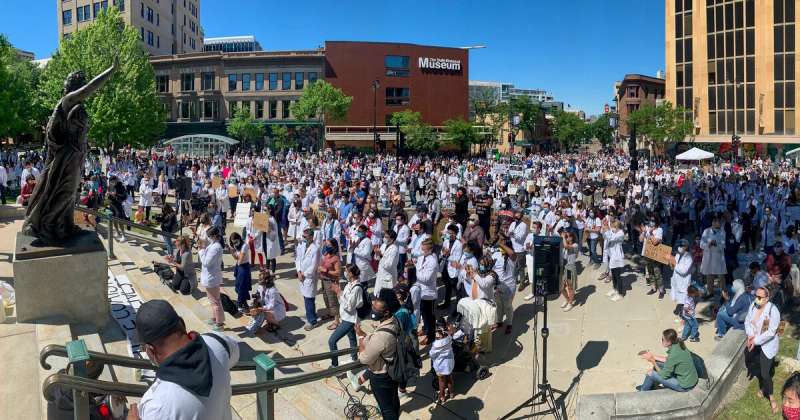
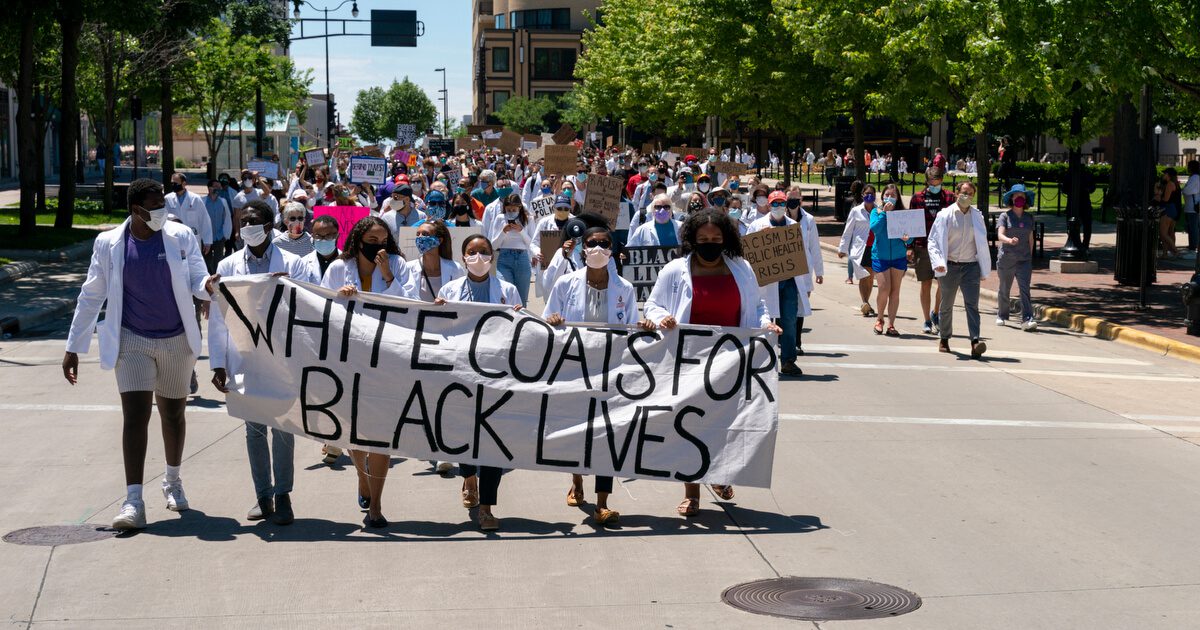
The state’s chief medical officer and epidemiologist stood on the steps of the Capitol Saturday before a sea of more than a thousand white coats to ask his colleagues in the medical profession to join him in the recognition that racism is a public health crisis.
One of more than a dozen speakers at the ‘White Coats for Black Lives’ demonstration, Dr. Ryan Westergaard said viruses move fastest through communities that have the fewest resources or tools to protect against it. That is proving true with COVID-19, he said, which has taken the lives of 169 Black Wisconsin residents. In all, 691 people have died due to the virus.
“That means that being Black in Wisconsin increases your risk of dying from COVID 19 by 450 percent,” Westergaard told the crowd. “So what can we do about this, those of us who wear white coats? The first thing we can do is say it out loud. Systemic racism is a public health crisis. Systemic racism is causing people to die of COVID-19.”
Westergaard said any risk factor that causes an increase of death by 450 percent should be considered an “urgent target for intervention.”
“We should not stop until we know exactly all the ways and everything we can do to fix the system,” he said.
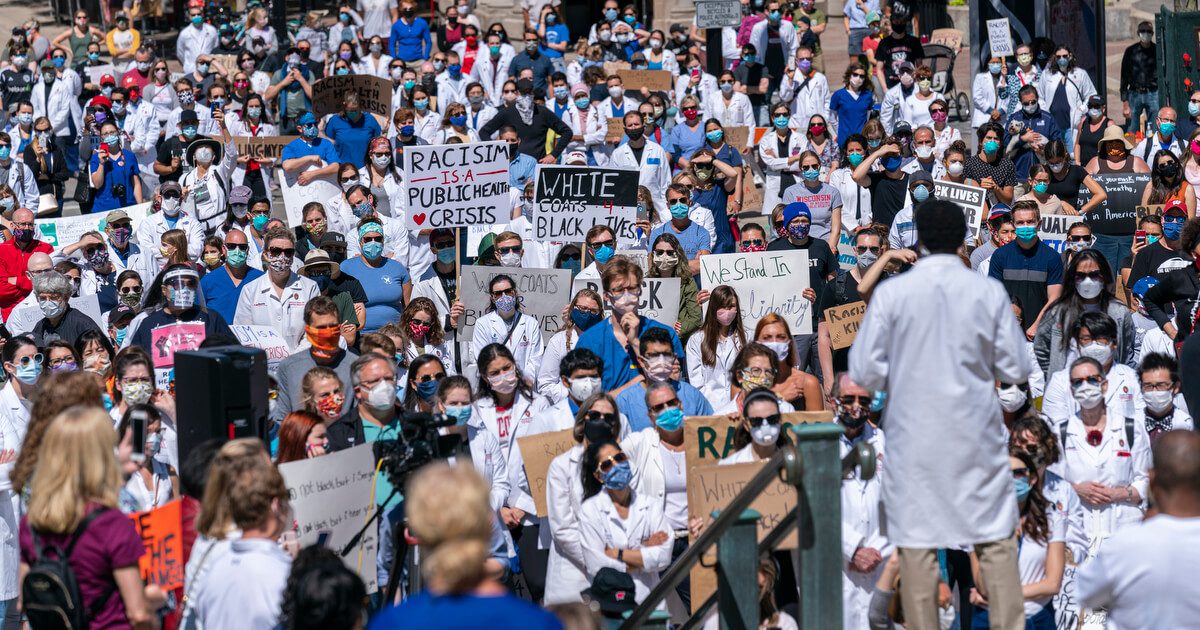
A local chapter of White Coats for Black Lives recently was started by medical students with the UW School of Medicine and Public Health. In the wake of the killing of George Floyd, an unarmed Black man, by Minneapolis police officers on May 25, White Coats for Black Lives has been holding demonstrations to highlight the healthcare disparities in Black communities.
The medical, student-run organization was first launched in 2014 with a mission to safeguard the lives and well-being of patients through the elimination of racism and to dismantle racism in medicine and promote the health, well-being, and self-determination of people of color.
Speakers at Saturday’s event in Madison included medical students, physicians, and community organizers and advocates including Urban Triage and Freedom Inc. They spoke about how systemic racism impacts health outcomes, how minority healthcare workers from nurses to surgeons are treated differently than their white peers and how more minorities need to be brought into the medical profession.
Edriss Drammeh is from The Gambia. After working as a nurse at SSMHealth Hospital for eight years, he graduated in December from UW-Madison with a doctor of nursing practice degree. He now works as an advance practice nurse prescriber in vascular surgery.

He said not everyone realizes it but there is a huge intersection between Black Lives Matter and healthcare.
“Here is a lot of discrimination inside healthcare. In one way it is toward patients and in another way it is toward providers of color,” Drammeh said. “We have to be frank about it. We have to be upfront about it.”
He said he can tell as soon as he walks into a patient’s room whether or not they will see him as a “competent person who knows what he is doing” or whether he will have to “present his resume before he can lay hands” on the patient.
He said 90 percent of the time he will get asked a list of questions such as where he earned his degree, how long it took him to earn his degree or whether he earned his degree in the United States or elsewhere.
“I also teach a lot of new (white) nurses,” he said. “When I go with them into rooms, they don’t get those questions. They can go straight to the patient. Sure, those questions may come up later during the course of normal conversations, but those questions are not asked as soon as the nurses walk into the room.”
He described this treatment as a soft form of descrimation. He said he sees it play out in how white and Black patients are treated, especially surrounding the management of pain.
“When Black patients say they are in pain and need medication, people will think they are seeking out medication or asking for too much,” Drammeh said. “It is perplexing. I don’t understand it. I guess it is the stereotype of the lazy Black person who is just seeking pain medicine”
This differing treatment of Black and white patients plays out in other ways, too.
Emily Cardamone and Becca Hall both work as nurse practitioners at a UW Health speciality clinic in Madison. They said they decided to attend the demonstration because racism is a public health issue and “as nurses, we need to help people,” said Cardamone, who held a sign that said “Imagine if Nurses Ignored I Can’t Breathe. Black Lives Matter.”
“It takes them longer to get to us,” Hall said. “They are not referred to us as quickly.”
Brandi Grayson, the founder and chief executive officer of Urban Triage, detailed to the crowd of medical professionals how the foundation of our culture, or our way of being has “created this ideology, this belief and acceptance that Black people are not intelligent enough, that we’re not brilliant enough, that we are criminals.”
She said because of this cultural foundation, “that has somehow translated into Black people should not be treated in the same framework of equity because we are not deserving.”
“It shows up everywhere. It shows up when I go to the hospital and can’t breathe when I’m having an asthma attack and I’m waiting in the waiting room for three hours waiting to get service,” Grayson said. “I might as well go home. I will die waiting in the waiting room for emergency service. This has happened to me too many times at UW (Hospital). I’ve lived this experience. I don’t get to take my black off.”
Laurel Mark, a retired physician with UW Health, and Nike Mourikes, an internal medicine physician with UW Health, attended the demonstration and held a 6-foot-long sign that had several messages, including “Health Care For All. Black Lives Matter, and End Racism.”
“The people at the bottom who don’t have access, who don’t have health insurance .. the healthcare system for them is like it is in a third world country,” said Mourikes. “And we have a lot of people who are on the bottom.”