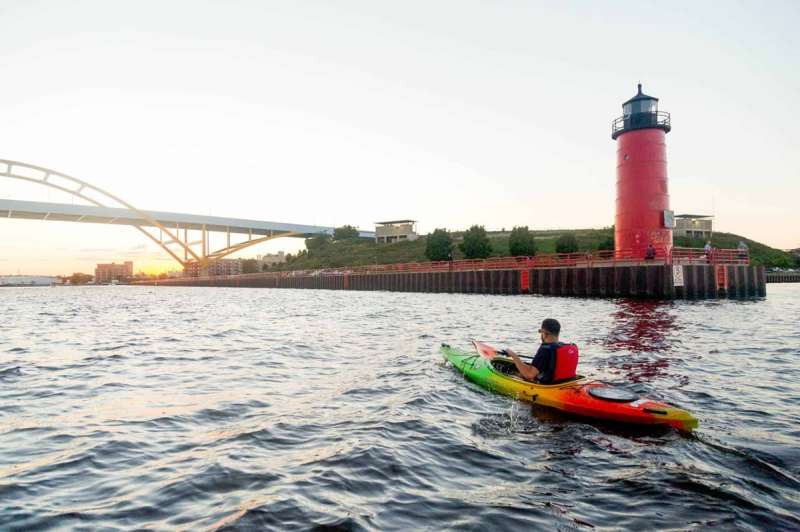
Just because Wisconsin is located in the middle of the country doesn’t mean that it’s a landlocked state. It’s surrounded by two Great Lakes, Lake Michigan and Lake Superior, and is also home to countless rivers, estuaries, lakes, and bays—all of which are great for spending time in, especially during the hot summer.
One of the most fun ways to hit the water in Wisconsin is on a kayak or a canoe, but those activities may seem daunting if you’re unfamiliar with it. Thankfully, you don’t have to be a paddling professional to take in the state’s scenic bodies of water. There are plenty of bodies of water throughout Wisconsin that are calm, wake-free, and easy to access—many of them offer kayak and canoe rentals, as well.
Beginners shouldn’t let inexperience hold them back from enjoying some of the best waterways that Wisconsin has to offer. Here are some of the best kayaking and canoeing spots throughout the state for beginners to try out.
Where should beginners try canoeing or kayaking in Wisconsin?
There are a lot of fun and scenic bodies of water in Wisconsin that are ripe for exploring—but if you’re a beginner, you should probably steer clear of some of them, including the Wolf River, with its whitewater rapids, and Lake Michigan and Lake Superior, which can have quick wind shifts and oftentimes be unpredictable.
Instead, beginners should look for bodies of water that are calm and don’t have a wake, or a trail of waves that follows behind a moving boat. Head out toward gentle lakes, without a lot of boat traffic, as well as slow-moving rivers, that don’t have any rapids or quick currents.
What are some tips for beginner kayakers and canoeists?
Before heading out onto the open water, here are some of the best tips for beginners:
- Look into renting a kayak or a canoe for a few hours before investing money into purchasing your own. Most of Wisconsin’s popular kayaking and canoeing locations have watercraft rentals available nearby.
- Bring a life jacket, even if you’re confident in your swimming skills. There are now Wisconsin laws requiring life jacket usage for adults, but the Wisconsin Department of Natural Resources strongly recommends it. You can also purchase life jackets for dogs, if you’re bringing your furry friend along.
- Look into the difference between kayaking and canoeing before deciding which one you want to do. Kayaks use a double-bladed paddle, and kayakers sit lower in their boat, sometimes submerged in the boat. Canoeists use a single-bladed paddle, and sit higher up on a seat in the boat. Typically, kayaks are more convenient for one person, and travel faster, while canoes are better for multiple people, especially if they’re bringing along bags or gear.
- Beginners should probably avoid any water that has rapids or white water, but if you do end up kayaking or canoeing in white water, be sure to wear a helmet.
1. Lower Dells
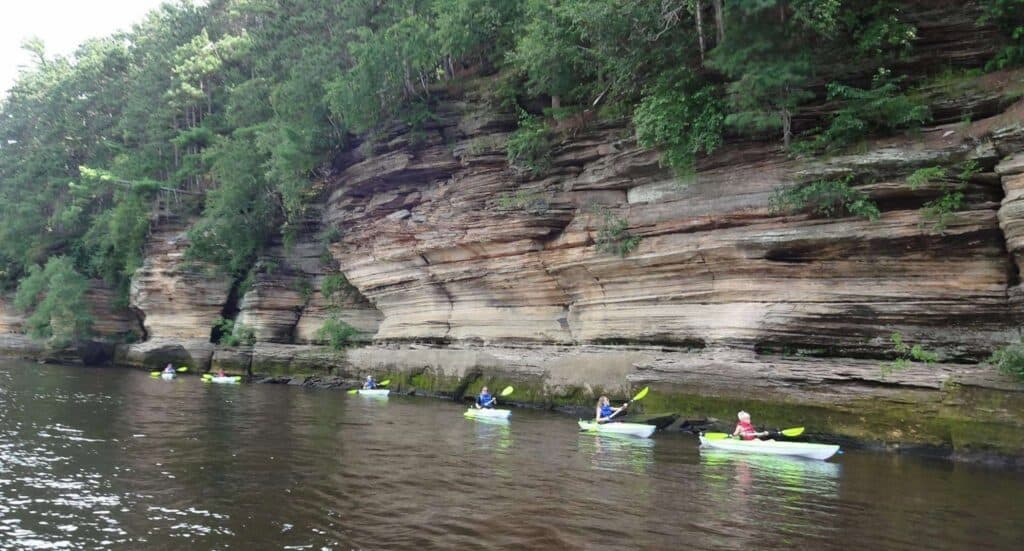
Most visitors to the Wisconsin Dells go for the water parks and often leave without seeing the unique feature that the resort city was named for: the Dells of the Wisconsin River. The five-mile-long gorge along the Wisconsin River is divided into two different portions, the Upper Dells and Lower Dells, which can both be explored by taking a boat tour—or can be better explored by kayak or canoe.
While the Upper Dells often have more scenic beauty, as they’re surrounded by towering sandstone cliffs, the Lower Dells offer a more gentle paddling experience, with a wider river and sandy beaches to stop at. During the summer, paddling in both sections of the Dells can be pretty hectic with boat traffic, so it’s recommended to either go early in the day to avoid a majority of the traffic, or explore the area by kayak or canoe in the springtime or fall.
2. Waupaca Chain O’Lakes
When kayakers or canoeists head out into the Waupaca Chain O’Lakes, they have access to 22 different lakes, all connected throughout the Waupaca County-based chain. The lengthy chain is divided into two parts: the Lower Chain, where there is a lot of motorboat traffic that doesn’t make for great paddling, and the Upper Chain, which consists of five smaller lakes that are only accessible to smaller watercraft. Beginners should stick to the Upper Chain, which includes Marl Lake, Pope Lake, Manomin Lake, Knight Lake, and Lake Orlando.
Adventure Outfitters LLC offers kayak rentals along the chain with several different paddling options, including pedal kayaks and completely clear kayaks. The company also offers guided tours of the Chain O’Lakes, including a nighttime tour in clear kayaks equipped with LED lights, so paddlers can see into the lake beneath them and admire its aquatic inhabitants, like turtles and fish.
3. Washington Park Lagoon
When you’re in a big city like Milwaukee, the largest city in Wisconsin, sometimes it can be difficult to feel connected to nature. That’s not the case in the city’s Washington Park, a 128.5-acre park on the city’s west side. One of the park’s most prominent features is its 10-acre lagoon, which is a perfect spot for beginner kayakers and canoeists to hit the water through one of the Milwaukee County Parks’ kayaking programs.
There are paddling events held by the Urban Ecology Center throughout the summer at Washington Park, including a 90-minute Kayaking for Beginners class, which goes over safety information and kayaking basics, and includes a guided group paddle through the lagoon. In order to explore the lake, it’s best to join one of the Urban Ecology Center’s programs, because personal watercraft are not allowed in Milwaukee County Park lagoons without written permission from the parks department.
4. Milwaukee River
For Milwaukee-based kayaking and canoeing beginners, taking a boat out onto Lake Michigan might be a bit too intimidating. Thankfully, the city has another option that is far calmer: the Milwaukee River. One of the three rivers that runs through downtown Milwaukee, the Milwaukee River is 104 miles long, and runs into the city from Fond du Lac County, and ends up dividing the city into its eastern and western sides. Especially in the downtown area, the water along the Milwaukee River is calm, and ideal for beginners, although there may be occasional boat traffic.
There are plenty of rental options along the Milwaukee River, including companies like Brew City Kayak, which has four-hour single kayak rentals for $44, as well as season pass options, which include unlimited rentals from May through September. Or, try the Milwaukee Kayak Company, which is based in the city’s Harbor View neighborhood, with two additional locations open on the weekends.
5. Monona Bay
There are a lot of lakes in and around Madison, but for the most part, they’re not great for beginner kayakers and canoeists because they’re so large, have lots of boat traffic, and can develop some choppy waves. One of Madison’s lakes, Lake Monona, has a calm and gentle bay, though, that is ideal for anyone who is new to paddling.
Monona Bay occupies the southwest corner of Lake Monona, a 3,274-acre lake, and the second-largest of Madison’s chain of lakes, and is separated from the rest of the lake by sets of train tracks, as well as the Monona Bay Bridge. This boundary helps to make the bay’s water protected from much of the traffic that happens on the rest of the large lake, and a tranquil place for kayaking and canoeing. Not only is it a great spot for beginners, with kayak and canoe rentals available from Madison Boats’ Brittingham Park location, but it also provides easy entry into Lake Monona once beginners feel a bit more experienced.
6. Mink River Estuary
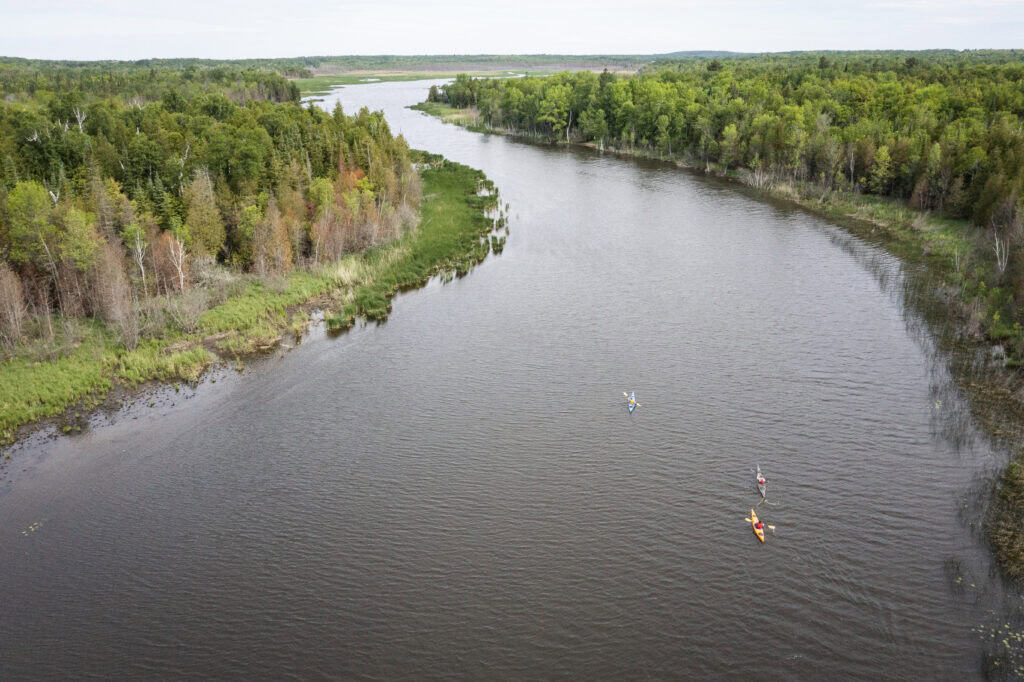
The tip of the Door Peninsula sits alongside Death’s Door—a 1.3-mile strait that separates the northern end of Door County and Washington Island and is notorious for being a rather dangerous place for ships to cross. At that point, the warmer waters of Green Bay mix with the cooler water of Lake Michigan, creating strong currents. There have been at least 275 shipwrecks in the area, making it a historically unsafe place to be on a sailboat, let alone a kayak or canoe. But, not too far south of the notoriously dangerous stretch of water is the Mink River Estuary, a nature preserve that is more than 2,000 acres and offers a great spot for beginner kayaking and canoeing.
The Mink River runs for 1.4 miles near Ellison Bay, ultimately empties into Lake Michigan, and is known for its calm and shallow waters, which make for great paddling, especially for beginners. The Mink River Estuary is also a State Natural Area, so while paddlers are kayaking or canoeing along the length of the river, they can try to catch a glimpse of birds, fish, and varied vegetation. While there are no kayak rental locations on site, nearby Door County Adventure Center offers eco kayak tours of the estuary.
7. Balsam Lake
In northwestern Wisconsin, there is a town called Balsam Lake, with a village located inside of it, also named Balsam Lake. The two municipalities share a name with Balsam Lake, a 1,901-acre lake in the town that is spotted with several islands, and is one of the best spots in the state for beginners to try out kayaking and canoeing.
There are plenty of motorized watercraft on Balsam Lake, but beginners shouldn’t let that deter them from heading out on the water, because the Polk County-based lake has a dedicated non-motorized zone, ideal for kayaking or canoeing. It also has plenty of access points to enter and leave the lake, including Balsam Lake Beach. The Balsam Lake Lodge offers kayak rentals for $25 for a half day, or $40 for a full day, as well as stand-up paddleboard and pontoon rentals.
8. Lake Joanis
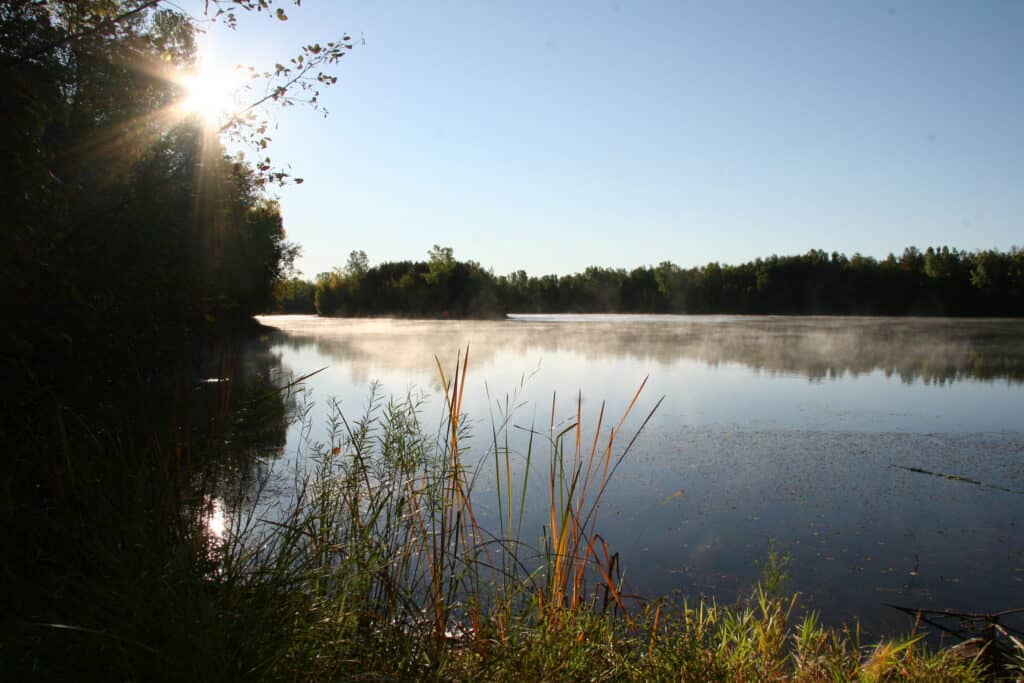
The University of Wisconsin-Stevens Point campus has a lot of delightful features, like a tropical conservatory, a rotating art gallery filled with work from students, guest artists, and faculty members, and the Schmeeckle Reserve, a 280-acre nature reserve managed by the school. The nature reserve has five miles of nature trails, as well as Lake Joanis, a 23-acre lake with calm water, and a great place for beginner paddlers to get out on the water.
Motorized watercraft aren’t allowed on the lake, and swimming isn’t allowed in it, so one of the only ways to get out onto the pristine, calm water is by taking a canoe or kayak. The beginner-friendly lake is relatively small, so anyone unused to paddling a lot won’t get too tired, and is surrounded by trees, which help to block wind. Visitors can rent kayaks and canoes from the Schmeeckle Reserve Visitor Center. Rentals can either be reserved at least two days in advance or are available on a first-come, first-served basis.
This article first appeared on Good Info News Wire and is republished here under a Creative Commons license.
Related: 11 last-minute Wisconsin day trips to make before school starts