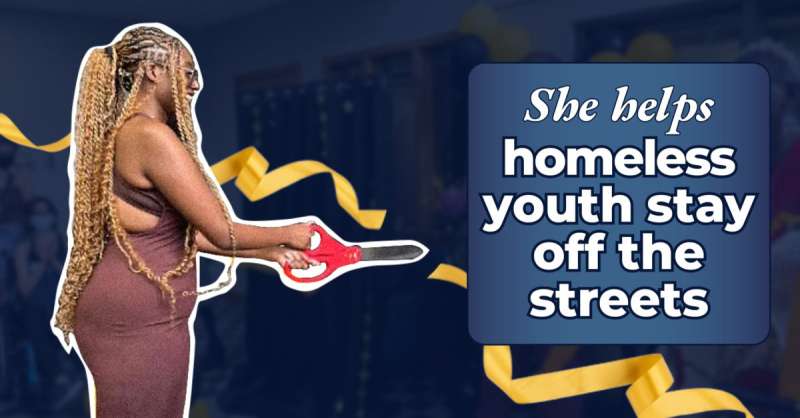
When TaMaya Travis sits across from her clients—young people between the ages of 17 and 24 who are frightened and homeless—she can relate in the most personal of ways.
Travis, just 21 and a bilingual peer navigator with the EverStrong program in Madison, lived on the streets herself for about 10 months when she was just 14, after fleeing a difficult and contentious situation at home.
The now-confident young woman, who is also studying criminal justice at the University of Wisconsin-Madison, had been living with her father, stepmother, and younger step-siblings when she made her plans to run away.
While she initially was able to stay with a close friend and her mother, she didn’t want to “overstay” her welcome. That began months of couch surfing, sleeping at homeless shelters, and, as the months passed, nights with nowhere to go but park benches and bridge underpasses.
“I was terrified at night when I wasn’t indoors where there wasn’t someone who could hurt me,” she tells UpNorthNews. “I felt very alone. It was terrifying being a young girl on my own. I was assaulted and lucky to have made it out alive.”
It’s because of Travis’s own experiences when she was a young high school student that she is so passionate about finding housing, jobs, and educational opportunities for her clients, who are desperate for help and have nowhere else to go.
YOUNG PEOPLE COME TO HER PETRIFIED
The EverStrong program serves homeless youth out of the Outreach LGBTQ+ Community Center, and Travis says that when new clients come in and sit across from her at her desk they are often “petrified.”
“A lot of times, they come in very timid and quiet and very hunched over with their body language, just very in a shell,” she says. Many “are in emotional turmoil. A lot of the time they’re just in complete survival mode, so they’ve turned off any other emotion and they are just trying to survive day to day.”
She explains that most of her clients have recently turned 18 and are leaving the foster care system with no place to go. Some have been released from incarceration, some have parents who are addicts or abusive, and others are dropped off by parents who want them out of the house now that they’re 18.
They tell Travis things like: “My mom said I can’t be at home anymore. I am 18 and now I have to leave even in the middle of the school year, even knowing that I don’t have anywhere to go.”
Travis will immediately work to find a place for each homeless young person to stay. If they are very lucky, she will have a spot in an apartment building that EverStrong operates, but usually she will have to send them to a YWCA Madison, Salvation Army, PorchLight, or Briarpatch homeless shelter.
Then she focuses on helping them find a job and permanent housing. Sometimes, she has to start with the very basics of helping them apply for a birth certificate and social security number.
“I always tell my participants that you need to be realistic, because it’s not going to happen overnight…there are going to be roadblocks.… But if you work with me, I’ll work with you. I’m telling you, I feel like my word is my bond,” she says.
It typically takes a few months to find permanent housing for each young person. Travis says that a remarkable 85% of the program’s participants stick with her through that time.
That’s because she earns the trust of her frequently skeptical clients, who have been let down so often in their young lives.
Travis tells them: “I can empathize with you because I’ve been on the street, I’ve been in the shelters. I’ve had to survive. I’ve had to do these things that you are actively going through to survive.”
Travis says that when she was in their shoes, “there were some nights where I didn’t even know if I would make it to the next day—where I’d be like, damn, am I ever going to be able to finish high school?”
Despite the dreadful nights, Travis still went to school every day. In fact, it was her safe space. She would arrive at 7:15 a.m. and shower in the locker room, get free breakfast and lunch there, and take snacks from the cafeteria to eat later.
She would stay in the building as late as she could—usually until 6:30 or 7 p.m., when all the after school activities ended and she had to leave the safety of the library to go back on the streets. “Every day I feared I wouldn’t be able to find a safe place to sleep at night, or wouldn’t be able to find a meal,” she says.
“It got to a point where I wanted to take my own life. I tried to kill myself,” she says, explaining that she attempted suicide in an isolated part of the school but fortunately was seen on a security camera and saved.
Travis was rushed to the hospital, placed under a 72-hour emergency hold, and then was sent to a juvenile mental facility, where she describes the staff as “wonderful.”
Most important for her, she says, the school administrators were able to reach her mother, who Travis had lost contact with following her parents’ divorce. They reunited at the hospital, and they’ve remained close ever since. In fact, today they live together.
It was surviving the experience of homelessness that made Travis’s work for EverStrong a mission that she says brings her “so much joy.”
She says that “just seeing when we are able to get a participant into housing…we have the funds for their security deposit and first month’s rent…and just seeing the light come back into their eyes when you hand them the keys and they’re in their apartment and they’re like, this is my home, nobody can take this from me” is her greatest reward.
“Knowing they trust me enough to support them through big life moments, that does make me feel good.”
However, she now dreads that the Trump administration will be able to withhold federal funding for EverStrong, along with thousands of other programs that help vulnerable people.
“It would be devastating in so many ways. A lot (of formerly homeless clients) would lose their homes and lose their way,” she says. “Young people need support and guidance. They need someone in their corner.”
Helping vulnerable people is exactly what she intends to do as a career. Despite her homeless experience, she graduated high school on the Honor Roll and plans to go to law school after college.
Her dream is to open her own law firm in Chicago, a city she loves, and to help clients, particularly of color, to get out of the prison pipeline.
“Seeing how many of my friends have gone to jail for things that were very minute…I know that more can be done and I want to be part of the solution.”