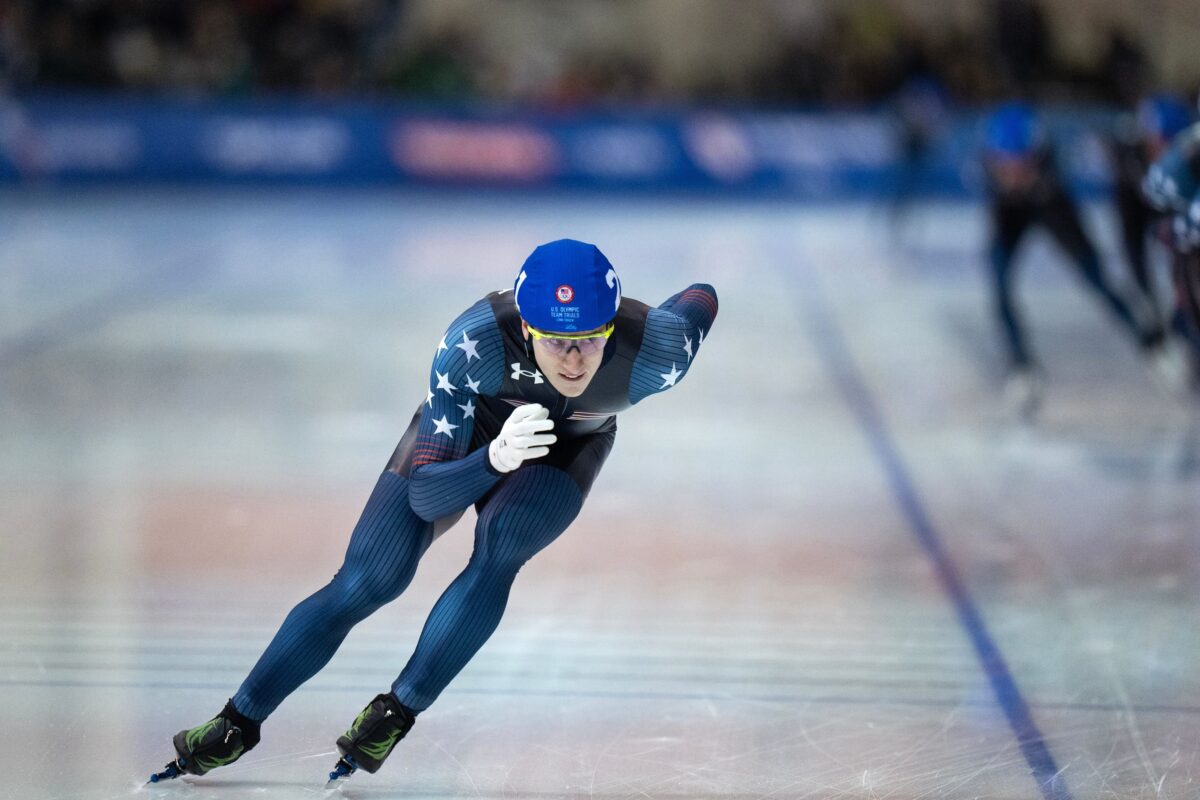
Jordan Stolz competes in the men’s second Mass Start at the U.S. Olympic long track speed skating Olympic team trials. (USA Today via Reuters Connect)
Congratulations are in order for Jordan Stolz, who took all the weight he’d had been carrying on his shoulders as an American Olympic favorite and the No. 1-ranked speed skater in the world, and put it in gold and silver around his neck.
That burden is finally lifted.
The hardware will last forever.
Not since Dan Jansen, Bonnie Blair and, before them, Eric Heiden, has the state of Wisconsin had such a vested interest in the sport of speed skating, with Milwaukee at one point ranked third among all U.S. markets for Winter Olympics viewing.
Maybe even Jane Bradley Pettit and her husband, Lloyd, didn’t even dare dream that this could happen when they gave more than $6 million to construct and support the Pettit National Ice Center, 12 years before Stolz was born.
But the 21-year-old Stolz, sweat-soaked and a bit tired, summarized the past two weeks best at the Milano Speed Skating Stadium immediately after his fourth and final race at the 2026 Milano-Cortina Olympic Games on Saturday, Feb. 21:
“I would say it was pretty successful. There’s things that could have gone better, but two golds and a silver − I can be pretty happy with that.”
Stolz came from his rural home in Kewaskum into these Olympics with unrivaled standards and unmatched expectations of any American athlete outside of the figure skaters.
He was the heavy medal favorite in the 1,000- and 1,500-meter races and the odds-on favorite for the super-sprint 500. And he delivered. Shaking off newfound nerves, Stolz kicked off the Games in the 1,000, coming from behind with a mind-blowing 1-minute, 6.28-second time to set an Olympic Record and win gold.
“I was feeling nervous, just because it was the first one, and it was, like, the Olympics,” Stolz said. “And it’s super important. Watching the men’s 5K − even just watching that made me a little bit nervous, because you’ve waited four years to be able to get here, and now you only have one chance to win. And I’ve been winning all the 1,000s the last … I don’t know, for how long. And I thought, I don’t really don’t want to lose this one.”
He then skated the best 500 of his life, setting an Olympic record and crossing the line at 33.77 seconds, the fastest time ever at sea level.
It was the first time an American man has won the event on the Olympic level since Joey Cheek in 2006.
“I felt a lot less pressure, just because I got the first one out of the way,” Stolz said. “And I thought this one’s not worth it, stressing over it, because it’s going be a toss up anyway. Like, it’s gonna be whoever skates a really clean race between me and Jenning [de Boo]. And we both skated clean, and I was able to win.”
In both races, he beat his biggest rival, the talented and strong de Boo, 22, from Netherlands.
“He’s the man to beat right now and I’m doing my absolute best to beat him, but he’s just crazy strong,” de Boo said.
In the second week of competition, Stolz took silver in the 1,500 − the first U.S. Olympic medal in the men’s 1,500 since 2010, when Stolz‘s mentor, Shani Davis, took silver.
Stolz was second only to a career-best performance by Zhongyan Ning of China, who carved out an Olympic record of his own to win. He still complimented the silver-medal performance by Stolz, because Ning understands how rare it is in the last 50 years to contend for medals in three different distances, the 500, 1,000 and 1,500, like Stolz.
“The energy systems required for 500, 1,000 and 1,500 are all different. To excel in all three is extremely difficult,” Ning told Chinese state media Xinhua News Agency. “I used to think that was impossible for a human being. But Jordan‘s emergence has challenged that perception. People call him a genius teenager. He truly is.”
Stolz missed the podium in the Mass Start, his fourth and final race, when he discovered that no skater was going to challenge Dutch leader Jorrit Bergsma for the win. The Mass Start is a completely different race than the 500, 1,000 and 1,500, and he found no friends or collaborators in that field willing to push the pack for the 16 laps of labor.
Stolz was passed up by an Italian at the very end to cost him a bronze medal, claimed by a winning field of veterans: Bersgma, 40; Viktor Hald Thorup, 31; and Andrea Giovannini, 32.
“There’s certain things I could have done different. I guess you have to expect the unexpected, from what people are going to do, like in the Mass Start,” Stolz said. “You would think that they would want to chase more to try to catch Jorrit, being that I already have two gold medals. The guys who are the gold-medal favorites in the Mass Start didn’t want to chase. Yeah, I wouldn’t have expected that.”
And yet, all four of these races just confirm what we already knew: Stolz was taking on the weight of the world with these four different challenges.
“Nobody manages pain at the end of the race while keeping his body mechanics and technique together like Stolz,” Apolo Anton Ohno said to US Speedskating.
No man achieves all of this alone.
Stolz has been surrounded and supported by a tight, close circle for his entire young career:
Coach Bob Corby, who was at his last Olympics in 1984 as the American team coach, has put Stolz through grueling training workouts to prepare for the multi-dimensional racing at the Olympic level.
Parents Jane and Dirk Stolz, who for years worked opposite shifts at their jobs to homeschool Jordan and then drive him 40 minutes each way from Kewaskum to the Pettit for practice.
Shani Davis, who mentored Stolz since he was a little boy, with encouragement and, when asked, advice.
And, to a degree, Paul Golomski, the general manager of the Pettit National Ice Center responsible for making the ice there. He was part of the ice-making crew that made the temporary structure in Milan fast and consistent, despite the warmer temperatures and changing air pressure outside.
“The condition is actually really good. I’m not sure how they did it,” Stolz said. “I mean, for a temporary rink to be able to skate this fast … I mean, we’re going faster than in Hereenveen [in the Netherlands]. I’m not sure how that is, but it’s pretty fun.”
This article originally appeared on Milwaukee Journal Sentinel: Jordan Stolz took on all challengers – including pressure – and came out on top | Lori Nickel
Reporting by Lori Nickel, Milwaukee Journal Sentinel / Milwaukee Journal Sentinel
USA TODAY Network via Reuters Connect
Author


What to know before Milwaukee Brewers’ Opening Day
As the cold subsides, Brewers fans can finally emerge from hibernation. The Milwaukee Brewers kick off their 2026 regular season on Thursday against...
Wisconsin survives late Ohio State rally to win National Championship
For the second straight season, the Wisconsin Badgers women's hockey team has won the National Championship. After taking down the host team, No. 3...

Brewers, manager Pat Murphy agree on new multi-year contract
PHOENIX – It took a little time, but the Milwaukee Brewers have finally locked down their man. The team announced Friday morning, Feb. 20 that it...

Milwaukee Bucks Marques Johnson, Doc Rivers finalists for the basketball hall of fame
ORLANDO, FL − Milwaukee Bucks legend Marques Johnson and current head coach Doc Rivers were named finalists for the Naismith Basketball Hall of Fame...