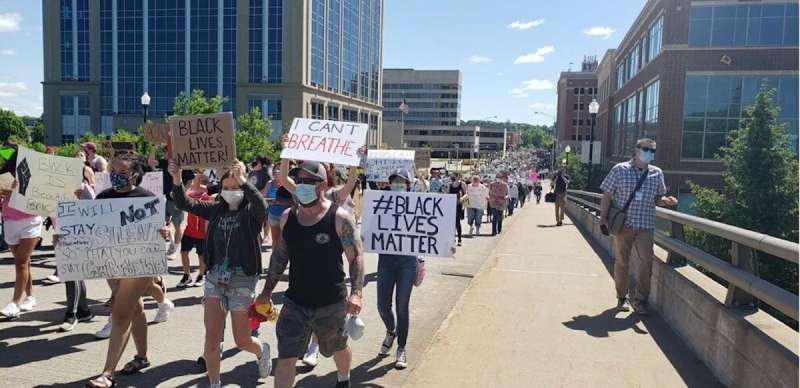
Demonstrations occurring in towns from Barron and Arbor Vitae to Wausau and La Crosse.
As an African American woman who lives in a city populated predominantly by white people, Nicole Sutton said she didn’t expect the May 25 death of George Floyd at the hands of Minneapolis police to prompt significant reaction in La Crosse.
“I figured you would see protests happening in the big cities,” said Sutton, 26. “I didn’t think it would be seen as such a big deal where I live.”
However, Floyd’s death after Minneapolis police officer Derek Chauven knelt on Floyd’s neck for nearly nine minutes seemed to strike a nerve with many Americans in communities large and small. It has sparked protests across Wisconsin and the nation and spurred calls for politicians to address systemic racism that has led to disparities in health care, incarceration rates, poverty and education.
Demonstrations and marches have garnered headlines in Wisconsin’s largest cities, Milwaukee and Madison, where protests attracted thousands, and where peaceful daytime events sometimes attracted looters at night.
But dozens of protests have occurred in smaller communities across the state, many of them in rural areas comprised of nearly all-white populations. The vast majority have been peaceful.
Protests have happened in cities of only a few thousand people, such as Barron and Arbor Vitae, and in some cases have even consisted of a handful of people holding anti-racist signs along country roads.
Numerous protests have occurred in La Crosse since Floyd’s death. Sutton has taken part in three of them. Hundreds have attended each event, seemingly motivated by what happened to Floyd and by long-standing disparities between whites and people of color.
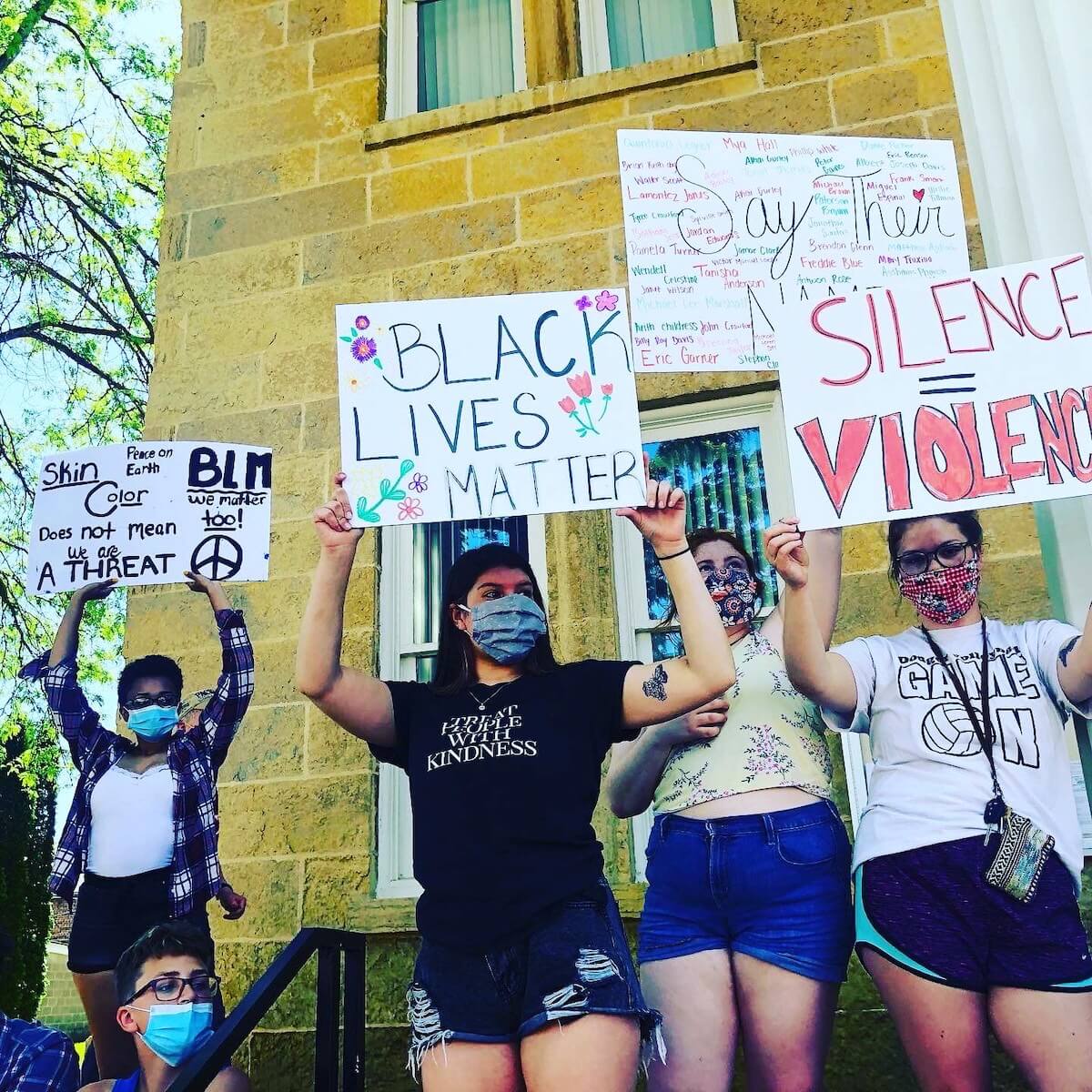
“When you see that video (of Floyd’s death), it’s basically just watching somebody get tortured,” Sutton said. “I think that act disturbed people enough to say something. They’re saying this has to stop. We have to do better.”
Protest events attracting more than 1,000 participants have occurred in Appleton, Eau Claire, Wausau, Green Bay and other locations as residents in those communities carried signs and chanted such phrases as “Say his name: George Floyd!” and “No justice, no peace” as they marched.
In smaller communities, such as Washburn, Dodgeville, Monroe and Hayward, demonstrators have held signs bearing anti-racism messages and marched while chanting pro-justice phrases. Some protests have involved sit-ins, where attendees sit silently, contemplating Floyd’s death and what it means in terms of race relations.
In an interview with UpNorthNews Monday, Gov. Tony Evers said protests across Wisconsin give him hope that change will happen, even as Republicans in the Legislature continue to block measures to address disparities.
“Look at all the people across the state of Wisconsin that are saying enough is enough,” Evers said. “I don’t care if you are from a homogenous part of the state or not. People are now understanding how important it is to treat people fairly and equitably.”
In addition to La Crosse, other communities, such as Monroe, Menomonie, and Eau Claire have been home to multiple protest rallies. For example, four protests and an online discussion about race-related issues happened last week in Eau Claire, culminating in a series of speakers and a march organizers said attracted more than 2,000 people.
“I think the people who have always been afraid to speak up about issues like racism are now finding their voices,” said Selika Ducksworth-Lawton, an African American professor of history and women’s gender and sexuality studies at UW-Eau Claire who has spoken at protests. “People are deciding they don’t want to leave their children this world that we are living in.”
Wausau Mayor Katie Rosenberg said she was overwhelmed by the crowd estimated between 1,500 and 2,000 that gathered in her city Saturday to protest Floyd’s death and systemic racism. The large group is a show of support, Rosenberg said, for treating people of color with more equitably. Wausau police joined in by marching and handing out water.
“We have a small Black community, but they really wanted to make their voices heard,” said Rosenberg, noting many Hmong residents participated in the event to support African Americans. “What is happening here is part of the national narrative.”
Laura Skattum took part in protests in Monroe, where peaceful events occurred Friday, Saturday and Sunday. Those protests and others in Dodgeville were organized by high school students.
Discussions in the wake of Floyd’s death are prompting her and many other white people to ponder their white privilege, said Skattum, a first-grade teacher in the Monroe school district.
“We can think we’re not racist, but you are born into a system that is inherently racist,” she said. “(Floyd’s death) is causing a lot of us to reflect on our behaviors. And we have to do that if we’re going to get to a better place.”