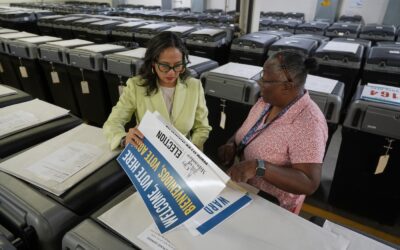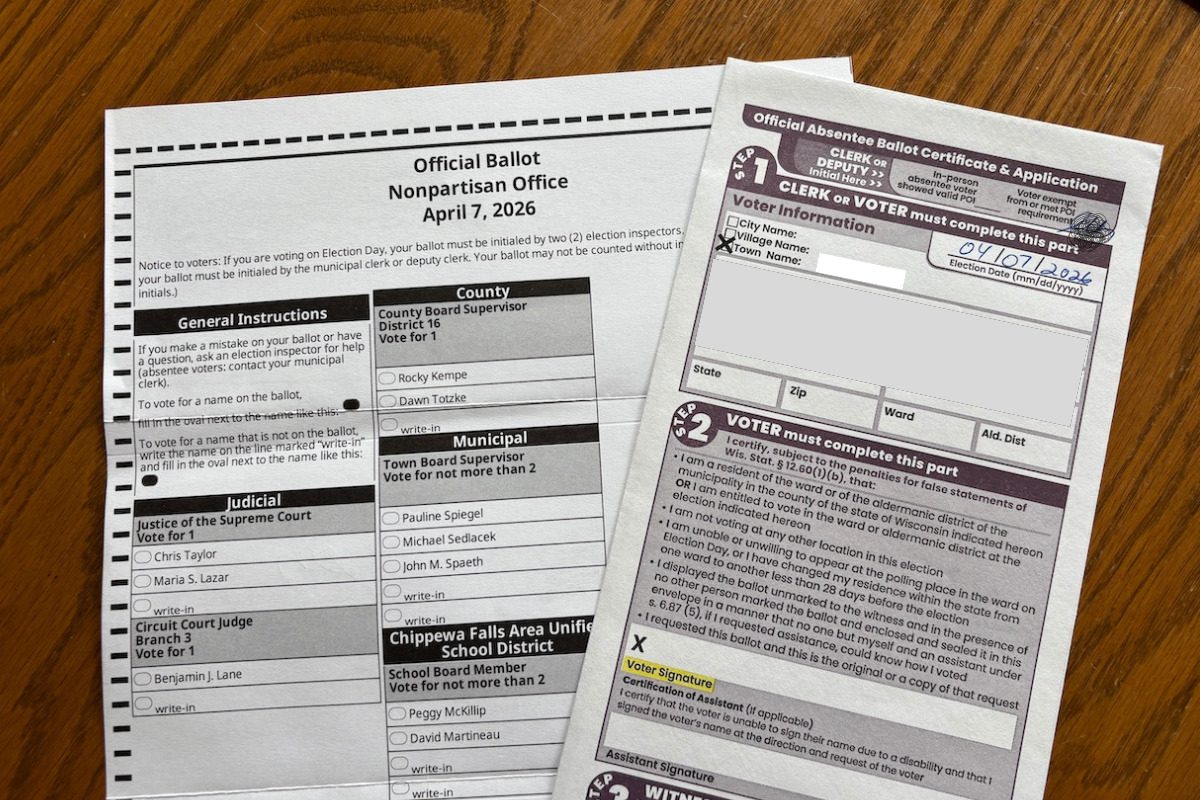
(Photo by Pat Kreitlow)
The Wisconsin Supreme Court race gets most of the attention, but spring elections fill many vital local roles in our communities without partisan politics — mostly.
Elections come in all styles and sizes in Wisconsin — with voting on everything from presidents to county coroners. There are occasional referendums about the constitution of our state or the property tax level for your local school district.
The spring elections are one of the two major types of elections in our state — nonpartisan offices in the spring, partisan races in the fall.
These are the main types of elections, with an emphasis on what will be on ballots around Wisconsin on April 7, 2026.
What we elect in April
The spring nonpartisan races are largely local — posts like judgeships, school boards, your county board of supervisors, and the board or council members in your city, village, or town — but there are regional and state elections as well for the Wisconsin Supreme Court and Appeals Court judges.
In some contests that reached a certain number of candidates, there were primary elections held in February to narrow the field for April’s general election.
The best way to learn what races are on your local ballot comes by visiting MyVote.WI.gov, created by the Wisconsin Elections Commission. By inputting your address, you can see every race on the April 7 ballot for your school district, county, and municipality.
School referendums
There are more than 70 school referendums up for consideration across the state on April 7, continuing a trend of school districts increasingly asking voters to raise their own property taxes to foot the bill for schools. To understand why, we must review the two main types of school referendums: capital and operating.
Many voters are familiar with capital referendums, where a district asks voters to raise their own local property taxes so that the capital can be used for projects ranging from a new school building to modernized equipment to an aging heating system replacement. But these projects are not what’s driving the trend in referendums.
Voters are becoming increasingly familiar, instead, with seeing operating referendums on the ballot. Operating referendums seek higher property taxes, but not for anything new — they’re about operating a school district at the same level, but with less cash because general school aid from the state legislature hasn’t kept up with inflation for 16 years. Without more cash from local taxpayers, school districts face cuts to staff and programs.
We have previously corrected misinformation about a Republican talking point that tries to blame a “400-year veto” by Gov. Tony Evers for higher school property taxes.
Judicial elections
In 2026, the marquee race in the state is for an open seat on the Wisconsin Supreme Court. Conservative Justice Rebecca Bradley decided last year not to run for reelection. Competing in April are two Appeals Court judges, progressive Chris Taylor and conservative Maria Lazar.
Along with the state Supreme Court, there are occasionally elections for seats on appeals courts. This year will be a quiet one, however.
Wisconsin has 16 appeals judges spread across four districts. These judges hear any appeals from the county circuit court level, and their decisions can be appealed to the state Supreme Court. They are elected to six-year terms. This year, there are three judges whose terms are ending. Judges Martin Joseph Donald (District I, Milwaukee County) and Rachel Graham (District IV in central, southern, and southwestern Wisconsin) have no opposition.
Judge Lisa Neubauer is retiring from her post in District II, covering much of eastern and southeastern Wisconsin. There is only one candidate on the District II ballot, conservative Anthony LoCoco. A former clerk to conservative Justice Annette Ziegler, LoCoco has worked at the right-wing Wisconsin Institute for Law & Liberty as well as the Institute for Reforming Government, and he is affiliated with the Federalist Society, which seeks to get far-right judges and justices elected and appointed.
Finally, at the local level, there are 26 circuit court judgeships on ballots around the state, though only six have contested races this year — where an incumbent is facing a challenger or an incumbent is not running. Those races are in Dane, Marathon, Washburn, Washington, Wood, and the combined circuit in Florence and Forest counties. Circuit judges serve six-year terms.
Local elections seeing more national dollars
Unlike high-stakes races like state Supreme Court, local elections usually don’t feature a lot of political ads or any kind of independent information about candidates — but that is changing.
Conservative political action committees (PACs) and other groups have been outpacing progressive organizations when it comes to spending on local races, especially school board contests. For example, the national group 1776 Project PAC — which describes itself as “the only national political action committee dedicated to electing conservative school board members” — is spending 240% more on Wisconsin races this year compared to 2025, according to reporting by Wisconsin Public Radio.
Progressives are playing catch-up with local groups like Blue Sky Waukesha County, which survey candidates in each local race in order to make recommendations.
What we elect in November
The spring elections are usually dwarfed by big-name races in the fall. Cycles like 2026 are referred to as midterm elections because they come in the middle of a president’s four-year term and serve as a kind of national referendum on the president and Congress. All eight of Wisconsin’s seats in the US House of Representatives will be up for two-year terms on Nov 3. Neither of Wisconsin’s two US Senate seats has their six-year terms expiring this year.
The marquee race in the state will be for governor. With the looming retirement of incumbent Democratic Gov. Tony Evers, seven well-known Democrats have entered the primary race hoping to face the presumptive Republican nominee, US Rep. Tom Tiffany, and keep the governor’s office in progressive hands.
Control of the Wisconsin Legislature is also at stake in November, with all 99 two-year seats in the Assembly on the ballot along with 16 of the state Senate’s 33 four-year posts.
There will also be fall elections for state attorney general, secretary of state, and treasurer.
Two amendments to the Wisconsin Constitution await voters in November, placed on the ballot by majority Republicans in the Legislature to gin up voter turnout. One would bar state and local governments from closing houses of worship, even in the existence of a public health emergency. The other is designed to target programs that address systemic racism by banning preferential treatment by “race, sex, color, ethnicity, or national origin in public employment, public education, public contracting, or public administration.” Critics say such “anti-DEI” measures actually prevent the government from addressing discrimination and instead locks it in place.
At the county level, there will be elections for district attorney, county clerk, sheriff, clerk of circuit court, register of deeds, treasurer, coroner (in counties that have one), and surveyor (in counties in which the office is elective).
In races where a primary is necessary (two or more candidates from a political party), those elections will be held August 11.
It is possible right now to request that your local clerk send you absentee ballots for the August and November elections once they are ready. Go to MyVoteWI.org to learn more.
Author
Support Our Cause
Thank you for taking the time to read our work. Before you go, we hope you'll consider supporting our values-driven journalism, which has always strived to make clear what's really at stake for Wisconsinites and our future.
Since day one, our goal here at UpNorthNews has always been to empower people across the state with fact-based news and information. We believe that when people are armed with knowledge about what's happening in their local, state, and federal governments—including who is working on their behalf and who is actively trying to block efforts aimed at improving the daily lives of Wisconsin families—they will be inspired to become civically engaged.

Harris underperforms recent Democrats in UW-Madison wards
Although Vice President Kamala Harris easily clutched a win against former President Donald Trump in Dane County, results from UW-Madison campus...

Harris says nation must accept election results while urging supporters to keep fighting
Harris delivered her remarks at Howard University, her alma mater and one of the country's most prominent historically Black schools, in the same...

Trump wins the White House
In state after state, Trump outperformed what he did in the 2020 election while Harris failed to do as well as Joe Biden did in winning the...

Presidential race too close to call as vote counts continue in key swing states
Results in Michigan, Pennsylvania, and Wisconsin may not come in until Wednesday morning, and Arizona and Nevada are unlikely to see calls made...