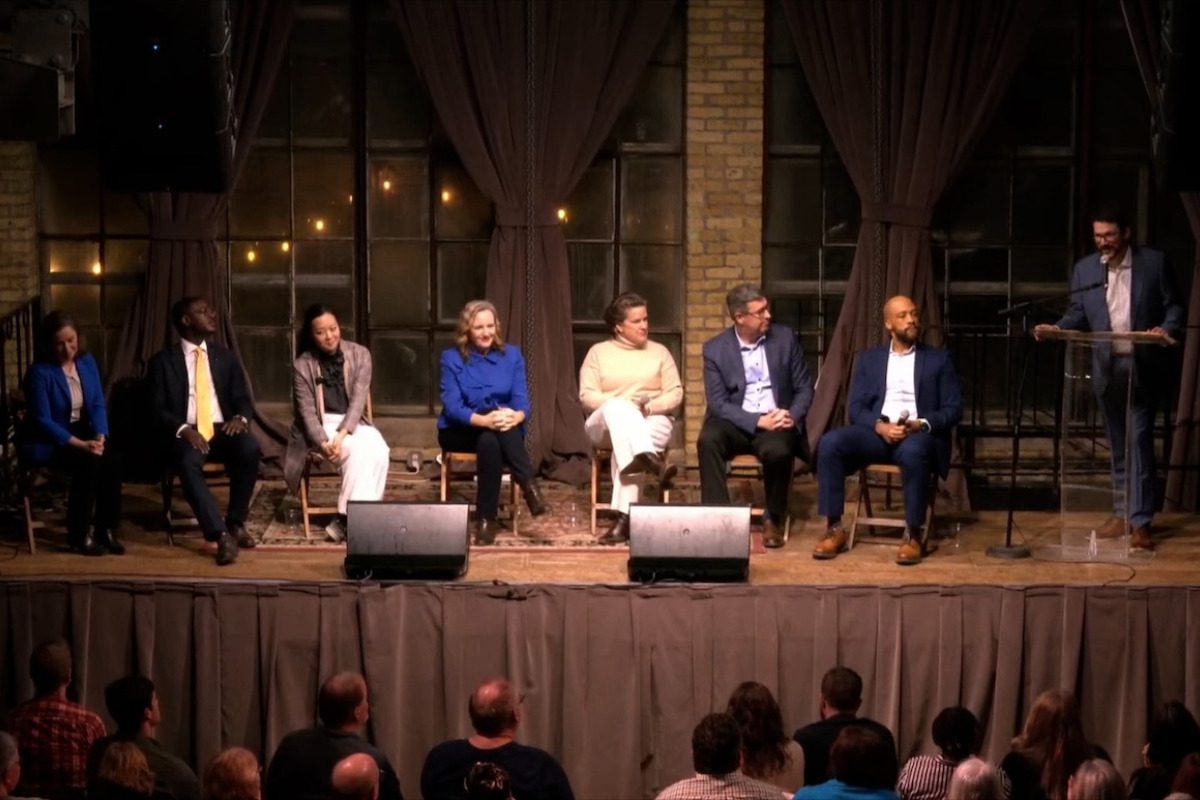
Seven Democratic candidates for Wisconsin governor appear at the first 2026 forum. Each hopes to win a primary election in August and a general election in November to keep the office in Democratic hands after next year's retirement of Gov. Tony Evers. Left to right: Lt. Gov. Sara Rodriguez, Milwaukee County Executive David Crowley, Rep. Francesca Hong, Sen. Kelda Roys, former WEDC director Missy Hughes, former state Administration Secretary Joel Brennan, and former Lt. Gov Mandela Barnes, all listening to moderator Dan Shafer of The Recombobulation Area. (Screen image from Civic Media video feed.)
Without big disagreements on top issues, gubernatorial hopefuls trumpet their varied experiences in leadership, public service, and different types of Wisconsin businesses.
After months of entry announcements and behind-the-scenes early fundraising, the seven Democratic hopefuls for Wisconsin governor gathered for the first candidate forum of the 2026 campaign Wednesday evening in Milwaukee. Each was eager to tell voters what makes them the best choice to take over from retiring Democratic Gov. Tony Evers next year.
Listed in the same random order as they appeared on stage at the Cooperage events center, the candidates are Lt. Gov. Sara Rodriguez, Milwaukee County Executive David Crowley, Rep. Francesca Hong, Sen. Kelda Roys, former WEDC director Missy Hughes, former state Administration Secretary Joel Brennan, for former Lt. Gov. Mandela Barnes.
The group did not show wide differences on several key issues, but each used part of their own life story to tell the audience — live and online via Civic Media— how they would govern on topics such as health care, child care, tax reform, and small business health. Those areas are high priorities for the forum sponsor, the Wisconsin chapter of Main Street Alliance, a group that advocates in part for family-friendly issues that provide entrepreneurs with a stable workforce and a fair regulatory field when facing big business competitors.
The discussion concluded with an audience question about keeping Wisconsin safe from President Donald Trump’s roving military presence on America’s streets.
Expanding BadgerCare to more families
Small business owners have been asking legislators to expand BadgerCare, Wisconsin’s name for Medicaid services that address the healthcare needs of lower-income families as well as other vulnerable populations. Republicans, who have controlled the Legislature for most of the past 15 years, have steadfastly rejected those pleas, leaving Wisconsin among only a handful of states that has not expanded Medicaid coverage to more households. Democrats want to go a step further by not only expanding BadgerCare but including a public option for anyone in the state to buy coverage.
“That will be in my first budget,” said Lt. Gov. Sara Rodriguez. “I have already put out a program called Badger Choice, which is a public option that would be on the (Affordable Care Act) exchange, using the state power and the state influence to be able to lower costs on premiums and other items. And we’re going to have a lovely Midwest region with all Democratic governors being able to work regionally, to be able to lower costs.”
“Yes, we need to have a public option,” said Milwaukee County Executive David Crowley. “I used to be on Badger Care. And so we absolutely need to make sure that we are supporting our small businesses in some type of capacity to make sure that we can lower health care costs for everybody.”
“When I had my restaurant for seven years, in the first two years, we almost had to shut down because providing health care for all the full-time employees,” said Rep. Francesca Hong. “We’re looking at ways where both employers and employees can access more health care, can lower their cost. When there are healthier employees, there are healthier employers.”
The child care crisis
The candidates heard a question about child care delivered by Corrine Hendrickson of New Glarus who had to shut down her home-based center when Republicans refused to fund a support program that used federal pandemic relief to keep providers in business. Hendrickson is now running for office in her state Senate district.
“It’s one of the biggest workforce challenges that we have,” said Joel Brennan, former state Secretary of Administration. “That’s about $1 billion in productivity that’s on the sidelines because we don’t have enough people in the workforce because they can’t find adequate, affordable childcare. Most of those people are women.”
“When you have a child, this should be a moment of joy and it shouldn’t feel like a burden,” said former Lt. Gov. Mandela Barnes. “We also have some folks who may be able to afford childcare, but unfortunately, there are no spots for them. And that’s why I support universal childcare. It’s one of the very first policies we put out there because childcare operators have been out there doing the Lord’s work for so long, trying to do the very best they can.”
Missy Hughes, former CEO of the Wisconsin Economic Development Corporation, noted the ways that some communities are taking the initiative to find childcare solutions and that should be encouraged.
“It is all critically important for our overall economy to have access to childcare, and of course, to allow folks to be unlocked and have the opportunity to choose to have children,” Hughes said, “not to have to get onto a waiting list and think, ‘okay, two years from now I’m going to get pregnant, and then I’m going to have my child. And hopefully at that point I can afford that childcare.’ But the work needs to be tactical, it needs to be local, and it needs to be what each community needs in order to support child care in their community.”
Paid family/medical leave
“Paid family leave has been a big priority for me since the first time that it was introduced in Wisconsin in 2011, when I was a coauthor on a bill to help establish a program in Wisconsin,” said Sen. Kelda Roys. “Making this universal is going to help small businesses start. It’s going to help them attract and retain employees and compete with the big businesses who can afford to offer more generous policies. But beyond that, paid family leave is just really important for families having the freedom to thrive here in Wisconsin.”
Crowley said Milwaukee County introduced a paid leave program when it was having difficulty recruiting and retaining workers.
“We absolutely need this because when we are able to have healthier families, healthier kids that make our state that much stronger, that much healthier moving forward,” Crowley said.
Small business support
Because Barnes, Brennan, and Hughes were all part of Evers’ first term cabinet, they were ready to show how they had supported small business growth and even its survival during the pandemic through programs like the Main Street Bounceback grant program.
“We were able to support 9,500 businesses in all 72 counties,” said Hughes. “We saw Main Streets at 100% capacity, full, looking for more businesses. Looking for more opportunities to move businesses into vacant spaces. And what that said to me was that Wisconsinites are hungry to start businesses. They have ideas. They have innovation, they have solutions.”
Hughes said she would restart the program — with state funds replacing the expired federal pandemic aid — and “grow 50,000 more businesses across the state.
“I had the opportunity with the governor to work on any number of issues,” said Brennan. “And I think that the most important thing that small businesses look for is speed and responsiveness. Those two things would be a hallmark of the work when I’m governor.”
“I’m proud to have been a part of the administration and going around from town to town all across Wisconsin,” Barnes said, “extensively working with these small business owners and not just providing relief, but ultimately asking questions because those grants only go so far. We know we actually have to talk about long term solutions and long term plans to ensure that businesses can thrive once those grants run out.
Small business groups also advocate for fixing a tax system they say is tilted too heavily in favor of large corporations. The Democrats took aim at the state’s Manufacturing and Agricultural Tax Credit, which sounds like it would help a broad swath of business but the benefit of the tax break goes overwhelmingly to the highest-income tax filers, leaving families and small businesses to make up the loss.
“The ‘man-ag’ tax credit cost the state almost half a billion dollars last year,” Hong said. “And when large corporations and some of the wealthiest apply for this tax, they pay 0.4%. Our small businesses are paying a higher tax rate than some of the wealthiest corporations. So get rid of it. No major corporations should be paying no income tax.”
“If you are going to take our hard earned money and give it to businesses,” Rodriguez said, “there should be something in return. So if we are going to give tax credits to businesses, we need to tie it to actually increasing the number of people that they are hiring, that they are actually contributing to the economy of the state of Wisconsin.”
Dangerous ICE
Moderator Dan Shafer, founder of the political news site The Recombobulation Area, said several audience members wanted a question about how each candidate would handle an influx of masked, secret officers from US Immigration and Customs Enforcement (ICE) — and how they would do so while avoiding the political trap of appearing “soft on crime.”
“I want to be very clear,” Crowley said. “Standing up for people’s constitutional rights, whether you’re a citizen or not, is not soft on crime at all. And we have to make sure that we continue to protect everybody and make sure that we are a safe community. We’re going to be creating a website for Milwaukee County residents about what you can and cannot do when it comes down to ICE coming into our communities.”
“This is the single biggest threat that our country is facing right now,” Roys said. “Donald Trump and his authoritarian Republican regime have unleashed a violent, unaccountable, lawless paramilitary force on American streets weaponized against all of us, all Americans. Every one of us is at risk because of this. We need to make sure that we elect a governor who will do everything in her power to stop this and protect us from harm, and hold every single ICE agent and every single enabler who breaks our laws fully accountable.”
From the GOP
There are two Republican gubernatorial candidates — US Rep. Tom Tiffany and Washington County Executive Josh Schoemann. While no forum involving the two has been announced, they have spoken jointly to Wisconsin Public Television about their campaigns.
The candidates who are still in the race on Aug. 11 will compete in their party’s primary election to determine which nominees will face off in the general election on Nov. 3.
Author
Support Our Cause
Thank you for taking the time to read our work. Before you go, we hope you'll consider supporting our values-driven journalism, which has always strived to make clear what's really at stake for Wisconsinites and our future.
Since day one, our goal here at UpNorthNews has always been to empower people across the state with fact-based news and information. We believe that when people are armed with knowledge about what's happening in their local, state, and federal governments—including who is working on their behalf and who is actively trying to block efforts aimed at improving the daily lives of Wisconsin families—they will be inspired to become civically engaged.

Billionaires associated with Project 2025 unload cash on Tom Tiffany in Wisconsin’s race for governor
The Uihleins found a roundabout way to make sure Tom Tiffany would get much more than what original campaign limits would have allowed. The...
Growing the Wisconsin economy? Missy Hughes has a plan for that
The former leader of the state’s economic development agency is now running for governor. With seven candidates seeking the Democratic nomination in...
Trump endorses Florida man running for Congress in Wisconsin — Sean Duffy’s son-in-law
Michael Alfonso, 25, has an active voter registration in Florida, where he voted in 2024, an inactive Madison record, and an active record at his...
Mandela Barnes says Tom Tiffany puts farm families on the back burner ‘time and time again’
The two leading candidates for governor are courting Wisconsin farmers, but one says the other’s rural record is “ridiculous.” Former Lt. Gov....