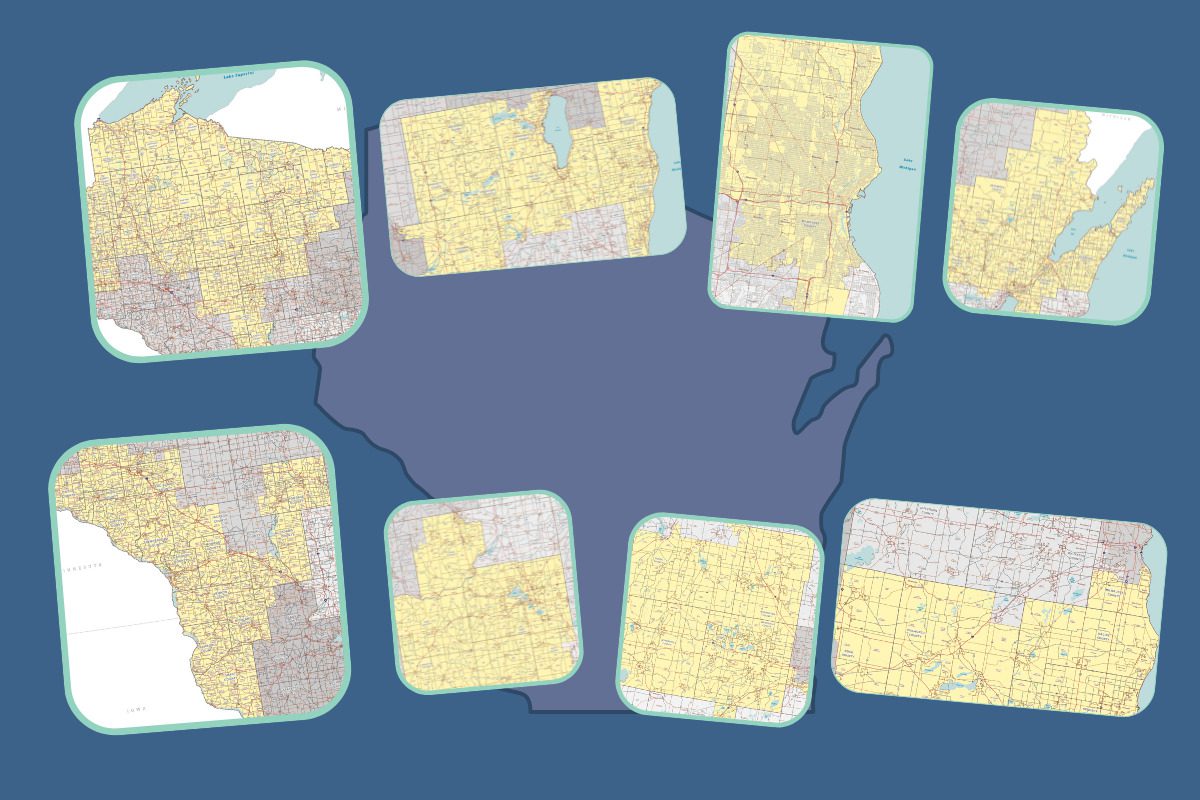
Wisconsin's eight congressional districts are at the heart of two new court challenges seeking fair maps for voters.
Legislative maps were rigged by politicians in 2011 but then recently changed. Congressional lines might be redrawn next.
A pair of three-judge panels will convene and hear arguments in Dane County that could result in the redrawing of Wisconsin’s congressional districts. It is the latest chapter in the long story of gerrymandering done by legislative Republicans more than a decade ago.
While the maps of districts for the state Senate and Assembly have since been rewritten, the lines that determine districts for the US House of Representatives remain in a position that gives Republicans three-fourths of Wisconsin’s congressional seats despite the state’s consistent 50-50 partisan voting split.
The slow momentum toward reform was set in motion in 2023 when voters ended 15 years of conservative dominance of the Wisconsin Supreme Court. The judiciary had previously rejected challenges that the GOP-drawn maps created an unfair partisan advantage and prevented voters from being able to choose their preferred representatives.
Wisconsin’s move away from gerrymandered maps comes as several other states become the focus of aggressive efforts by President Donald Trump and Republicans to rig maps in order to prevent voters from ending their control of Congress.
How did Wisconsin’s maps get out of balance?
Voters across the country in 2010 ended a short period of Democratic dominance, a midterm result remembered as a “shellacking,” as described by then-President Barack Obama, who took responsibility for ongoing economic struggles from the Great Recession and public dissatisfaction with the congressional healthcare debate that resulted in the Affordable Care Act. Wisconsin voters elected Republican Scott Walker as governor and gave the GOP control of both houses of the Legislature just in time for political maps to be redrawn after the 2010 census.
Republican lawmakers in Madison quickly rejected the types of moderate changes made in past decades, embracing advanced computer mapping tactics, writing the maps in private lawyers’ offices rather than the Capitol, and requiring signatures on secrecy pledges.
As described by the New York Times in 2017, Republicans “tried out map after map, tweak after tweak. They ran each potential map through computer algorithms that tested its performance in a wide range of political climates. The map they adopted is precisely engineered to assure Republican control in all but the most extreme circumstances.”
In other words, the priority of these Republican politicians was to win elections rather than provide maps for Wisconsin voters that should have been, as they say, “fair and balanced.” At times, Republicans nearly held two-thirds majorities that would have allowed them to override vetoes by Democratic Gov. Tony Evers, even as Democratic and progressive candidates won nearly all of a dozen statewide elections.
A US Supreme Court dominated by conservative justices rejected the notion that gerrymandering done in Wisconsin and elsewhere for partisan purposes was something they could review, even while acknowledging it could be “incompatible with democratic principles.” Their decision was a “racers, start your engines” moment for map rigging that continues to the present day.
Politicians run but can’t hide from voters wanting fair maps
After the 2020 census, Wisconsin had a Democratic governor but the legislative Republicans were still able to write maps that were largely unchanged, thanks to conservative state Supreme Court justices who arbitrarily required a “least changes” approach to the existing maps, locking in the gerrymandered boundaries.
But when Justice Janet Protasiewicz was elected in 2023, progressives took control of the court, and Republicans could sense the changing of the political winds. The legislative maps were ordered to be redrawn and the 2024 election saw Democrats flip 10 seats in the Assembly and four in the Senate with maps that more accurately reflected the views of Wisconsin voters.
GOP steps in its own trap
Democrats and other advocates for fair maps focused on the legislative maps due to a tight timetable to wage a court fight in time for the 2024 elections. A later challenge to the current congressional maps was rejected by the Supreme Court, not on the merits of the case, but because the people bringing the lawsuit brought it directly to the court instead of filing it in a lower circuit where it could be heard in detail and move through the appeals court process.
Two separate challenges to the maps were then filed in Dane County Circuit Court. Before 2011, a Dane County judge would have heard the case, but Republicans changed the law because they claimed a judge in a largely Democratic county would be biased. The law they wrote said a challenge must trigger a process where the state Supreme Court (then controlled by conservatives) would appoint a three judge panel to first hear the case before it can be considered by the higher court.
Last week, the progressive justices in the majority and conservative Justice Brian Hagedorn agreed to set up the panels, over the objections of the court’s other two conservatives. One case will be heard by judges from Dane, Portage, and Marathon counties, and the other will be heard by judges from Dane, Milwaukee, and Outagamie counties — with both cases being heard in Dane County. Hagedorn joined the other conservatives in objecting to the specific judges chosen by the liberal justices.
No timeline was immediately established, and even if one or both cases result in an order for new maps, there is no certainty they could be prepared in time for the 2026 congressional election.
Author
Support Our Cause
Thank you for taking the time to read our work. Before you go, we hope you'll consider supporting our values-driven journalism, which has always strived to make clear what's really at stake for Wisconsinites and our future.
Since day one, our goal here at UpNorthNews has always been to empower people across the state with fact-based news and information. We believe that when people are armed with knowledge about what's happening in their local, state, and federal governments—including who is working on their behalf and who is actively trying to block efforts aimed at improving the daily lives of Wisconsin families—they will be inspired to become civically engaged.

Question of the Week: Wisconsin after Evers and Vos retire
Assembly Speaker Robin Vos has announced he will not run for reelection this fall. Neither is Gov. Tony Evers. After eight years of butting heads,...

Evers deploys flattery on the Legislature, hoping for a final bipartisan act
The governor’s final State of the State address highlights two terms of bipartisan progress, hoping for one more deal to support public schools and...

Evers makes one last ask of Republicans to take property tax relief seriously
School districts dealt with legislative underfunding long before the “400-year” veto GOP lawmakers blame for a record number of referendums. Gov....

Inside Kelda Roys’ very Wisconsin holiday mix of faith, food, and family
The gubernatorial hopeful talks faith, food, and family, and why Donald Trump’s comments on affordability miss the mark for Wisconsinites this...