Republican lawmakers also reject Democratic attempt to reign in spending millions of taxpayer dollars on private lawyers.
Democratic members of the Legislature’s budget-writing committee didn’t understand why their Republican colleagues were voting to remove criminal justice reforms from the budget that the Republicans have said they supported.
Rep. Mark Born (R-Beaver Dam), who co-chairs the Joint Finance Committee, argued that criminal justice reforms should be done through legislation, not the budget. But Democrats countered that by putting reforms in the budget, the funds needed to enact those reforms are secured. Plus, while there is a lot of talk of bipartisan support for reforms, there hasn’t been as much action.
Many of the criminal justice reforms proposed would save the state money in the long term. Wisconsin’s incarceration rate is 676 per 100,000 people, slightly below the national average, according to the Prison Policy Initiative. But the criminal justice system is just one more way the state continues to worsen racial disparities, as Wisconsin incarcerates Black men at by far the highest rate in the nation and continues to lag about a decade of bipartisan criminal justice reforms in other states.
Rep. Evan Goyke (D-Milwaukee) pointed out that the state budget spends more on the Department of Corrections (DOC) than the University of Wisconsin system.
“If there’s a collective bipartisan will to get a piece of legislation done to not only give people greater opportunities in life, save taxpayers money, just overall do the right thing, I don’t know why we’re talking about it now: it should have been done a long time ago,” said Sen. Jon Erpenbach (D-West Point). “We don’t need a task force. We don’t need a study group. We know what we need to do.”
RELATED: How Wisconsin’s Criminal Justice System Feeds Racial Disparities
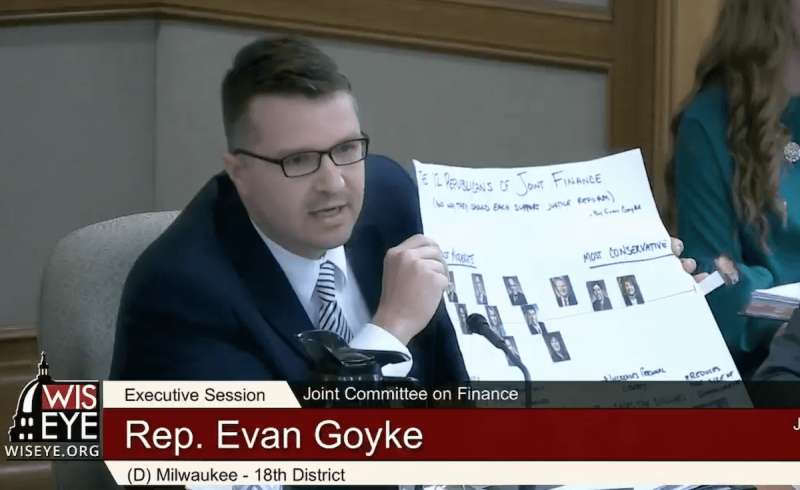
Goyke said he has been short on charts and props this budget session due to having a newborn at home, but he made one for Thursday’s session that showed all the Republican members of the committee along a spectrum that he assesses from most moderate to most conservative—with Sen. Duey Stroebel (R-Cedarburg) on a tab attached to the far right of the page.
Goyke, who said he got into politics to enact criminal justice reform after his experience as a public defender in the Milwaukee area, talked about how different conservative values align with criminal justice reform, from religious grounds to small government. In the end, his pleas didn’t work.
“When we spend more on prisons than on the university system, that is a problem,” Goyke said. “That is not sustainable.”
A big part of Gov. Tony Evers’ and the Democrats’ proposals dealt with juvenile justice reform, including new facilities for young people currently housed at the troubled Lincoln Hills and Copper Lake institutions. While Republicans said they supported the timeline for closing the facility, their failure to put forward the necessary funds means they will miss the July 2021 deadline.
Democrats’ reforms would have also raised the age that young people can be tried as an adult and ended the practice of automatically trying 17-year-olds as adults, something only two other states do. Evers’ budget had also proposed additional mental health resources for juvenile offenders, who are statistically more likely to have experienced childhood trauma.
Goyke pointed to a study that found 40% of men and 80% of women in prisons have diagnosed mental health disorders. Expanding Treatment Alternatives and Diversion programs would require those individuals to get the help that they need and reduce the state’s prison population. Democrats wanted to invest an additional $19 million; Republicans cut it to $7 million.
Another Democratic proposal would have put an additional $26 million for correctional officer (CO) overtime pay. The statewide shortage of COs, which has been growing since Act 10 passed in 2011, has resulted in COs across the state being transferred to two-week stints at Waupun Correctional Institute, which is short-staffed by 45%. Waupun is in Born’s district.
The Republican members of the Joint Finance Committee rejected the Democrats’ proposals to develop earned release and revocation alternatives, which also reduce the prison population, a $10 million pay progression for District Attorneys, and expand Opening Avenues to Reentry to reduce recidivism.
Dems try to reign in outside counsel
Democrats also proposed requiring a vote of the full Legislature before majority leadership could hire outside private attorneys at taxpayer expense.
This proposal came on the heels of a Legislative Fiscal Bureau report that over the last three years the Republican-led legislature has racked up $8.5 million in private attorney fees.
The lawsuits include Republican-led efforts to restrict Evers and public health officials from enacting COVID-19 protective measures, to redistrict Wisconsin’s already heavily gerrymandered maps so they continue to give Republicans a majority in the statehouse, and to restrict voter access in order to continue promulgating the lie of widespread voter fraud.
Goyke noted that in the DOC budget, Republicans had capped the salaries of public defenders at $60 an hour; the private attorneys they have hired charge up to $350 an hour. He and other Democrats on the committee noted that while these attorneys were hired by the Legislature, Democrats did not have access to outside attorneys.
Goyke said he tried to speak with the attorneys hired for the lawsuit over the “lame duck” actions of the Legislature after the 2018 election, when Republicans voted to strip away some of the powers of Evers and Attorney General Josh Kaul. He said that he was told the attorney could not speak with him without the approval of one the Joint Finance chairs: Born and Sen. Howard Marklein (R-Spring Green).
“What is happening with this funding and these lawyers is completely unaccountable,” said Goyke.
The motion failed 4-11 along party lines.