Wisconsin’s most active Democrats have had it fairly easy the last seven times they gathered at a state convention, with popular incumbents serving as governor, US senator, and state attorney general; and five of the last six state Supreme Court winners had Democratic support.
But with Gov. Tony Evers stepping aside after two terms, delegates have work to do this weekend in Madison: deciding which of the seven candidates vying for their party’s nomination will earn their support in the Aug. 11 primary election.
“Having a lot of candidates out there communicating about what the party is fighting for, bringing their own energy and vision and excitement to the race is a good thing,” Democratic Party of Wisconsin Chair Devin Remiker told WISC-TV, invoking 2018 when Evers emerged from an even larger field of candidates and defeated Republican incumbent Gov. Scott Walker.
Remiker also said a large pool of candidates offers a better look than how Republicans have surrendered all of their candidate selections in order to allow President Donald Trump to “anoint” the person he thinks should run for any given office.
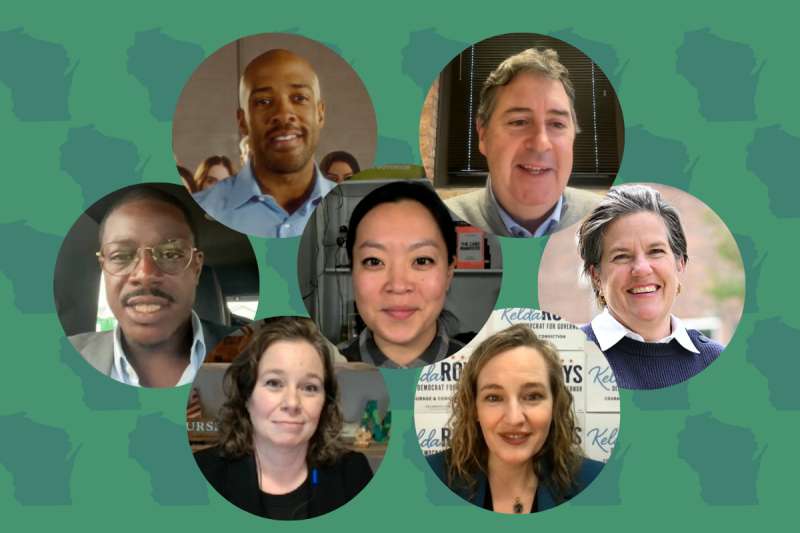
The seven candidates will speak to the delegates at a Saturday evening floor session. The speaking order starts with current Lt. Gov. Sara Rodriguez, followed by former Dept. of Administration Secretary Joel Brennan, Milwaukee County Executive David Crowley, Sen. Kelda Roys, former Lt. Gov. Mandela Barnes, Rep. Francesca Hong, and former CEO of the Wisconsin Economic Development Corporation Missy Hughes.
No endorsement fights
Unlike state Republicans, the Democratic Party of Wisconsin does not normally endorse a candidate at their conventions — an acknowledgement that it’s the voters who should determine who becomes the nominee on the November ballot. The lack of endorsements avoids the nasty public infighting often seen at other conventions, but it means the party will go another eight weeks without a single “face” of the party who would also have earlier access to party resources, donor lists, and other perks.
The candidates understand they’re part of a free-for-all as more than 2,800 delegates give them a thorough review this weekend at the Monona Terrace Convention Center in Madison.
“The convention is a fun time,” said Barnes. “It’s a big family reunion. It feels like 2018: people know we can do things even better because the opportunity for a new legislature is upon us, so the race for governor is potentially more ambitious than it’s been in a very long time. And tapping into that energy at convention, being able to mix it up with folks and talk about my plan is something I’m really looking forward to.”
“I’m excited about going and having conversations with people at the convention,” said Brennan. “I expect to come out of there with some wind at my back.”
Question of the Week: Should state Democrats endorse a candidate at their convention?
So what else happens at the convention?
Lots of talking: business and social. The convention is where the party faithful get to exchange their Zoom meetings for face-to-face discussions about candidates, strategy, messaging, and idea swapping. There are speeches from other party leaders, especially members of Congress and other state offices. The party’s various interest groups get together: the environmental caucus, the rural caucus, caucuses for women, veterans, and more are scattered around the venue’s many conference rooms. Breakout sessions cover topics such as how to run for office, protecting voting rights, and leadership training for people who want to become more active within the party.
And no political convention is complete without hospitality suites. When the evening’s speeches conclude, delegates swarm from room to room where candidates and incumbents provide themed decorations, entertainment, and a political food court of appetizers and beverages. Evers’ suite usually features one of his favorites, ice cream.
After the parties, doing the party’s business
Party leaders also get some business done at their annual meeting. Their executive committee deals with top-level issues, including a review of the party’s financial picture. The delegates, meanwhile, get down to business debating resolutions about a plethora of issues. Do a majority of delegates want to reform the filibuster or go on record calling for it to be abolished? Will more delegates favor a resolution for a $10 minimum wage or one set at $15? The highest priority issues become part of the party’s platform: a single document of values and positions.
Roys said she expects the party to be united both after the convention and the primary.
“At the end of the day, I am one of seven candidates,” Roys said, “all of whom are good people, all of whom I consider friends. I think I’m best positioned to win the primary and beat Tom Tiffany, but we’re all on the same team and we’re all going to be working toward the same goal, which is making sure that Wisconsin has a Democratic governor and a Democratic legislature come 2027.”