Reporting by Blaise Mesa, Milwaukee Journal Sentinel / Milwaukee Journal Sentinel
As the Peshtigo fire burned on Oct. 8, 1871, the crew aboard the G.L. Newman lost their way in the thick smoke and ran the 122-foot ship aground near the southeast point of Green Island.
Samuel Drew, the lighthouse keeper on Green Island, jumped into action. He rescued the crew, then housed them for a week while they worked to salvage what they could from the ship.
That’s another day on the job for a lighthouse keeper. While the work was often long and grueling, Wisconsin wouldn’t be the same without the men and women who spent their days making sure the state’s lighthouses were shining bright.
“Growth and development would have been really, really slowed [without lighthouses],” said Barb Wardius, a Milwaukee resident who, with her husband Ken, has written multiple books about Wisconsin’s lighthouses.
Pottawatomie Lighthouse
When lighthouses were first built in the area, Wisconsin wasn’t yet a state. The sparsely populated land was home to Native American tribes, but there was little infrastructure.
There weren’t any railroads, Wardius said, and if there were roads, they were in poor condition. But the country was expanding, which meant more materials needed to move to the burgeoning Wisconsin region. The Great Lakes would be critical in that regard.
“Water was the way to move things and people,” Wardius said.
But with more boats came more opportunities for wrecks. Wisconsin’s first lighthouse was the Pottawatomie Lighthouse on Rock Island, built in 1836 after mariners implored the federal government to do something to prevent shipwrecks.
Pottawatomie Lighthouse helped ships travel through the Death’s Door passage, said Friends of Rock Island State Park president Tina Jacoby. Death’s Door is the strait that links Lake Michigan and the bay of Green Bay, between the tip of the Door County peninsula and Detroit, Pilot, Plum and Washington islands.
As the name implies, it wasn’t easy to sail through Death’s Door. Ships had a low success rate because most of the hazards are underwater and hard to see, Jacoby said. The stretch of water was littered with shoals and small islands.
Most ships preferred to avoid Death’s Door because nearby Rock Island passage was wide and easy to navigate. But some sailors would choose to go through Death’s Door in an effort to save time, and others sometimes confused one route for another.
That all changed when the lighthouse was installed and lit the way to safe passage.
Without lighthouses, early sailing was treacherous, Wardius said. On a day with good weather, a ship’s captain could usually see where the ship was going, but nautical charts were often incorrect or nonexistent. If the sky was clear, captains could sometimes rely on the stars.
Lighthouses drastically increased the ease of navigation as they marked safe passages.
Raspberry Island Lighthouse
Even after more lighthouses were built, shipwrecks still happened from time to time. Tamara Thomsen, a maritime archaeologist with the Wisconsin Historical Society, said thousands of ships were registered to Milwaukee or Chicago during peak travel in the 1870s.
The two cities were leading grain ports because the railroad didn’t travel to them until about 1850, Thomsen said. That means ships came in droves, and lighthouses needed to remain in tip-top shape.
But what does lighthouse keeping actually require? A day in the life of a lighthouse keeper changed drastically over the years.
In the 1850s, lighthouse keepers would spend their time hauling lard oil to the top of the lighthouse, trimming the wick and cleaning the lamp, said Bob Mackreth, a retired park ranger and park historian at Apostle Islands National Lakeshore.
But more than a century later, in the 1970s, a diesel generator kept things running and lighthouse keepers might be “watching ‘Happy Days’ on television,” Mackreth said. Still, lighthouse keeping was far from an easy job.
“They are a bear to maintain,” Mackreth said. “If I had a worst enemy, I would give them an offshore lighthouse and tell [them] to maintain it.”
There is a long list of things that need maintaining. The towers needed to be a particular color, which meant regular painting. The fuel needs to be measured to keep the light burning and the lenses need to be cleaned – and if that’s done incorrectly, it could scratch the lens.
Lighthouse keepers sometimes even grew their own crops and had their own cattle to supplement their food supply.
An 1881 instruction manual from the U.S. Lighthouse Board put it this way: “[The keeper] must practice the strictest economy compatible with maintaining at all times the best possible light; and he must be careful to prevent waste, theft or misapplication of lighthouse property.”
Today, there are six light stations and seven working towers on the Apostle Islands, though one is set to be demolished and replaced with a light buoy. The main museum for those towers is at the Raspberry Island Lighthouse.
While Raspberry Island Lighthouse was largely completed in 1862, it didn’t start lighting the way for ships until the following year. The specialized lenses needed for the lighthouse came from France, and shipping them across the ocean took months.
The two-story tall white house has the lighthouse rising out at the top, with chimneys flanking both sides. The “boxy, two-bedroom house” could accommodate a lighthouse keeper and his family, according to the National Park Service.
North Point Lighthouse
Many lighthouses are secluded. The Pottawatomie Lighthouse, for example, was so isolated that one lighthouse keeper was given two weeks to return to the mainland to find a wife.
He was not successful.
But not every lighthouse stands far from civilization. The North Point Lighthouse in Milwaukee is part of a residential neighborhood, said Dave O’Brien, North Point Lighthouse Friends board president.
North Point Lighthouse opened in November 1855, but its original building has been torn down and rebuilt. Erosion chipped away 16 feet of the lighthouse’s front yard, so the new building was set 100 feet back.
Its most famous keeper is Georgia Stebbins. After she caught tuberculosis in the 1870s, doctors told her she had a short time left to live and directed her to leave New York and find somewhere with better air. Her father was the keeper at North Point Lighthouse, so Stebbins made her way to Milwaukee. Soon she was doing the bulk of the lighthouse work.
“She never spent a single night away from the lighthouse,” according to the North Point Lighthouse Museum. “Her son Albert and her two grandsons were born at North Point Lighthouse.”
Her father retained the title of keeper for years until she was appointed lighthouse keeper. Stebbins became the longest-serving lighthouse keeper in North Point history, holding the position for 26 years.
But Stebbins’ time as lighthouse keeper ended abruptly. The North Point Lighthouse needed to be razed because glare from the city lights and trees made it harder to see the light. It was decommissioned during construction.
Stebbins reluctantly resigned, then reapplied after construction was complete. While she had worked at the lighthouse for years, the job was instead given to a man who had no experience. At the time, female keepers were rare but not unheard of.
Cana Island Lighthouse
As technology improved, the days of the lighthouse keeper began to fade.
The electrification of lighthouses involved a few major steps, and the transition to electricity can be seen at Door County’s Cana Island Lighthouse.
It’s the most visited and most photographed lighthouse in Wisconsin – and that’s notable because Door County has more lighthouses than any county anywhere in the country, said Sam Perlman, deputy director of the Door County Maritime Museum and Lighthouse Preservation Society
When it was built in 1869, Cana Island Lighthouse was the tallest building in Door County. The lighthouse’s tall, white tower stands next to the residence and still shines today. It was automated in 1944.
Thomsen, the maritime archaeologist, said ship technology has come a long way since the days of the early days of Wisconsin’s lighthouses, with better maps, radio telegraphs, navigational lights and autopilot.
But even with all the technology, there’s still a need for lighthouses, said Thomsen, who has spent dark nights on a research boats before.
“It’s sure nice to be able to see a white spire on the horizon,” she said. “[That] mark on the landscape that you can steer your boat toward.”
Sherwood Lighthouse
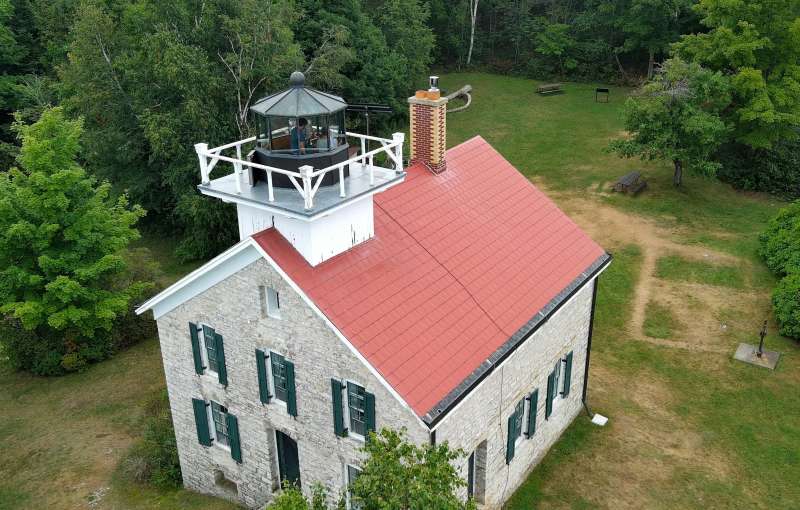
Sherwood Lighthouse, another Door County lighthouse, had Wisconsin’s last lighthouse keeper, who was retired in 1983, according to Ken Wardius, who has co-authored books about Wisconsin’s lighthouses with his wife, Barb.
Now, the Coast Guard manages most of the lights. The Coast Guard manages only the light, not the buildings. Some lights are solar powered, others have electricity and several use batteries.
Sherwood Point remains active. It can be rented out by active duty and retired military members, and the lighthouse is typically a busy vacation spot, Perlman said.
Sherwood Point didn’t need much renovation work, Perlman said, but not every lighthouse is so lucky.
That was the case for North Point Lighthouse, where an effort to remake the lighthouse to be historically accurate to the time when lighthouse keepers lived there was hindered by multiple issues. The floor layout was chopped up, the walls had cracks and the floors were in poor condition.
“It was really in shambles,” O’Brien said. “It was tricky and dangerous just to get in the place.”
That lighthouse was saved with $1 million in funding from private donors, but Wardius said not every lighthouse will be similarly saved. Wisconsin has 48 lighthouses. Most are not open to the public, he said, and fewer than half have been restored or are in reasonable shape.
For many people, though, like Mackreth in the Apostle Islands, lighthouses still hold a special place in history.
“Lighthouses house the full spectrum of human experience,” Mackreth said. “There were babies born at the lighthouses … people died at the lighthouses.”
How to visit Wisconsin’s lighthouses
- Pottawatomie Lighthouse: Tours are given daily from 10 a.m. to 4 p.m. from Memorial Day to Columbus Day. It’s also open during lighthouse passport days.
- Raspberry Island Lighthouse: Park rangers conduct tours during the summer.
- North Point Lighthouse: The lighthouse is open Saturdays and Sundays from 1 to 4 p.m. It also hosts regular lectures.
- Cana Island Lighthouse: The lighthouse is open May to October from 10 a.m. to 5 p.m. daily. It’s open during lighthouse passport days.
- Sherwood Point Lighthouse: The Sherwood Point Lighthouse is only open on lighthouse passport days. That includes four separate periods in 2026. The last one is Oct. 2-4.
This article originally appeared on Milwaukee Journal Sentinel: These Wisconsin lighthouses helped to shape the state’s history
USA TODAY Network via Reuters Connect