Wisconsinites couldn’t legally purchase yellow-colored margarine for more than seven decades. (kevin brine/Shutterstock)
You may think you know all about the Badger State, but there are some facts about Wisconsin that are truly surprising, even to long-time Wisconsinites.
Wisconsinites have a lot of state pride, and with that pride comes plenty of facts that residents can list about their home state, like the fact that Wisconsin is a major producer of cheese and cranberries, or that the Green Bay Packers have won four Super Bowls, or that the ice cream sundae, Harley Davidson motorcycle, and American kindergarten were all created in the state.
But there are some facts about Wisconsin that even the most dedicated residents of the Badger State might be shocked to find out, like the fact that they can visit a chapel that Joan of Arc also (reportedly) prayed at, or that they’ll be hard-pressed to find margarine in any Wisconsin restaurant.
From surprising Wisconsin residents to astonishing ancient fossils found in the state to weird laws that were enacted throughout the Badger State, there are plenty of facts about Wisconsin that are truly mind-boggling.
11 wild facts about Wisconsin:
1. Marathon County produces 95 percent of the country’s ginseng
Wisconsin produces a whole lot of food for the country. As America’s Dairyland, the state is responsible for plenty of dairy production, but it’s also responsible for a majority of the ginseng production throughout the country as well. Ginseng, an herbal plant, has historically been used in teas, medicines, soups, and stir-fries. Although it’s been used for centuries in Asian countries, where it’s cultivated, ginseng is also native to Wisconsin, and it first started being cultivated in the state in the 19th century.
In fact, more than 95 percent of the ginseng grown in the United States comes from Wisconsin, specifically the central part of the state, which has been referred to as the Napa Valley of American Ginseng. While the region grows a majority of the ginseng consumed throughout the United States, Wisconsin ginseng farmers also send their product to other countries, including China, which spent $9.83 million on American ginseng in 2020.

2. Milwaukee is home to a chapel that Joan of Arc may have prayed in
Milwaukee was officially incorporated in 1846, making the city 179 years old as of 2025, but one of the buildings in the city goes back more than 600 years. The St. Joan of Arc Chapel, which can be found on Marquette University’s campus, was first constructed in 1420. The chapel was originally built in the French village of Chasse-sur-Rhône. According to a sign that was on the original building, Joan of Arc may have visited the chapel and prayed there after meeting King Charles VII of France in 1429.
The chapel was abandoned after the French Revolution, but was rediscovered by the architect Jacques Couëlle after World War I. He negotiated its transfer to Brookville, New York, where it was owned by Gertrude Hill Gavin, the daughter of James J. Hill, who founded the Great Northern Railway. When Gavin died, the chapel was sold to Marc B. Rojtman and his wife, Lillian, who gave it to Marquette University. It has been a fixture at the school since 1966. According to Marquette University, the chapel is “the heart of [the school’s] campus,” and has been the site of protests, vigils, and, of course, regularly-held Masses.
3. Margarine was banned in the state for decades
As proud residents of America’s Dairyland, it’s presumed that most Wisconsinites would choose butter over margarine when given the choice. But for several decades, Wisconsin residents, and anyone who grocery shopped in the state, weren’t given much of a choice, as yellow margarine was banned throughout Wisconsin for several decades. Margarine is naturally white or pale gray, making it arguably unappealing to eat, so margarine producers started adding yellow dye to the product, giving it a close resemblance to butter. The sale of margarine was banned in 1895 to help protect the state’s dairy industry, and the ban wasn’t repealed until 1967.
While Wisconites can buy margarine at the store, there are still regulations in place surrounding the spread. Wisconsin restaurants are banned from serving yellow margarine instead of butter unless specifically requested by a customer, and margarine is banned from being served to students, patients, or inmates in state-run schools, hospitals, and prisons. There are also strict requirements for how much dye is used in margarine, and how the product is packaged and labeled, according to the Wisconsin State Farmer.

4. The state is home to the largest soy sauce production facility in the world
Soy sauce, made from fermented soybeans, has a Chinese origin and is typically associated with Asian cuisines, so it’s a bit mind-boggling that the largest soy sauce production facility in the world is in Wisconsin. Kikkoman Corporation, a company based in Noda, Japan, has been the world’s largest soy sauce producer since 2022, and the Japanese company’s largest production facility is in Walworth, Wisc. The factory, which opened in the 1970s, was Kikkoman’s first American production facility, and it was one of the first times that a Japanese company opened a factory in the United States.
The facility currently produces approximately 29 million gallons of soy sauce each year. In 2024, Kikkoman announced plans to open another production facility in Jefferson, Wisc., to produce soy sauce and teriyaki sauce, with the first shipments expected in late 2026.
5. Stalin’s daughter called Wisconsin home
Svetlana Alliluyeva, the only daughter of Soviet Joseph Stalin, was born in the Soviet Union in 1926 and spent the first four decades of her life living in the nation that her father led. After her father’s death in 1953, Alliluyeva worked as a lecturer and translator in Moscow and fell in love with Brajesh Singh, an Indian politician whom she met in the Soviet Union. When Singh died in 1966, she was allowed to make her first trip outside of the Soviet Union, to take Singh’s ashes to his family and pour them in the Ganges River. She asked for permission to stay in India, but was denied and ordered to return to the Soviet Union. Instead, Alliluyeva went to the American embassy in New Delhi and defected from the Soviet Union.
Alliluyeva arrived in New York in 1967 and denounced both her father’s legacy and the Soviet Union. After moving around the United States, Alliluyeva eventually settled in Wisconsin. She became a naturalized American citizen in 1978, going by the name Lana Peters, and briefly married Frank Lloyd Wright’s former son-in-law, architect William Wesley Peters. Alliluyeva moved back and forth between the Soviet Union, England, and the United States, but spent the last few years of her life living in Richland Center and Spring Green, Wisc. She died in Richland Center, Wisc., in 2011.
6. Barbie is a Wisconsinite
Plenty of famous people have called Wisconsin home at some point in their lives, like Gene Wilder, Frank Lloyd Wright, and even Oprah Winfrey. But Wisconsin’s most famous resident might arguably be Barbie. Yes, Barbie, as in the doll, is a Wisconsinite. According to the character’s fictional biography, Barbara Millicent Roberts, or as people all around the world know her, Barbie, was born during a snowstorm in the fictional town of Willows, Wisc. She met her boyfriend, Ken, in Willows, and they attended Willows High School together.
The character’s fictional background was first published by Random House in a book, “Here’s Barbie,” in the 1960s. Some of Barbie’s Wisconsin history was retconned in 2015, in a vlog, where Barbie reaffirms that she’s a fan of both cheese and the Green Bay Packers, but said that her family moved to Malibu, Calif., when she was 8 years old. To commemorate one of the state’s most famous residents, the Wisconsin Historical Society, which is headquartered in Madison, has an original Barbie doll, donated by a family from Oshkosh.

7. There is an ancient coral reef in Milwaukee
Coral reefs are among the many wonders found underwater, primarily in tropical and subtropical locales such as the Caribbean, Mexico, and Australia. There is also one near the corner of Wood Avenue and General Mitchell Boulevard in Milwaukee. The Soldiers’ Home Reef in Milwaukee isn’t even underwater, or at least it isn’t anymore. It’s a fossilized coral reef rock formation that was formed approximately 400 million years ago, when the area that’s now Wisconsin was under a shallow tropical sea.
Over time, the corals were preserved as limestone and were first identified by geologist Increase A. Lapham in the 1830s. The reef is located on the Clement J. Zablocki Veterans Affairs Medical Center, and was declared a National Historic Landmark in 1993.
8. A Russian spacecraft crash-landed in a Wisconsin city
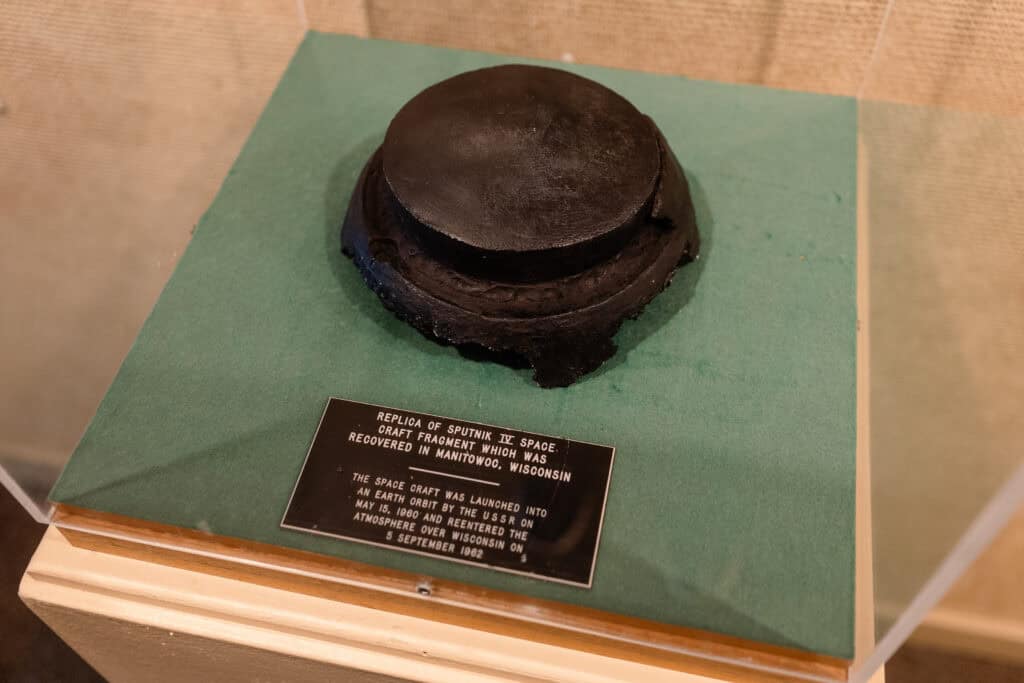
Like a scene out of a science fiction movie, on Sept. 5, 1962, at approximately 4:30 a.m., a part of a Russian spacecraft, Sputnik IV, crashed into the middle of Manitowoc’s 8th Street, near the city’s Rahr-West Art Museum. The crash occurred more than two years after the spacecraft was launched on May 15, 1960. Sputnik IV, as it’s known in Western countries, was part of the Soviet Union’s space program, the Vostok programme, and was the country’s first spacecraft launched as part of the program. The goal of Sputnik IV was to test life support systems and the physical stresses of spaceflight ahead of crewed missions.
After a guidance system error a few days after its launch, Sputnik IV went into a higher orbit, and floated around space for more than two years, until it began plummeting back down toward Earth. Most of Sputnik IV burned up upon reentry into Earth’s atmosphere, but a 20-pound piece crashed into the Wisconsin city. No one was injured in the crash, which was discovered by two Manitowoc police officers.
9. The largest woolly mammoth ever excavated was found in Kenosha
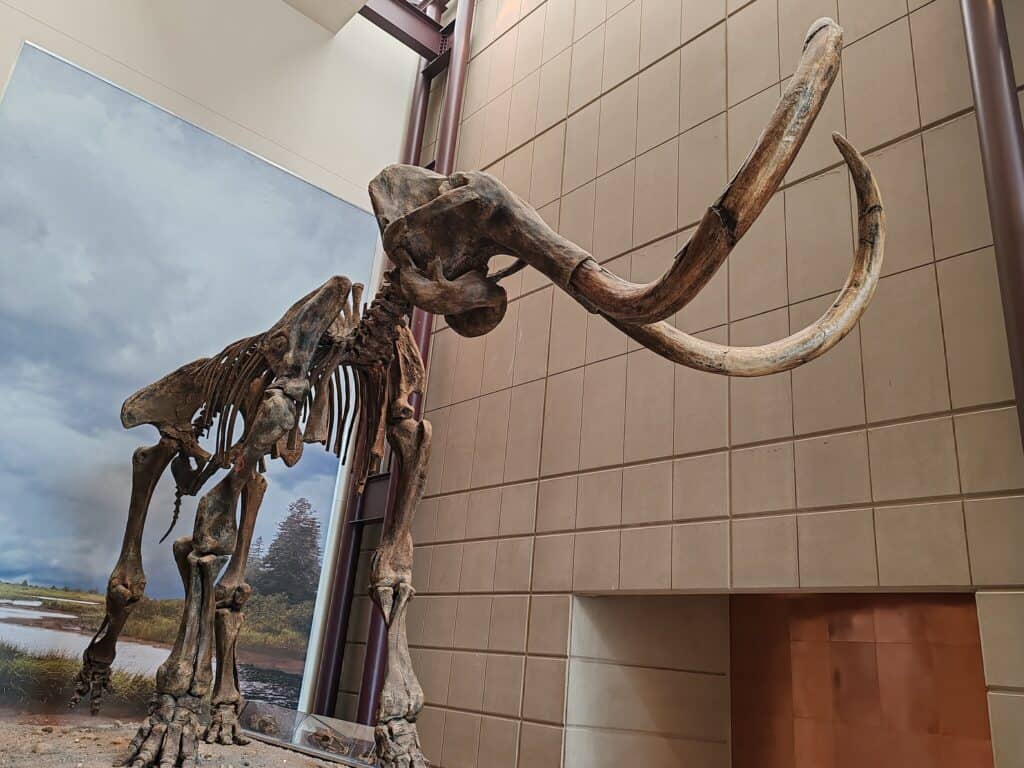
It’s hard to imagine long-extinct creatures, like the woolly mammoth, ever roaming through Wisconsin, but the animals are confirmed to have called the state home, because the largest woolly mammoth ever excavated was found in Kenosha County, Wisc. Two different mammoths have been discovered and excavated in the southeastern Wisconsin county, the Schaefer Mammoth and the Hebior Mammoth.
The Hebior Mammoth, the larger of the two, and the largest ever excavated, was discovered in the 1990s, while an archeological group from Marquette University was excavating the Schaefer Mammoth. Kenosha County farmer John Hebior approached the site and asked about a bone that he had found on his property years before. It was determined that the Hebior Mammoth was at least 14,500 years old, had 85 percent of its bones intact, and bore butchering marks, proving that humans existed in the area 1,000 years earlier than previously thought. The bones became some of the oldest evidence of human habitation in North America.
The Schaefer Mammoth is on display at the Kenosha Public Museum, while the Hebior Mammoth is at the Milwaukee Public Museum. The Hebior Mammoth’s bones are too fragile to display or mount, according to the museum, but a fiberglass replica is on display.
10. “The Wizard of Oz” held its world premiere in Wisconsin
Normally, premieres for splashy Hollywood films are held in theaters in, well, Hollywood, or other parts of Los Angeles. But that wasn’t the case for one of the most iconic films of all time, “The Wizard of Oz.” While the film did have a premiere event at Grauman’s Chinese Theatre in Los Angeles on Aug. 15, 1939, it actually premiered five days earlier in Green Bay, on Aug. 10, at the Orpheum Theatre. The movie premiere was held two weeks before the film was widely released, on Aug. 25, 1939.
It’s unknown why the city was chosen to host the premiere for the beloved film, and the historic theater where the event was held now sits vacant on Green Bay’s Walnut Street. The film also premiered in Kenosha on Aug. 11 and Oconomowoc on Aug. 12, which served as test markets, and there is a plaque in downtown Oconomowoc commemorating the screening, which incorrectly states that the film had its world premiere there.
11. Sheboygan is a popular surf spot
When thinking of iconic surf destinations throughout the United States, places like Hawaii’s North Shore, Santa Cruz, and Malibu come to mind. What’s one thing that those places all have in common? They’re located on an ocean. Sheboygan, a city in eastern Wisconsin, certainly isn’t near any oceans, but it’s still a top-tier surf spot.
Midwestern surfers flock to the city and county seat of Sheboygan County because it’s one of the best places to surf on Lake Michigan. Sheboygan is so renowned as a Midwestern surfing destination that it’s claimed the nickname Malibu of the Midwest. For more than two decades, the city played host to the Dairyland Surf Classic, the largest lake surfing competition in the world.
While surfers can head out to hit the Sheboygan waves any time of year, the peak surfing season runs throughout the fall and winter, when the waves are at their most consistent. Some of the best beaches to catch a wave in Sheboygan are King Park and North Beach, and even beginners can get in on the action with surf lessons from local businesses like EOS Surf Shop.
Author

50 years after sinking, the legendary Edmund Fitzgerald still has stories to tell
A half century after the Great Lakes' most famous shipwreck came to rest on the floor of Lake Superior, the SS Edmund Fitzgerald’s grip on the...
A haunted hotel, a ghost ship and the afterlife of a priest — Manitowoc’s tales of the strange and unexplained
MANITOWOC – Tales of mysterious noises in abandoned houses or strange creatures rising out of cold lake waters fascinate folks year-round. But they...
5 unsung films that dramatize America’s rich labor history
By Peter Dreier, Occidental College The U.S. is in the midst of a new upsurge of union organizing. Is a Hollywood drama about angry Starbucks...

From tubs to tugs: Surprising stories behind 6 Wisconsin shipwrecks
A maritime archeologist shares the stories of six surprising shipwrecks in Wisconsin’s Great Lakes, from historic vessels to unusual cargo. Did you...