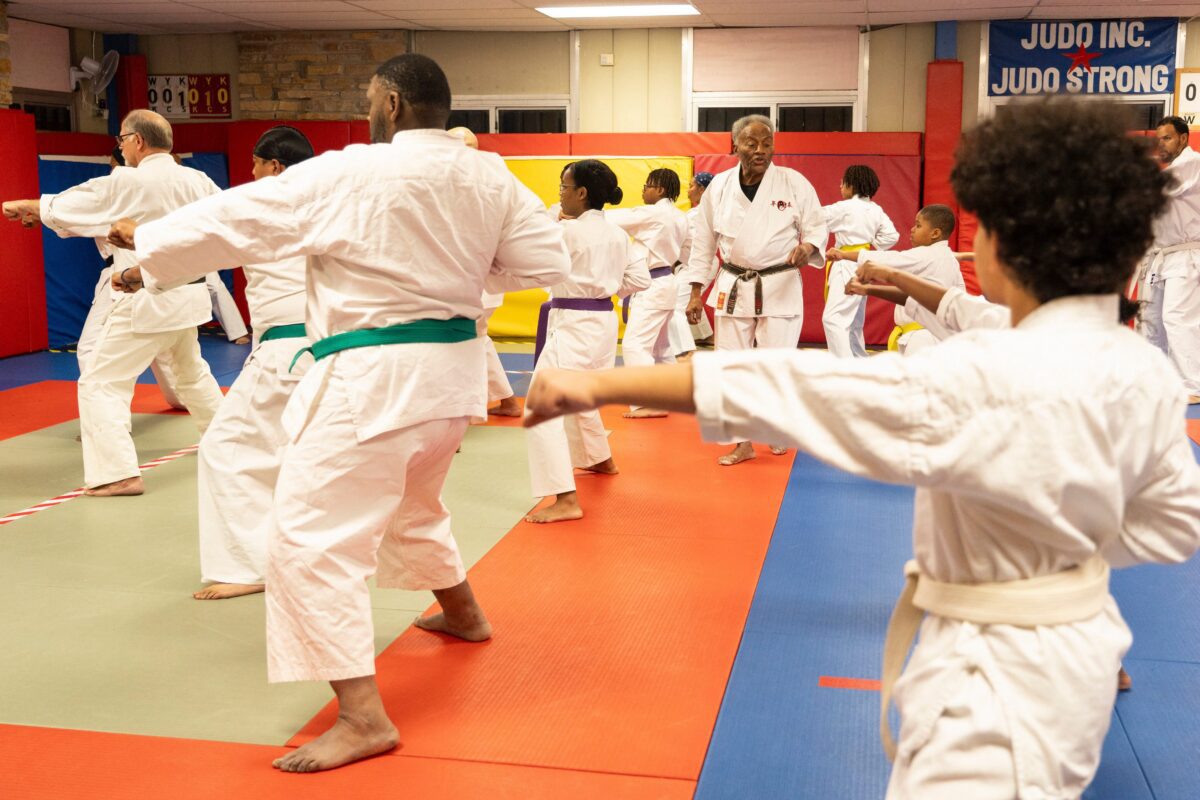
Students participate in a Kempo-Goju School of Karate class on Jan. 28, 2026 in Brown Deer, Wisconsin. Master Charles Warren developed Kempo-Goju karate by combining Chinese Kempo and Japanese Gojo Ryu Karate. (USA Today via Reuters Connect)
Cheryl Knox, 66, used to walk past the Kempo Goju dojo on her way to and from Keefe Avenue Elementary in the mid-1970s.
She said she was enamored by the trophies in the window and the martial arts students training in the distance.
“I was captivated by everything,” Knox said. “I always thought, one day, I would go inside, and then finally I did.”
The students were practicing Kempo Goju, a martial arts discipline founded in Milwaukee by Charles Warren, 78, in the 1960s.
The karate style incorporates Chinese Kempo and Japanese Goju Ryu and is an internationally recognized discipline, with dojos in Wisconsin, Mississippi and Europe.
Knox eventually joined Warren’s school when she reached the sixth grade.
Warren’s students were under a rigorous program, Knox said. Kempo Goju training required students to exercise daily to keep up with their classes.
He also taught about responsibility, and he led by example, she said, adding that he supported many students outside of class emotionally and financially.
Knox continued to train with Warren years after she left Milwaukee to attend the University of Wisconsin-Madison.
“I can’t overstate the impact he had on his students,” Knox said.
How was Kempo Goju developed?
Warren developed the integrated karate style in the mid-1960s after studying under a Kempo master in Albuquerque, New Mexico, and later, a Goju Ryu master in Japan.
He returned to Milwaukee in the late 1960s and began to blend the rapid and circular hand techniques of Kempo with the traditional striking and blocking techniques of Goju Ryu in his own training.
By 1970, Warren began teaching his techniques to his first students, whom he met through his wife, Sharon Nash.
Warren and Nash started dating in their junior year of high school. When he left for service, they stayed in touch, but the distance at times was difficult.
When he returned to Milwaukee, they began again where they left off, and he asked her out on a date to the movies. When Warren went to pick her up at her parents’ house, her brothers, Kevin, Reggie and Wayne, surrounded him.
“They told me, ‘If you are gonna keep taking our sister out, we’re gonna we see if you can handle yourself,”’ Warren said.
Warren and the three brothers went down into the basement, and Wayne was the first to step forward.
“And boom! I punch him, and he is on the floor. Then the next oldest decided he’s tough and tried to box me, and I knocked him on the floor,” he said. “Little Kevin ran upstairs and yells, ‘Mom! Wayne’s on the floor in a ball!”’
Warren said their mother rushed downstairs, looked around, and told the brothers to leave him alone.
Warren married Nash some years later, and they have been together for over 50 years.
In 1970, Wayne, Reggie and Kevin became Warren’s first students, and were known as The Milwaukee Kick Fighters.
The classes were small at first, comprising mostly Sharon’s brothers and a few of their friends. The group trained at the old Northside YMCA on North 12th Street and West Garfield Avenue.
Eventually, Warren moved the budding school to a space near North Green Bay Avenue and West Silver Spring Drive.
By 1976, he moved The Milwaukee Kick Fighters to North 18th Street and West Atkinson Avenue.
Kempo-Goju gains traction
That same year, Warren and eight of his students were invited to the U.S. Karate Association’s Grand Nationals Tournament in La Crosse.
They did not win the full tournament, but Warren’s new Kempo-Goju style began to gain attention from the martial arts community.
“We did real, real well,” Warren said. “People wanted to know where we were from and we said Milwaukee.”
Some organizers of the tournament saw the potential for Warren’s school and told him that the name of the school would not be taken seriously in national tournaments. So, he changed the name to Kempo-Goju, and Warren has been recognized as the discipline’s original master ever since.
As the discipline grew in popularity, Warren’s students began to take home trophies from tournaments across the country and internationally.
Over time, Warren began to incorporate other martial arts disciplines like Judo and Aikido to teach his students to be well-rounded enough to react to any situation.
What was expected of Kempo Goju students?
One of the key responsibilities Warren taught his pupils was how to show restraint, according to Knox.
If a student was put in a position where they had no choice but to fight, they were expected to use methods that would do the least amount of damage, unless they were in a life-or-death situation.
“If one of us got into a fight, we were also expected to come back and explain everything we did to avoid using our hands,” Knox said.
It was called the “Circle of Honor,” according to Warren. If one of the students gave an inadequate answer for why they chose to use force, they would have to complete an intensive workout or more difficult training to discourage the behavior, he said.
However, fights outside the dojo or a tournament were rare for Warren’s students.
According to Knox, other dojos had a reputation for students instigating fights outside class, but at Warren’s school, they maintained a reputation of excellence and honor.
“You could probably count on one hand the number [of students] that got in trouble with the police,” Knox said. “He kept them on the right path.”
Because of his teaching style and the effectiveness of Kempo Goju, Warren’s students, including Knox, were contracted as security for local events.
The school provided security when Jesse Jackson visited Milwaukee in the late 1970s.
“I always said that if I got the chance to meet Jesse Jackson again, I would tell him, ‘Hey, did you know I did security for you back in the day?”’ Knox said.
Warren establishes a Kempo Goju dojo in Kosovo
Outside Kempo Goju, Warren served as a Wisconsin state trooper, and in 2000, his supervisors offered him an opportunity to travel to Europe to train police in Štrpce, Kosovo.
Warren saw that the conflict in the region between the Federal Republic of Yugoslavia and the Kosovo Liberation Army left local children with little to do. So, he began training children who were interested in martial arts in a nearby middle school gym.
The gym was damaged from bombings, and the school conserved electricity by shutting the power off at 7 p.m. every day.
“At one point, I was teaching over 50 kids,” he said.
“The kids would bring candles, and we would train by candlelight.”
Some of his original students in the area took over the school and are still teaching Kempo Goju in Kosovo to this day.
Warren retired from the State Troopers in 2000 and remained in Kosovo for two years as a liaison.
When he returned to the U.S., he became the police chief of the Village of Palmyra in southeast Wisconsin. In 2012, he was dismissed over decisions he made that were deemed controversial.
Later, he became Palmyra’s municipal court judge and served for 10 years before retiring in 2022.
Where is Kempo-Goju now?
Today, there are four Wisconsin Kempo Goju dojos, including one in Brown Deer, Brookfield, Palmyra and Hudson.
There is also a dojo in Mississippi and Kosovo.
Training at Kempo Goju dojos typically begins around age 5, but all ages are accepted. According to the website, some students train well into their 70s and 80s.
Instructors are trained to teach students with injuries and mobility concerns.
Fees for classes cost about $45 per month, but prospective students are encouraged to call or inquire at specific locations.
Warren still helps instruct some of the classes, and he visits each location at least twice a year.
He wants his students to continue his legacy of not only exceptional martial arts but also showing respect and maintaining control over their emotions.
“The students here can go anywhere in the world, into any dojo, and be accepted because of what we have done here and the rules we follow,” Warren said.
“You gotta make good people, not just fighters.”
Everett Eaton covers Harambee for the Journal Sentinel’s Neighborhood Dispatch. Contact: [email protected].
Neighborhood Dispatch reporting is supported by Bader Philanthropies, Zilber Foundation, Journal Foundation, Northwestern Mutual Foundation, Greater Milwaukee Foundation, and reader contributions to the Journal Sentinel Community-Funded Journalism Project. Journal Sentinel editors maintain full editorial control over all content. To support this work, visit jsonline.com/support. Checks can be addressed to Local Media Foundation (memo: “JS Community Journalism”) and mailed to P.O. Box 85015, Chicago, IL 60689
The JS Community-Funded Journalism Project is administered by Local Media Foundation, tax ID #36‐4427750, a Section 501(c)(3) charitable trust affiliated with Local Media Association.
This article originally appeared on Milwaukee Journal Sentinel: This martial arts form, founded in Milwaukee, continues to empower students
Reporting by Everett Eaton, Milwaukee Journal Sentinel / Milwaukee Journal Sentinel
USA TODAY Network via Reuters Connect
Author
50 years after sinking, the legendary Edmund Fitzgerald still has stories to tell
A half century after the Great Lakes' most famous shipwreck came to rest on the floor of Lake Superior, the SS Edmund Fitzgerald’s grip on the...
A haunted hotel, a ghost ship and the afterlife of a priest — Manitowoc’s tales of the strange and unexplained
MANITOWOC – Tales of mysterious noises in abandoned houses or strange creatures rising out of cold lake waters fascinate folks year-round. But they...
5 unsung films that dramatize America’s rich labor history
By Peter Dreier, Occidental College The U.S. is in the midst of a new upsurge of union organizing. Is a Hollywood drama about angry Starbucks...
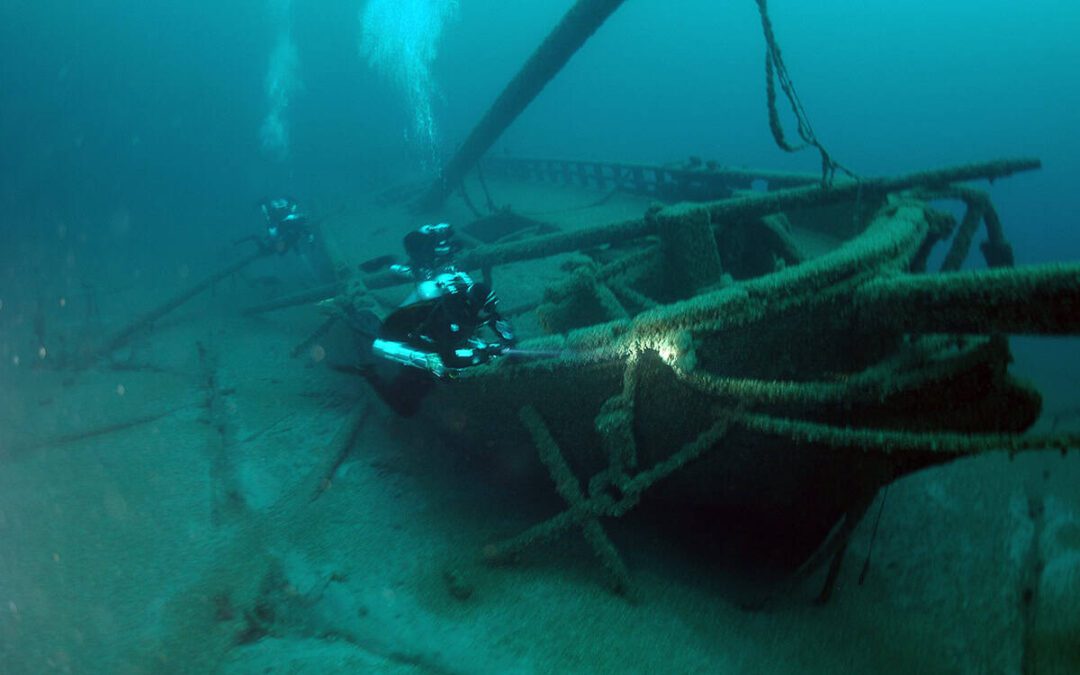
From tubs to tugs: Surprising stories behind 6 Wisconsin shipwrecks
A maritime archeologist shares the stories of six surprising shipwrecks in Wisconsin’s Great Lakes, from historic vessels to unusual cargo. Did you...