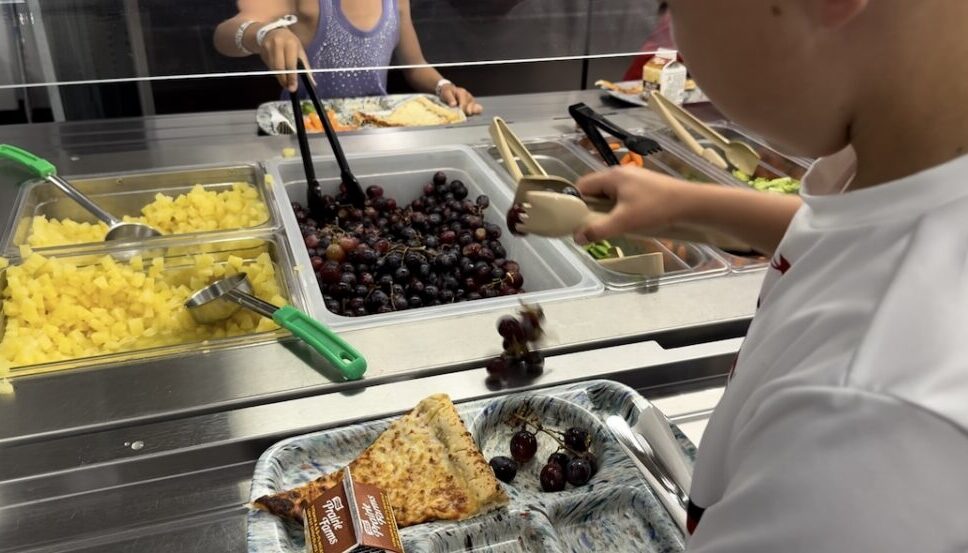
SNAP recipients used to be automatically enrolled in free or reduced school meals, saving districts time and administrative costs. Photo by UNN/Salina Heller
Fewer kids in our state will have access to free school meals as President Donald Trump rolls out the federal cuts to SNAP that he included in his “Big Beautiful Bill.”
Tom Burkhalter grew up in Union Center. The village isn’t very big. In fact, it’s 0.8 square miles. Situated along the Baraboo River, the community only has about 230 people.
About a 30 minute drive down Highway 33 into Sauk County is Reedsburg—its population is about 10,000 more than Union Center. Burkhalter recalls Reedsburg as being the “big city” where he and his family did their shopping.
After a few moves and jobs, Burkhalter now resides in that “big city,” serving as the superintendent of the School District of Reedsburg. His 2,600 students are spread out over 260 square miles, and in addition to Reedsburg they come from five other small surrounding communities.
Acres to apples
“We have one primary grocery store in Reedsburg—in our school district boundaries—that’s a 20 minute drive for some of our families from these outlying communities to get into the only reliable grocery store and food source in the area,” Burkhalter said.
Schools and districts like Reedsburg that serve rural communities act as critical, consistent, and sometimes the only food providers for millions of children.
“These smaller towns absolutely have a much, much more difficult time in receiving any type of support or or help that way,” Burkhalter said. “So having programs in the school is that much more important.”
“It’s absolutely a hurdle—it’s almost impossible if you don’t have reliable transportation.”
“We become even more of a primary resource for those nutritious meals—for a lot of our students, school meals are the best thing they’re going to eat that day.”
Red tape hunger
Wisconsin Gov. Tony Evers, superintendents, state health leaders, and child advocacy groups have raised concerns about the impact hurtling toward schools from President Trump’s 2026 federal funding cuts to the Supplemental Nutrition Assistance Program—known as SNAP in other parts of the country, and FoodShare in Wisconsin.
FoodShare helps nearly 700,000 Wisconsinites put food on their tables, according to the state Department of Health Services.
Wisconsin is on track to lose roughly $314 million in SNAP federal funding through President Trump’s cuts, and the state would be required to start matching federal funding for the program—which would put a greater burden on Wisconsin taxpayers.
Wisconsin Medicaid Director Bill Hanna said that “Wisconsin runs one of the best SNAP programs in the country,” but even so, Hanna noted that Trump’s bill will lead to new red tape that could cause 90,000 Wisconsinites to lose some or all of their benefits.
Burkhalter said the SNAP cuts in the One Big Beautiful Bill Act create a fiscal wreck for Wisconsin schools, especially rural ones, by directly dismantling the funding systems they rely on to feed students.
He explained how things used to be before the bill. “When you qualify for SNAP, our families actually qualify for ‘direct cert,’” Burkhalter said. “So they’re directly qualified for all of our free and reduced lunches.”
As of late 2025 and moving into 2026, significant changes to SNAP have disrupted the automatic, or “direct certification,” process that previously enrolled SNAP recipients in free school meals.
While the US Department of Agriculture (USDA) still designates children in households receiving SNAP as categorically eligible for free school meals, the mechanism to automatically transition them from benefits to the school lunch program is breaking down. In other words, the red tape has gone up.
New, stricter work requirements and reduced funding for SNAP means many families are losing their benefits entirely or having them reduced, removing their “direct” eligibility status for school meals.
“Our numbers are down, and I know our need is not down,” Burkhalter added. “There is an impact right now.”
Instead of a seamless, automatic enrollment, many SNAP families now need to manually complete a school meal application to ensure their children continue to receive free or reduced-price meals, as the automatic link between the systems has been severed.
Burkhalter said that link allowed district staff to provide support for the family “in a very low key, low stress way,” and now it’s a barrier.
“Some families just don’t do it, or for some it’s fear, for some, it’s embarrassment.”
These red-tape requirements are anticipated to lead to Wisconsin children going hungry.
Schools that are highly reliant on direct certification for federal funding—particularly for Title I and the Community Eligibility Provision (CEP)—face significant financial challenges when there’s no automatic enrollment.
“It’s very difficult for some of these families to ask for help and we really want to make sure that we are providing everything that we can for the students.”
When all eligible students aren’t accounted for in the free and reduced lunch program, Burkhalter said that spirals into the district getting less funding and revenue overall.
“When our direct cert numbers go down, there’s a direct relationship with our free reduced lunch rates also going down, which then has an impact on our federal grant funding— including all of the Title funds tied to that number—almost every federal, grant, relief, or aid is tied to that number,” said Burkhalter.
Filling every gap
Schools across the state are taking action to feed students facing food insecurity in the wake of the big SNAP cuts to combat hunger through innovative, localized solutions.
“Part of the conversation is, ‘How do we expand other programs?’” said Burkhalter.
At the School District of Reedsburg, the district runs The Den, a free food market that’s available to all students, staff, and community members.
“Once a week we have a drive-through food bank where people can come and get their week’s worth of food when they need it—and that’s a great partnership with Second Harvest—two public entities working together in addition to students helping to serve our community,” Burkhalter said.
Employed by the district, food bank director Ryan Hayes said guests are grateful. He said The Den helps families through hard weeks and “takes stress off their shoulders.”
“The Den exists to remove barriers around food access and provide real, immediate support to families in our community,” he said. “There are no applications, no income requirements, and no judgment.”
“By offering consistent access to food, we help reduce stress, stretch household budgets, and give families peace of mind knowing they’ll have meals for the week. What makes The Den especially powerful is the way it brings our community together through volunteers, partnerships, and shared care for our neighbors. The impact goes far beyond groceries; it builds trust, stability, and hope across Reedsburg.”
“In an ideal world, the district would not have to be the primary lever for everything with this,” Burkhalter said. “We absolutely understand that it falls on us right now and that we will do whatever it takes for our community and for our students of the School District of Reedsburg.”
“It’s a burden that we’re going to take on—and we’re not, and it’s not, going anywhere. But again, in an ideal world, we wouldn’t have to do it.”
Food for thought
Sauk County is served by six primary school districts, the biggest being Wisconsin Dells, Baraboo, and Reedsburg. There aren’t any huge cities or metropolitan suburbs.
Even so, the county has a big status: It’s known as a bellwether county, which means it acts as a barometer for voting trends. The votes in Sauk County, in other words, typically predict state and national election results.
“When we talk about politics, we forget about people sometimes,” Burkhalter said. “We talk about numbers, we talk about dollars, and we talk about tax impact.”
“We don’t talk about the millions of people who rely on this, and how you need to make sure that those needs are met one way or another.”
“When we’re talking about some of the priorities that we’re hearing about right now, it’s clear that we’re not really thinking about the masses and the people that need these programs,” Burkhalter said.
For his “big city” and all of the rest, Burkhalter is sure of one thing. “I do think that something as simple as this is a basic human right—to have access to food in the United States of America.”
Author

Support Our Cause
Thank you for taking the time to read our work. Before you go, we hope you'll consider supporting our values-driven journalism, which has always strived to make clear what's really at stake for Wisconsinites and our future.
Since day one, our goal here at UpNorthNews has always been to empower people across the state with fact-based news and information. We believe that when people are armed with knowledge about what's happening in their local, state, and federal governments—including who is working on their behalf and who is actively trying to block efforts aimed at improving the daily lives of Wisconsin families—they will be inspired to become civically engaged.


7 things at America’s Black Holocaust Museum that will stay with you well after your visit
One of Milwaukee’s most powerful museums, America’s Black Holocaust Museum is home to moving exhibits you can learn about below. Living in or...

University of Wisconsin-Madison chancellor Jennifer Mnookin leaving for Columbia
University of Wisconsin-Madison Chancellor Jennifer Mnookin is leaving at the end of the school year for a job as president of Columbia University....

Virtual learning growing in Wisconsin, school leaders say
After eight hours of training at the Milwaukee Ballet Academy, Cecilia Smucker logs onto her laptop for four hours of online learning through...
How many students are going to each UW school in fall 2025?
Enrollment at Wisconsin's public universities remained stable from last year despite a challenging political landscape and an 8% drop in...