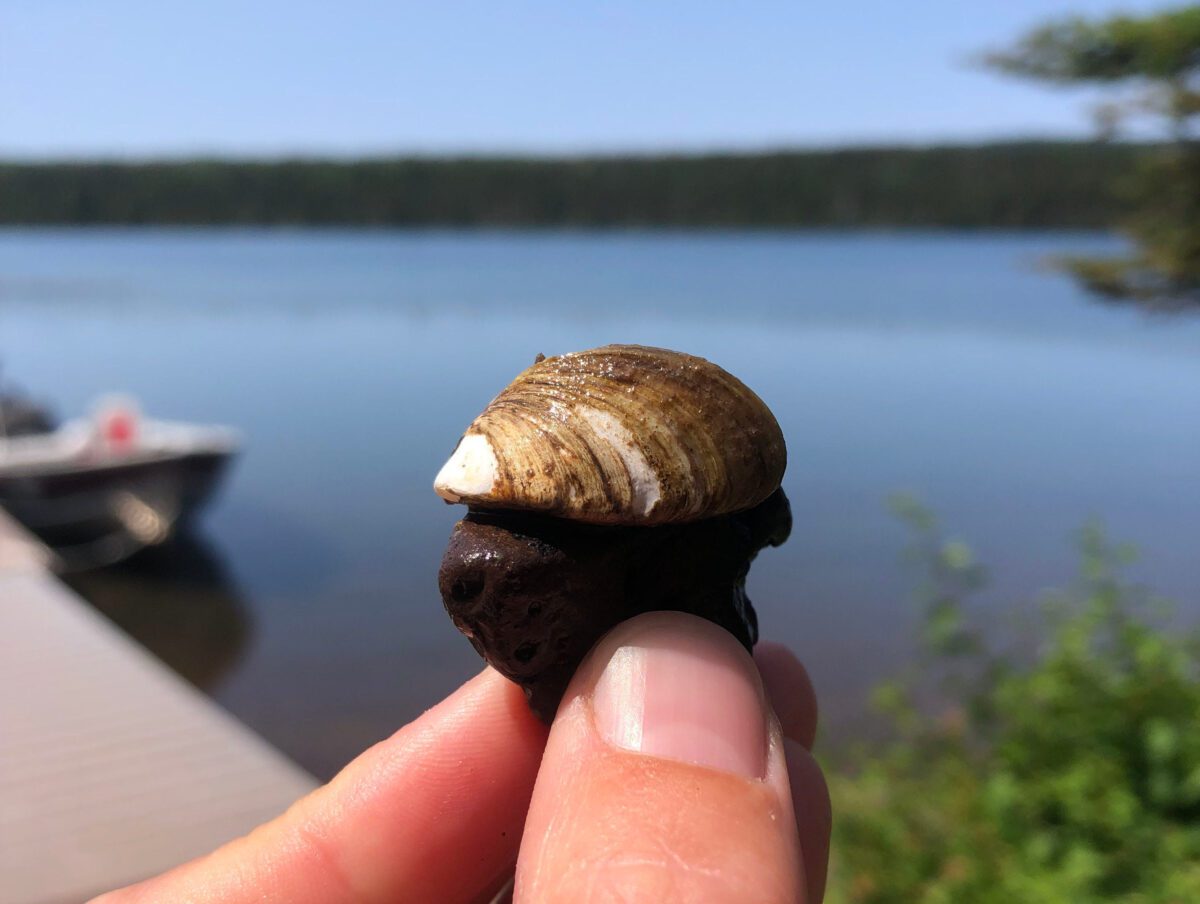
Invasive mussels in Lake Superior. (USA Today via Reuters Connect)
Last August, Lauren Isbell dove around Mott Island Dock at Isle Royale National Park, plucking invasive zebra mussels from the lakebed – sometimes with her fingers, other times with a credit-card sized piece of plastic attached to a lanyard on her wrist.
As Isbell removed each mussel, she put it in a parmesan cheese container with a flip-top lid. A graduate student at the University of Minnesota Duluth who previously worked in the national park, she and another diver removed 97 zebra mussels that day.
Thanks to removal efforts, scientists and park staff have been able to keep densities low despite the more than 3,000 invasive mussels discovered near that same dock in 2018.
The Great Lakes’ most destructive invasive species has been popping up around Lake Superior for decades. Most recently, scientists observed mussels for the first time in Black Bay, east of Thunder Bay, Ontario.
So far, however, they are not yet established throughout the lake.
But there is growing fear that Lake Superior’s window of avoiding a full takeover by invasive mussels may be closing. That’s why efforts are underway to remove mussels where possible, and to better understand how vulnerable the last of the Great Lakes to avoid a broader invasion has become.
There’s little question the clock is ticking.
Lake Superior is the second fastest warming lake in the world thanks to climate change, and the warmer it gets, the more suitable its habitat may become for invasive mussels.
Invasive mussels can reproduce once the water hits 54 degrees Fahrenheit, a temperature threshold that the lake is hitting more often with climate change. Between 1979 and the mid-2000s, summer surface temperatures rose 4.5 degrees Fahrenheit in Lake Superior.
Invasive mussels are a very adaptable species, said Doug Jensen, aquatic invasive species planner at Minnesota’s Department of Natural Resources. Warming water could help expand their range throughout the lake, especially in bays that are generally warmer and have more nutrients than open water.
Invasive zebra and quagga mussels also cannot grow when calcium levels – needed to form shells – are too low. But Jensen explained that their establishment in Nipigon Bay, the northernmost point of the lake in Ontario, is challenging the scientific literature. That bay has extremely low calcium levels.
Quagga mussels overwhelm lower Great Lakes
Both zebra mussels and the closely related and similarly devastating quagga mussels are native to eastern Europe, and arrived in the U.S. via ballast water in the late 1980s.
The invasive mussels popping up in Lake Superior are primarily zebra mussels. They were first observed in the Duluth-Superior Harbor in 1989, and have since been found in 16 locations along the shoreline, Jensen said. They are known to be reproducing in four locations: Duluth-Superior Harbor, as well as Ontario’s Thunder, Black and Nipigon bays.
Quagga mussels have overtaken zebra populations in the lower four lakes, but have been found in only two locations in Lake Superior: Duluth-Superior Harbor in 2005 and Nipigon Bay in 2017. They are not known to be reproducing in the lake yet.
However, it’s important to note that before invasive mussels form a shell and anchor to the lakebed or another surface, they drift throughout the water column. And monitoring from the U.S. the Environmental Protection Agency shows that DNA from invasive mussels is present across much of Lake Superior’s open water.
Quadrillions of invasive mussels blanket the bottom of the lower four Great Lakes: Michigan, Huron, Ontario and Erie. They have upended food webs by filtering out plankton, starving native fish populations and inciting harmful algae blooms. They also have cost the region billions in damage by smothering infrastructure and clogging pipes, as well as damaging boats and recreation areas.
Because of the profound ecological and economic consequences, experts continue to closely monitor the lakes and work to prevent the introduction of additional invasive species that could further destabilize the system. Early detection has become a critical line of defense, as agencies race to identify new threats before they can gain a foothold.
Lake Superior’s Isle Royale, Apostle Islands, Pictured Rocks all at risk
Spotting zebra mussels suctioned to the murky lakebed – and sometimes under rocks – is no easy task. They are about the size of a finger nail. But Isbell developed a sixth sense about where to find them.
“It’s like looking in your garden, the longer you look the more you will find,” Isbell said.
Since 2018, divers have removed mussels from different areas of the park and measured them and measured the size of each mussel to help determine the age class to understand whether they are reproducing and how vulnerable the national park may be.
When Isbell thinks about the beautiful rock formations at the bottom of the lake near the shore, she can’t imagine them one day being covered by mussels. But the park’s size makes it difficult to monitor.
At Isle Royale, zebra mussels have been found in areas where there is high boat traffic, but at the Apostle Islands they’ve been found on reefs as well, according to Brenda Moraska Lafrancois, an ecologist at the National Park Service.
The park service first documented zebra mussels during a training dive at the SS Sevona shipwreck off the Sand Island shoal in 2015. Since then, the population has become established at low densities near many of the islands. Moraska Lafrancois says the park service has yet to confirm whether the mussels are reproducing, though.
A few juveniles have been found at a boat landing at Grand Portage National Monument, Moraska Lafrancois said. While national park staff have not yet surveyed at Pictured Rocks National Lakeshore, she said, their presence there is likely, as they have already been discovered in Marquette Harbor and Munising Bay. Park staff are expected to conduct surveys this summer, she said.
She’s especially alarmed by the infestation in Ontario’s Nipigon Bay, because of its apparent unsuitability.
Scientists first confirmed the establishment of invasive zebra mussels in Nipigon Bay in 2017, although fishermen noticed them years prior, said Chris Robinson, an ecosystem scientist at Parks Canada.
Nipigon Bay, especially near the marina, is the epicenter of the invasion in the Lake Superior National Marine Conservation Area, Robinson said. The conservation area is not only the world’s largest freshwater protected area, but the bay is one of the few sites that has both zebra and quagga mussels.
Data from scientists at Parks Canada show that not only are these populations reproducing and present at high densities, but the zebra mussels are much larger those found throughout the Great Lakes.
The quagga question
Invasive mussels have changed the ecosystem so dramatically in lakes Michigan and Huron that they’ve pushed lake whitefish to the brink of collapse. In Wisconsin’s Lake Michigan waters alone, lake whitefish harvests have fallen drastically from a peak of about 2 million pounds in 1999 to only 150,000 pounds in 2024 – a more than 90% decline.
Moraska Lafrancois and other scientists are even working to remove invasive mussels from key sites in Lake Michigan for this very reason. Experts like her worry about what could happen to the prized fish in Lake Superior, especially near the national parks, which have some of the best spawning sites in the lake.
Most of the invasive mussels in Lake Michigan are quagga, which do not need to anchor to a hard surface like zebras do. Quagga mussels can also handle colder water, helping them smother the lakebed.
A lingering question is the extent to which quagga mussels may be hiding in the deeper waters of Lake Superior, Moraska Lafrancois said. Most monitoring and detection efforts have focused on shallower areas, leaving deeper habitats largely unexplored. She noted that the EPA has already found quagga mussels in samples dredged off Michigan Island, the southernmost of the Apostle Islands.
The good news, Robinson said, is scientists know what the risks are and they can be proactive with prevention efforts, like community engagement.
“I would hate to see (Lake Superior) turn into the rest of the Great Lakes,” Robinson said.
Caitlin Looby covers the Great Lakes and the environment for the Milwaukee Journal Sentinel. Reach her at [email protected] and find her on X @caitlooby. All of her work and coverage decisions are overseen solely by Journal Sentinel editors.
Caitlin is an Outrider Fellow whose reporting also receives support from the Brico Fund, Fund for Lake Michigan, Barbara K. Frank, and individual contributions to the Journal Sentinel Community-Funded Journalism Project. The project is administered by Local Media Foundation, tax ID #36-4427750, a Section 501(c)(3) charitable trust affiliated with Local Media Association.
This article originally appeared on Milwaukee Journal Sentinel: Scientists race to protect Lake Superior from invasive mussels
Reporting by Caitlin Looby, Milwaukee Journal Sentinel / Milwaukee Journal Sentinel
USA TODAY Network via Reuters Connect
Author

Fall colors have peaked in northern Wisconsin, but southern spots to peak as late as November
Wisconsin continues to be a divided state — when it comes to fall color. Many northern and central Wisconsin locales are past peak leaf color,...
Wisconsin fall colors peaking up north, but could be delayed elsewhere
On your mental map of Wisconsin, draw a diagonal from the southwestern corner of the state through Green Bay. Much of the state north and west of...
Your guide to Wisconsin’s 4 entries in the National Park System
There may not be any National Parks in Wisconsin, but the state isn’t lacking in National Park System entries. Learn about all four. Out of the 63...

Summer time is swimming time. Here’s how to avoid 4 common Wisconsin lake hazards
If your dad ever told you to go jump in a lake, now is the time to do it. With Memorial Day in the rearview mirror, and Labor Day off in the...