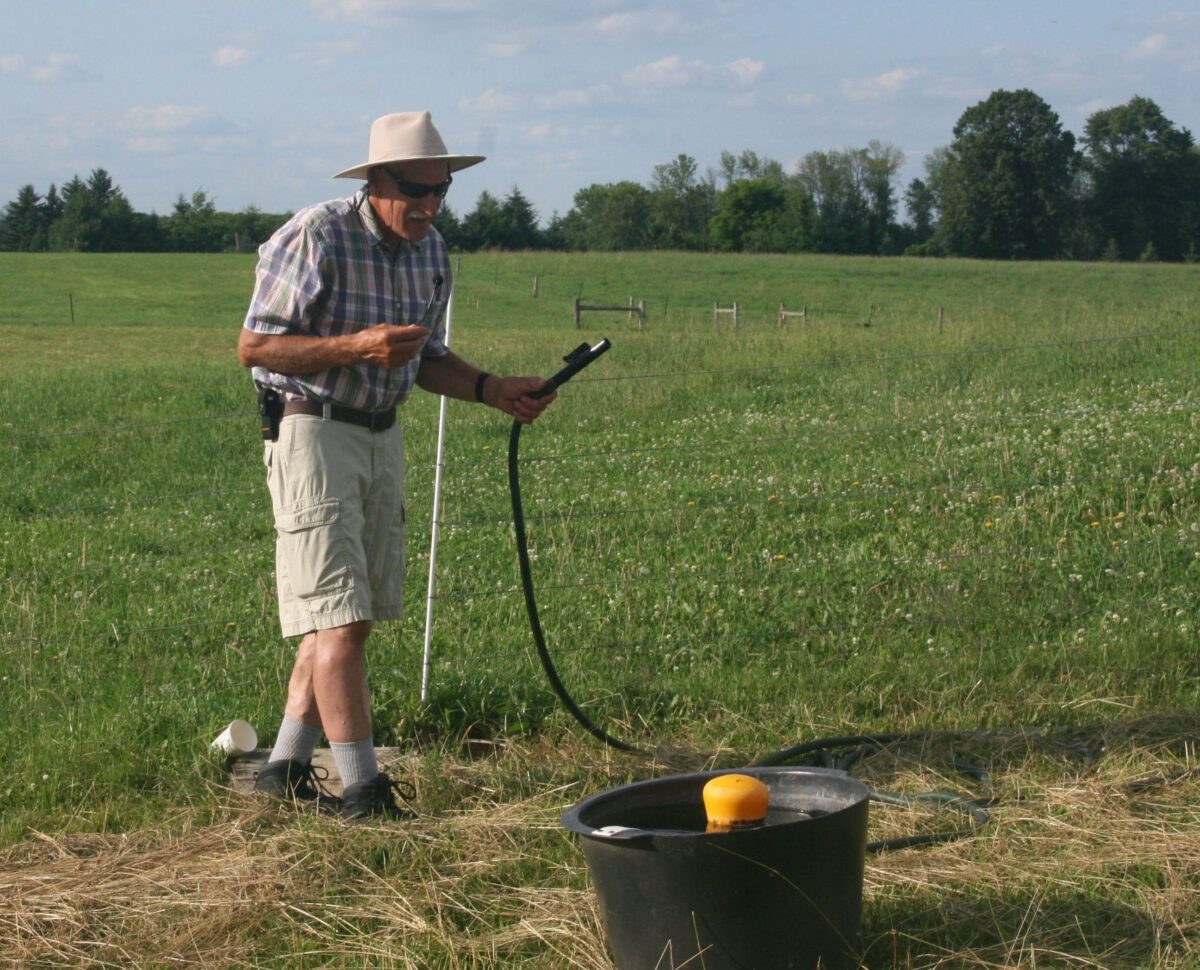
Bob Leder points out the water lines placed strategically throughout the pastures that provide the animals with a continuing supply of drinking water. (USA Today via Reuters Connect)
BEAR CREEK, Wisconsin – Earlier this year Jeff and Alex Wepner were looking for a place where their dairy heifers could grow and develop during the summer months before returning them to the home farm.
Instead of shipping the heifers to a feedlot in a distant state, the father and son management team of the 400-cow family dairy trailered the animals about 10 miles to an adjoining township to spend the summer in the pastures at the farm of Dr. Bob Leder, a retired veterinarian, and his wife, Penny.
Several years ago, the Leders established a successful managed rotational grazing system on nearly 80 acres for raising sheep. In addition to a perimeter fence, they divided the pastures into several paddocks where the animals could be regularly moved for the most efficient grazing. Water lines were also installed for convenient access by the animals to drinking water.
This year, the Leaders decided to discontinue their sheep operation but still wanted to utilize their pastures. They saw seasonal grazing of dairy heifers as an ideal way to achieve their goal and also earn some income.
Responding to dairy farming changes
The dairy farming landscape has changed dramatically over the last 50 years. Where there were once 40-cow herds nearly every quarter mile, now the cows have been consolidated on a handful of farms milking hundreds and even thousands of cows.
This trend led to the transition of hundreds of acres from pasture and dairy crop rotations to all row crops resulting in a variety of potential ecological problems.
Also, more heifers from larger dairy herds are being shipped longer distances to out-of-state feedlots to be raised from post-weaning to pre-fresh/pre-calving in large-scale confinement operations.
Wisconsin opportunities
These changes in dairy farming enable Wisconsin landowners to keep more replacement dairy heifers on the land in well-managed pastures. This can improve soil health, water quality and biodiversity. Heifer grazing can also offer cost savings to the cattle owners and help support the landowners.
Animal health and performance are often improved for heifers raised in a managed grazing system, supplying dairy farmers with successful replacements for their milking herd.
Farms of all sizes can benefit from well-managed pastures. Rotational grazing can provide high-value and low-cost forage for dairy heifers. The reduced input costs of heifer grazing compared to confinement systems with TMR feed regimens can increase dairy farm profit margins.
Connecting graziers with farmers
Bringing dairy farmers together with custom heifer graziers can open the potential for new, more local enterprises that tap into the animal expertise of those who may be thinking of selling their milk cows.
This new relationship could also help prevent the conversion of pastures and dairy crop rotations that include alfalfa and small grains to annual row crops, keeping more continuous cover and perennial systems on the land.
A more localized dairy herd replacement system helps lower the climate impact and the stress of shipping heifers long distances. Grazing heifers closer to home also may reduce the risk of spreading bird flu (HSN1) currently found in some dairy herds, and help avoid additional regulations on interstate shipment and milk testing.
The University of Wisconsin-Madison Grassland 2.0 project, in collaboration with local partners, has been working to bring together heifer graziers and farmers considering grazing heifers on their land. Using the Grassland 2.0 support tools,
The group has modeled a shift in over 4,000 acres of row-crop land to well-managed pasture.
Building a profitable grazing enterprise
In addition to environmental benefits, economic analysis shows cost savings for farmers raising dairy heifers in managed intensive rotational grazing and potential profit for custom heifer graziers.
The approximate cost of raising a heifer seasonally (assuming 180 days of grazing) in a managed grazing system is 99 cents per head, per day, compared to $2.50 a head per day in a confinement system, or a saving of $1.51 for each head, each day.
An operation with 100 heifers over a 180-day grazing season could save $27,180. A custom heifer grazier, raising 50 heifers for another farm (cost of 99 cents per head, per day), charging the going rate of $2.50 per head, per day, could cover costs and net $16,308 over the grazing season. At $3 per head, per day, the net return to the custom operator would be $21,708.
This work also includes consideration of transition costs and return on investment (ROI). Estimates show a 5-year, or less, ROI, even when not counting on USDA NRCS or other cost-share programs.
Developing a heifer supply chain
The Cloverbelt Learning Hub has also developed a logistics model for a dairy heifer supply chain, using a 38 percent replacement rate.
This model considers the size of the group of heifers being raised and when sending farms would deliver their animals to the custom graziers. Several models may work well, depending on what part of the heifers’ lifecycle might be the best fit.
From an animal performance perspective, bred heifers may be easier to successfully raise on pasture because their metabolic needs are more stable than younger animals that are growing into reproductive age.
Some custom graziers concentrate on raising bred heifers, receiving animals at about 13 to 15 months of age and raising them until about 40 days before calving. Other custom graziers may feel more comfortable with the younger, pre-bred heifers and managing nutritional intake more intensively and/or supplementing with grain to meet the animals’ needs and client goals.
Forming partnerships
The Grassland 2.0 project has been working with farmers, nutritionists, agency technical support providers and researchers to scale dairy heifer grazing in the Upper Midwest as part of a place-based, strategic action to build regenerative dairy systems. The focus on dairy heifer grazing came out of community conversations in central Wisconsin.
These ideas are being developed by farmers, nutritionists, along with staff from counties, USDA, nonprofits and the University of Wisconsin–Madison.
For more information on the potential benefits for grazing dairy heifers in Wisconsin, contact Sarah Lloyd, Grassland 2.0 Supply Chain Specialist at: [email protected] or 920-210-7335.
This article originally appeared on Wisconsin State Farmer: Retired veterinarian uses pasture for seasonally grazing dairy heifers and extra income
Reporting by Dan Hansen / Wisconsin State Farmer
USA TODAY Network via Reuters Connect
Author

Federal cuts threaten rural progress in Wisconsin, report finds
Across the country, rural Americans are facing challenges that go far beyond headlines and statistics: An Appalachian woman whose life was saved by...
China is boycotting American soybeans. Wisconsin farmers will pay the price for it, trade group says
As China and the U.S. remain locked in a tense standoff over tariffs, Wisconsin soybean farmers have found themselves in the crossfire of the...
Opinion: Wisconsin farmers struggling amid trade wars and broken promises
From Trump’s trade wars to slashed programs and support for big corporations, Congressman Van Orden is backing policies that hurt Wisconsin farmers....

Gwen Frisbie-Fulton: ‘The people closest to the problem are often the ones who can find the solution’
About two years ago, tents started to show up in my neighborhood along the creek beds and in small stands of trees. Most only became visible when...