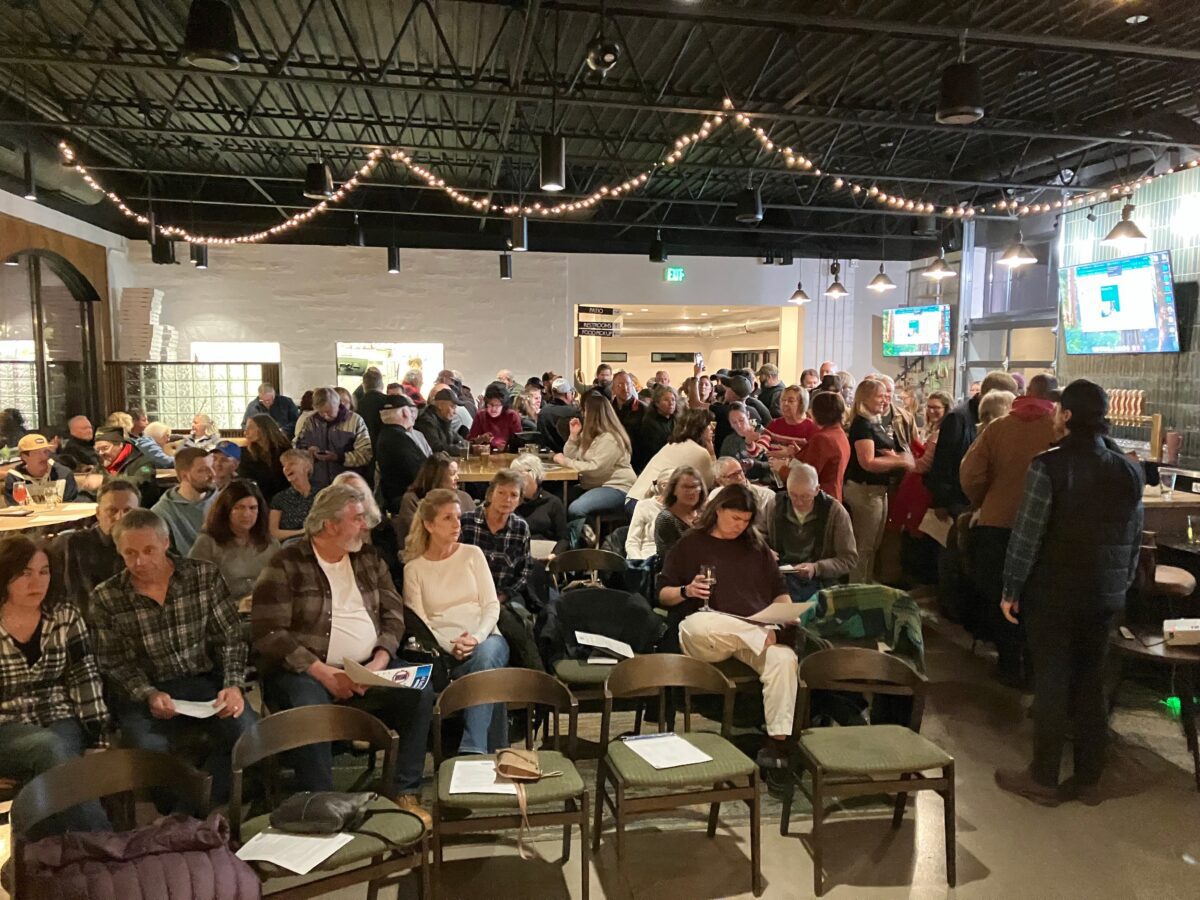
Residents of Greenleaf and other nearby communities on Jan. 12 gathered to learn what they can do to oppose efforts to develop an AI data center in the southern Brown County village. (USA Today via Reuters Connect)
The real estate company looking to bring a data center to Greenleaf has ended its pursuit of property after residents and officials made clear they opposed the idea.
Greenleaf last week became the latest Wisconsin community swept up in the national, bipartisan backlash to a growing AI industry when residents learned Cloverleaf Infrastructure was offering to purchase property between Fair Road and Mallard Road west of State Highway 32/57.
The Seattle-based company and village officials on Jan. 13 confirmed that Cloverleaf is no longer looking at Greenleaf for a data center.
The news reached residents and supporters after about 80 Greenleaf, Wrightstown and rural southern Brown County residents filled the Gnarly Cedar Brewery tasting room Jan. 12 to capacity to learn how to focus their opposition to a possible data center development.
Cloverleaf Infrastructure had offered purchase agreements to property owners in southern Brown County, specifically in Greenleaf and the Town of Wrightstown, as part of a larger property scouting effort in northeastern Wisconsin, according to its chief development officer Aaron Bilyeu.
On Jan. 13, Bilyeu said the company would no longer pursue property in Greenleaf, but continues to be interested in siting a data center in northeastern Wisconsin.
“We will continue to look for sites in supportive jurisdictions,” Bilyeu told the Press-Gazette in an email.
Greenleaf area residents rapidly mounted opposition, got support from Charlie Berens
Word of purchase agreements immediately spurred residents in the village and nearby towns to rapidly organize in opposition to the data center. They created a Facebook group called Stop the Greenleaf Data Center the morning of Jan. 7 as a place for locals “to communicate and organize against this unwanted development,” the group’s description said. The group as of Jan. 12 had almost 3,000 members, or about three times the population of Greenleaf.
Residents circulated online and paper petitions opposing the data center. One area resident organized a yard sign order; another made “no data center” stickers. The community even got a supportive video shoutout from Wisconsin comedian Charlie Berens, who noted “they picked the wrong week to mess with Wisconsin” after the Green Bay Packers’ wild-card game loss to the Chicago Bears.
“We are going to push back against this data center. We’re gonna help your local officials see there has got to be a better way to help a community than an AI data center, which it doesn’t. It’s not investment, it’s extraction,” Berens said in the video. “They’re here for our land. They’re here for our water. And in the long run, these things just don’t work out.”
Adam and Katrina Magnuson, owners of LedgeStone Vineyards and Gnarly Cedar, hosted the community information meeting where presenters offered residents tips from other communities’ fights against data center proposals and suggestions on how to press elected officials to oppose such projects.
Jodi Labs of the Izaak Walton League’s Brown County chapter encouraged residents to educate themselves on data centers’ impacts, show up to government meetings, consider a voter referendum and to stick with it even if the current effort doesn’t materialize.
“You need to come together and let [your elected officials] know how you feel,” Labs said.
Here’s what we know about the plans for a data center in the region and why Greenleaf residents opposed it.
What was behind the rumors of a data center in Greenleaf?
Bilyeu said Cloverleaf was interested siting an AI data center somewhere in northeastern Wisconsin. To that end, his company has contacted representatives of multiple units of local government to gauge their support for an AI data center, as well as reached out to landowners to purchase their properties.
The Village of Greenleaf, which incorporated as Brown County’s newest village in 2023, was one of those locations. The community formed from the Town of Wrightstown and is home to about 920 residents. Residents have learned the company made offers to purchase land in the village.
Greenleaf has received no application, plan submission or other request in writing, according to village clerk Stephanie Owen. However, Bilyeu said the company has offered purchase agreements to residents, some of whom have already agreed to sell land.
“I’m not trying to hide anything. We’re just trying to find the right spot,” Bilyeu said.
What is Cloverleaf’s role in the data center development?
Cloverleaf is a data center development company whose job is to assemble enough land for a data center, apply for local permits, and works with power companies to ensure ample supply to the site. It then sells the project site to an end user and a builder, Bilyeu said.
The company would play the same role as it did in Port Washington. It acquired the rights to the land involved, lined up the necessary approvals and sold the project to the developer, Vantage Data Centers, and end-users, Open AI and Oracle.
Why northeastern Wisconsin for an AI data center?
There’s much that’s attractive about Wisconsin and its northeast to Cloverleaf Infrastructure for AI data centers. Bilyeu cited the state’s abundant electric supply and the region’s spacious land, plus a nearby workforce capable of building and staffing the centers.
But most crucially, Bilyeu pointed to a special privilege Wisconsin has given since 2023 of exempting data centers from sales and use taxes.
“That really fueled the expansion of data centers” in Wisconsin, Bilyeu said. “States with sales and use tax exemptions have data centers. States without exemptions don’t.”
So far, four data centers have qualified for the exemption, according to the Department of Revenue, all in the state’s south: Epic Hosting in Verona, Microsoft in Mount Pleasant, Meta in Beaver Dam, and Vantage in Port Washington that has been especially contentious with residents calling for a mayoral recall.
How much land were we talking about?
The minimum required would be about 200-300 acres for a small data center, but the amount of land it is able to secure in a given area will determine the size and scope of a project, Bilyeu said. A large site could host multiple small data centers or a single, very large one, Bilyeu said.
Who would have occupied the Greenleaf data center?
That would have been determined much later. The plan would have had to advance further along before a company is attached to a data center project.
Greenleaf residents say a data center would be too big for such a small village
The general consensus among residents at Gnarly Cedar was the data center would be so big and imposing it would destroy the charm and character that made Greenleaf incorporate.
Brandon Huebner said residents incorporated because they wanted Greenleaf to “stay a village,” not to become “an industrial park.” He said a data center doesn’t fit here and he’s concerned Cloverleaf isn’t being forthcoming with the community.
Amy Leonhard lives off State 57 near where Cloverleaf had made offers to purchase land. She hasn’t heard of any neighbors who support the data center. The sudden announcement and lack of details about what could be involved have left her concerned about how a data center would impact her water well, property values and the quaint community she calls home.
“We’re too small for this,” Leonhard said.
Julie and Doug Carter said the quiet, rural setting they moved to 30 years ago on Fair Road would be forever changed if the view out their front door went from farmland to a data center.
“I would look at a factory that stretched as far as the eye could see,” Julie Carter said. “It would be devastating.”
Cloverleaf addresses concerns about power, water, utility costs
Bilyeu said data center builders and operators have incorporated technologies to minimize water use. Most data centers now use closed-loop systems to cool data centers with a lot less water use. He cited Port Washington as an example, saying that data center will use the same volume of water as about 65 homes.
He also said data center operators have committed to paying all costs for additional electric infrastructure new data centers require and support a legislative proposal to create an electric rate structure just for data centers.
Bilyeu said Cloverleaf and other companies involved are willing to work with municipalities and residents to address common quality of life questions around noise, building heights and other concerns.
Republicans have their own policy proposals to mitigate data center side effects. Not everyone’s happy, especially Cloverleaf
A Republican bill, similar to a Democratic-led bill several months before, proposes to mitigate the worst effects of data centers, like spiking electricity costs and water consumption, while reaping the economic benefits, such as job creation and, in the case of Racine County, millions of dollars added to tax rolls. The bill would:
- Require annual energy and water usage reports to the state’s Public Service Commission.
- Prohibit costs associated with a data center’s electric infrastructure from being passed on to other customers.
- Mandate that water used for cooling purposes be part of a closed-loop system.
- Require that any renewable energy facility primarily serving the data center be located on-site.
- Return the site to its former state after the data center is finished operations.
“New is scary. Big is scary. That’s why we’re doing this bill,” said state Rep. David Steffen, R-Howard, during a Jan. 12 news conference at the Brown County STEM Innovation Center on the University of Wisconsin-Green Bay campus.
Some of the bill’s provisions raised Bilyeu’s eyebrows. He said he had no qualms with abiding by the bill’s measures, except for two: the restrictions on renewable energy, which he said went against how electricity is returned to the larger electric grid, and the condition to return the site to its a pre-construction state, which he called “an absurd condition to put on a private business.”
Democrats were also wary specifically of the renewable energy provision. State Sen. Jamie Wall said he was on board with the bill, except for the restriction for on-site renewable energy, which he likened to Republican “hostility” to renewable energy.
Steffen during the news conference had attributed the reason for the renewable energy measure to insulating the region from local affairs, or as he put it: “Not ‘Greenleaf decides to maybe allow a data center,’ and then the people of Oconto, who weren’t involved in that discussion, then have to deal with losing farmland to a solar field or whatever.”
“If they got rid of that, I think [the bill] would pass almost unanimously.” Wall said.
Contact business reporter Jeff Bollier at (920) 431-8387 or [email protected]. Follow him on X at @JeffBollier.
Jesse Lin is a reporter covering the community of Green Bay and its surroundings, as well as politics in northeastern Wisconsin. He also writes a weekly column answering reader questions about Green Bay. Contact and send him questions at 920-834-4250 or [email protected].
This article originally appeared on Green Bay Press-Gazette: AI data center plans for Greenleaf scrapped amid community opposition
Reporting by Jeff Bollier and Jesse Lin, Green Bay Press-Gazette / Green Bay Press-Gazette
USA TODAY Network via Reuters Connect
Author


Wisconsin gas prices up 40 cents in a week as Iran conflict continues
As the U.S.-Israel conflict with Iran continues, the average price of gas in Wisconsin surged above $3 a gallon for the first time this year. The...
Roys: Wisconsin deserves a governor who fights for families—not billionaires
Wisconsin state Sen. Kelda Roys says she’s ready to “fight for our democracy” and stand up to President Donald Trump as she campaigns for governor...
Oppose ICE? Here’s how you can take action
The moment we’re in The US Senate is currently deciding whether to approve new funding for the Department of Homeland Security (DHS), including...
Oppose ICE? Here’s how you can take action
The moment we’re in The US Senate is currently deciding whether to approve new funding for the Department of Homeland Security (DHS), including...