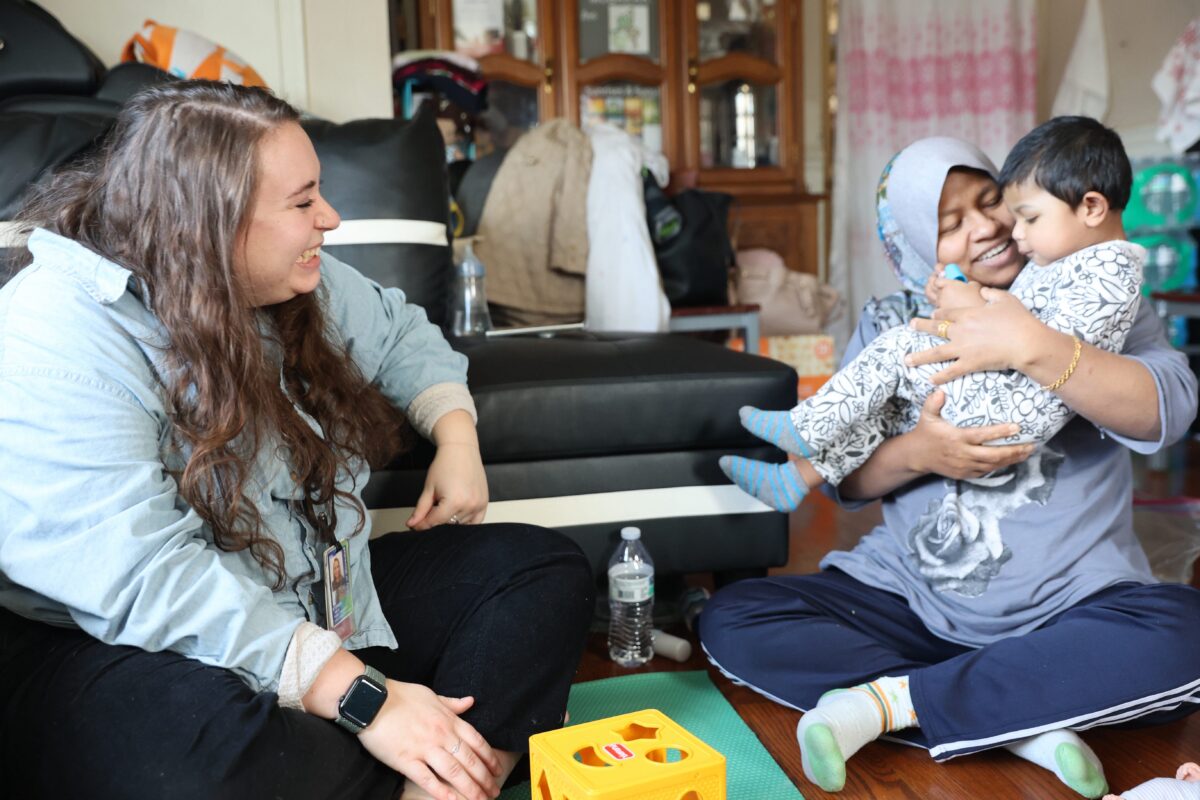
Emilie Steiner, an RN with the Empowering Families of Milwaukee program, visiting with 16-month-old Noor Aiman Hafiz Salim (Noor means “lightening from God”; Aiman means “brave girl) and her mother Zakiah Habibul Rahman, in a home visit in Milwaukee, Wisconsin, February 12, 2024. The family enrolled in the program are Rohingya refugees from Burma. The program – funded by the federal Maternal Infant and Early Childhood Home Visiting (MIECHV) program – is designed to help teach parenting skills and to help connect families to health and community resources. The Milwaukee program is based on the Parents as Teachers model. (USA Today via Reuters Connect)
Home visiting programs help parents learn about child development skills. The free programs are for pregnant women and families with a child under age 5.
They are run by local governments and nonprofit organizations, and are funded largely through the federal Maternal, Infant, and Early Childhood Home Visiting program started in 2010 as part of the Affordable Care Act.
In the Milwaukee area, home visiting programs include Empowering Families of Milwaukee and Direct Assistance for Dads Project overseen by the Milwaukee Health Department. Also offering the programs area Next Door, a nonprofit that focuses on early childhood education, and Children’s Wisconsin.
How can you apply for home visiting programs?
The Milwaukee Health Department application form is here: https://city.milwaukee.gov/Health/Services-and-Programs/MCH/visit.
More details about home visiting programs across the state are available on the website for the Wisconsin Department of Children and Families: https://dcf.wisconsin.gov/cwportal/homevisiting.
Why are home visiting programs important for young children?
Empowering Families of Milwaukee and the DAD Project are outgrowths of the growing awareness of the importance of the first three years of life in a child’s intellectual, emotional and physical development and parents’ influence on that development. This matters because by the time many children reach kindergarten or even preschool they already have fallen behind their peers. And studies have shown that this so-called achievement gap doesn’t narrow appreciably as children move through school.
How long do the home visiting programs last
The programs are free and consist of home visitors – registered nurses and social workers – who typically visit families for 60 to 90 minutes either weekly or once every two weeks. The programs, which generally begin before a child is born and can last two years.
What kind of training do home visitors receive?
The home visitors in Empowering Families of Milwaukee receive extensive training in how to build relationships, read cues, respond to difficult situations, help families set goals and the steps needed to realize them as well as learn about child development, parenting and community resources. The same goes for the home visitors in a similar program, the Direct Assistance for Dads Project, known as the DAD Project, for fathers. “They can’t just follow a script,” said Jon Korfmacher, a child psychologist and senior research fellow at the University of Chicago. “They need more specialized training. And they have to know how to partner with families – to really pay attention to the needs of the families and how to address those needs.” The Milwaukee Health Department’s home visiting programs are based on the Parents as Teachers model, one of the five models approved by Wisconsin for the federal program.
The curriculum for the model – developed over decades – totals thousands of pages online.
How home visiting programs help young kids with language development
Studies also have shown that the quantity and variety of words heard by a child – as well as the length of the utterances and, at least in some cultures, back-and-forth conversations – are important in acquiring language skills.
So, too, are so-called wh-questions – who, what, where, when and how.
Differences in the size of children’s vocabulary first appear at 18 months of age — and, again, language skills at the start of school strongly predict future success in school.
More than 40% of children are read to less than four days a week, and every day is the ideal. Further, children from affluent families – children at less risk of starting school behind their peers – are read to more on average than children from families with low incomes. Just 15 minutes a day, starting at birth, can have a significant influence on a child’s vocabulary.
This article originally appeared on Milwaukee Journal Sentinel: Home visiting programs help parents learn child development skills
Reporting by Guy Boulton, Special to the Journal Sentinel / Milwaukee Journal Sentinel
USA TODAY Network via Reuters Connect
Author


Meet the record number of women in the 2026 Miss Door County pageants
The Miss Door County Scholarship Program pageants appear to be more popular in 2026 than ever before, both with competitors and audience members. A...
Indigenous practices help heal trauma passed down through generations
It’s not uncommon for Indigenous people to feel distrustful or on guard when around White people, explains Lea Denny. That distrust is passed from...

Fan of the Year uses Packers games to teach first-grade students
Green Bay Packers fans are everywhere, even Middlebury, Connecticut, where first-grade teacher Ashley Christensen might be creating more....

How photography became one Wisconsin man’s way of protecting the Apostle Islands
Peter Wagner’s photography journey began more than 50 years ago when his brother handed him a 35 millimeter camera. Now, he's using his skills to...