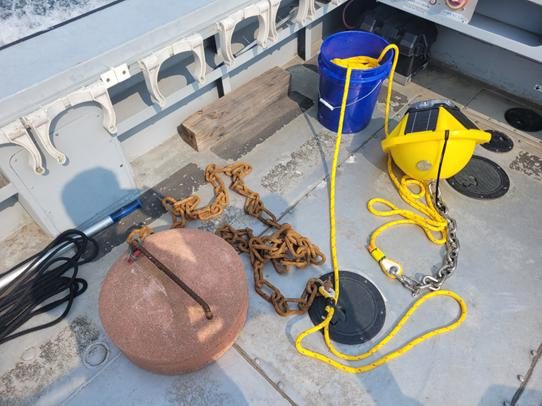
The mooring and buoy that was deployed off Muskegon, Michigan, which broke loose last winter. The spotter buoy, which is roughly the size of a basketball, collected some of the first data that exists on how ice and waves collide in the most treacherous season on the Great Lakes. (USA Today via Reuters Connect)
Winter is a quiet time for Great Lakes research, at least out on the water. Research vessels remain secured to their docks; most monitoring equipment is ashore.
But last winter, a basketball-sized buoy off Muskegon, Michigan, broke free from its mooring. Set up to track temperature and wave height, it remained out on the lake and collected data scientists have chased for years: real-time measurements of what happens in the open water far from shore.
It’s some of the first data that exists on how ice and waves collide during the most treacherous season on the Great Lakes.
“It just aligned perfectly with the kind of work we were trying to do,” said Steve Ruberg, a scientist at the National Oceanic and Atmospheric Administration Great Lakes Environmental Research Lab.
The timing was especially serendipitous because it was a normal ice year. That’s not a given as climate change is driving an overall decline in ice cover mixed with swings from extreme high to low ice years.
The runaway buoy broke loose in mid-January, drifting about 33 miles and nearing the center of Lake Michigan. Strong winds eventually pushed it back into an icy area south of Grand Haven, where it became wedged in thick ice, providing data on how much ice actually dampens strong waves.
All of this is not typically possible.
Direct observations are typically not possible in winter
For context, winter brings the strongest winds and waves to the Great Lakes. Scientists rely on models to try to understand conditions, but direct observations are scarce. It’s too dangerous on the water; no research vessels can safely operate in winter storms. Search and rescue vehicles are pulled for the season.
Spotter buoys, like the one that got loose, can withstand the conditions, but they don’t roam freely. There are larger, yellow buoys scattered throughout all five lakes that collect a lot more information. However, they are not as durable and must be brought in before winter.
That leaves gaping unknowns: How do waves behave in the middle of the lakes during winter? What happens beneath the ice during winter storms?
It’s information that could provide better forecasts for commercial freighters operating during those months, if it was available.
“Our passion here is to try to make that happen,” Ruberg said.
Serendipity begins to fill a winter gap
Scientists can’t glean information about how ice affects waves from the ocean. Lake ice is stronger than ocean ice because saltwater freezes at colder temperatures.
“There is almost no data, so anything was going to be exciting,” said Ayumi Fujisaki-Manome, a scientist at the Cooperative Institute for Great Lakes Research who studies hazardous weather and ice on the Great Lakes.
Enter last year’s rogue buoy.
The buoy was deployed off Muskegon, Michigan, by NOAA and the Cooperative Institute in late summer 2023, and stayed there until it broke loose.
When it drifted back from the middle of the lake in early February it floated into a zone of broken, consolidated ice before eventually becoming trapped in solid ice over open water – a perfect gradient illustrating the transition from fractured ice to a solid ice sheet.
On Feb. 7 and 8, a severe storm hit, drumming up waves more than eight feet high beneath the solid ice.
What it revealed, Fujisaki-Manome said, was that the models scientists used were dampening waves more than they should. The actual waves under ice cover are much higher than the models predicted.
Fujisaki-Manome compared how the models performed over open water with their performance in Saginaw Bay, where ice is more stable. There, the models are doing a good job. But out in the middle of Lake Michigan the models need to be improved.
The rogue buoy eventually washed up on shore north of South Haven on March 25, and a local resident dragged it up on the beach two days later. Ruberg and his team retrieved it in early April.
‘We can’t measure yesterday, but we can start today’
Winter is a risky time to be on the water, but advancements in technology – and some creativity – are making it more plausible to collect information on the Great Lakes.
Researchers, like Hayden Henderson, a scientist at Michigan Technological University, have gone so far as to deploy buoys using a helicopter. Two years ago marked the first time his team placed a larger buoy with more capabilities farther offshore. Last year, they expanded the effort, dropping buoys from helicopters into Lake Superior, northern Lake Huron and northern Lake Michigan.
“But technology is changing, and we’re making advancements, and I think we’re going to be able to do a better job,” Ruberg said. “But it’s always a challenging time.”
Ruberg said scientists are hoping underwater robots may eventually help close the winter data gap as well.
And it’s an important gap to fill, Henderson said, as winter is the fastest changing season in the Great Lakes.
Better observations lead to more reliable predictions, which is increasingly important as the Great Lakes experience stronger storms, changing water levels and accelerating coastal erosion. Accurately predicting the winter sea state, Henderson said, is essential to understand how coastlines are changing and how to plan for future development.
“We can’t measure yesterday, but we can start today,” Henderson said.
Caitlin Looby covers the Great Lakes and the environment for the Milwaukee Journal Sentinel. Reach her at [email protected] and find her on X @caitlooby. All of her work and coverage decisions are overseen solely by Journal Sentinel editors.
Caitlin is an Outrider Fellow whose reporting also receives support from the Brico Fund, Fund for Lake Michigan, Barbara K. Frank, and individual contributions to the Journal Sentinel Community-Funded Journalism Project. The project is administered by Local Media Foundation, tax ID #36‐4427750, a Section 501(c)(3) charitable trust affiliated with Local Media Association.
Learn more about our community-funded journalism and how to make a tax-deductible gift at jsonline.com/support. Checks can be addressed to Local Media Foundation with “JS Community Journalism” in the memo, then mailed to: Local Media Foundation, P.O. Box 85015, Chicago, IL 60689.
This article originally appeared on Milwaukee Journal Sentinel: Oh buoy! Runaway research buoy gets data on Great Lakes winter waves
Reporting by Caitlin Looby, Milwaukee Journal Sentinel / Milwaukee Journal Sentinel
USA TODAY Network via Reuters Connect
Author


Fall colors have peaked in northern Wisconsin, but southern spots to peak as late as November
Wisconsin continues to be a divided state — when it comes to fall color. Many northern and central Wisconsin locales are past peak leaf color,...
Wisconsin fall colors peaking up north, but could be delayed elsewhere
On your mental map of Wisconsin, draw a diagonal from the southwestern corner of the state through Green Bay. Much of the state north and west of...
Your guide to Wisconsin’s 4 entries in the National Park System
There may not be any National Parks in Wisconsin, but the state isn’t lacking in National Park System entries. Learn about all four. Out of the 63...

Summer time is swimming time. Here’s how to avoid 4 common Wisconsin lake hazards
If your dad ever told you to go jump in a lake, now is the time to do it. With Memorial Day in the rearview mirror, and Labor Day off in the...